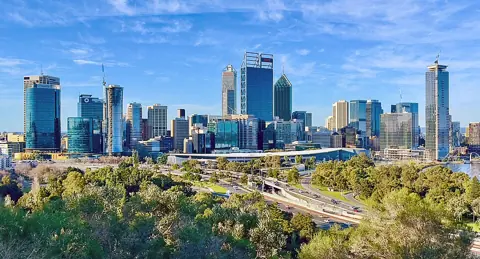
What Perth's economy actually runs on
Western Australia's economy is built on ore, gas and gold, and Perth is the office it is run from. The state's resources sector achieved $220 billion in sales on production in 2024-25, according to the Western Australian Government's Statistics Digest announcement, published in May 2026.
That figure matters to you only because of what it drags behind it: head offices, contractors, auditors, engineers and a rotating workforce that flies north and comes back again. The people spending money in the Perth CBD on a Tuesday night are mostly not tourists.
The mines themselves are hundreds of kilometres away, in the Pilbara and the Goldfields. Perth is where the flights leave from and where the money is spent between rosters, which is why a city of this size supports the hotel stock, restaurant prices and airport traffic that it does.
Why midweek beds cost more
Midweek demand in Perth comes from work, not leisure, and that inverts the pattern most travellers expect. Corporate travel, contractor stays and workers transiting between rosters concentrate on Monday to Thursday nights, while the leisure demand that props up weekend rates in other cities is comparatively thin in the Perth CBD.
The scale of the rotating workforce shows up at the airport. Perth Airport's FY24 annual report records 6.01 million regional passengers out of 16.1 million total, and states that regional travel, "underpinned by the FIFO market", was up 43 per cent on 2019. The airport then handled 17.5 million passengers in FY25, an 8.5 per cent rise, according to its FY25 results announcement.
Two things follow for a visitor. Accommodation near the airport is often built and priced for workers on short turnarounds rather than for sightseers, so a cheap-looking room out there can be a long way from anything you came to see. And in the CBD, the nights you assume will be quiet are the nights the city is fullest.
When to book, and for which nights
Book your Perth weeknights earlier than your weekend nights, which is the reverse of the habit most travellers bring. If your dates are flexible, price the same itinerary twice: once starting Monday, once starting Friday. In the CBD the weekend version is often the cheaper one, because the business demand has gone home.
This table compares the two booking patterns for a CBD stay.
| Nights | What sets the price | Booking approach |
|---|---|---|
| Mon-Thu | Corporate and resources travel | Book several weeks out; expect firm rates |
| Fri-Sun | Leisure demand only | Later booking often works; check for weekend rates |
| Event weeks | Conferences, sport, school holidays | Book as early as you can commit |
Two caveats keep this from being a rule. Major events, conferences and Western Australian school holidays override the weekday pattern entirely, and suburbs like Fremantle, Scarborough and Cottesloe run on leisure demand, so they behave the opposite way to the CBD and firm up at weekends.
If your trip is four nights or longer, split it deliberately: weekdays in a suburb with beach access, weekend in the city when city rates soften. You give up the convenience of a single check-in, and you gain the difference between two pricing patterns.
What you will actually spend
Perth's everyday prices sit inside a high-wage local economy, and that is the honest way to describe them. Mining recorded the highest full-time adult ordinary time earnings of any Australian industry at $3,224.20 a week in the May 2026 Average Weekly Earnings release, and Western Australia as a whole recorded $2,227.40, higher than every state and behind only the Australian Capital Territory.
Wages of that size support hospitality prices that a visitor from a lower-wage economy will feel, particularly for a sit-down meal, a coffee and a beer in the CBD. General price movement is not extreme: the Australian Bureau of Statistics' Consumer Price Index recorded a 3.8 per cent annual rise for Perth in the 12 months to July 2026, against 3.5 per cent nationally, with Perth food and non-alcoholic beverages up 3.6 per cent.
The reliable saving is structural rather than clever. Self-catering breakfast, a supermarket lunch and one paid meal a day cuts a Perth food budget more than hunting for cheap restaurants does, because the wage floor under hospitality applies across the city.
The distance nobody budgets for
Perth is a long way from the rest of Australia, and that shapes the budget before you arrive. It is the only mainland capital on Australian Western Standard Time, and it does not observe daylight saving, so the gap to Sydney, Melbourne and Brisbane widens in the southern summer when those cities move their clocks forward.
Treat Perth as its own trip rather than an add-on. A transcontinental flight from the east coast is one of the longest domestic sectors in the country, and a two- or three-night visit spends most of its value on travel time and jet lag. If you are combining Perth with an eastern capital, budget the flight as a real cost and the arrival day as a half day.
The time difference also has a practical edge. Booking calls, work commitments and family check-ins scheduled on eastern time land inconveniently in Perth, and a same-day connection east means an early start; confirm the exact offset for your travel dates before you schedule anything tight.
Where the free things are
Perth's best-known attractions are free to enter, which is the single largest structural saving available to a visitor. Kings Park is open daily with free entry, and free guided walks led by volunteer guides depart at 10am and 1pm, according to the Botanic Gardens and Parks Authority. The Indian Ocean beaches cost nothing beyond the fare to reach them.
This table compares entry at three central attractions.
| Attraction | Entry | Hours |
|---|---|---|
| Kings Park | Free | Open daily |
| Art Gallery of WA | Free general entry | 10am-5pm daily |
| WA Museum Boola Bardip | AUD 15 general, AUD 10 concession | 9.30am-5pm |
The Art Gallery of Western Australia asks visitors for a voluntary donation on entry and closes on Good Friday and Christmas Day. Next door in the Perth Cultural Centre, the WA Museum Boola Bardip charges $15 for general admission, with free entry for children 15 and under and for carers holding a WA Companion Card, so a family visit costs less than the headline price suggests.
If you can move one full sightseeing day to a Sunday, do it. The fare saving is real, and it pairs well with the free entry sites.
Seasons, hours and short staffing
Perth's tourist peak and its resources-travel pattern are two different calendars, and they overlap rather than align. Leisure visitors concentrate on the warm, dry months and school holiday blocks; resources and corporate travel runs steadily across the working weeks of the year, thinning around Christmas and the New Year when projects wind down.
Western Australia drew 11 million overnight visitors and $19.2 billion in visitor spend in the year ending December 2025, according to a WA Government media statement, of which 8.7 million overnight visitors were intrastate and 1.2 million interstate. Most of the demand you compete with in Perth is domestic, which means it follows Western Australian school terms and public holidays, not international seasons.
Plan your evenings around this rather than being caught by it. Booking a table, or eating earlier than you would in Sydney or Singapore, removes most of the problem.
Before you lock in your dates
Price your Perth trip in this order, and you will avoid the two mistakes visitors most often make here.
This guide does not price airfares, car hire or day trips beyond the metropolitan area, and it does not quote restaurant, hotel or grocery prices, because no official Western Australian source publishes a visitor price basket. Use it to shape the dates and the structure of your trip, then get current prices from the operators and venues themselves.