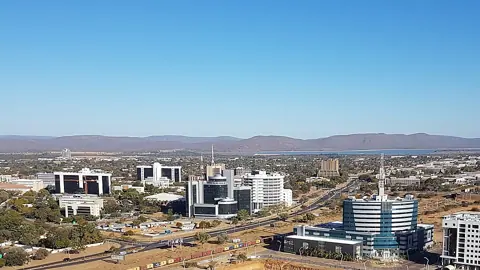
How do I get from Gaborone airport to the city centre?
The Civil Aviation Authority of Botswana (CAAB) runs the airport. On its Sir Seretse Khama International Airport page, it places the airport about 10 km north of the city. That is a short drive, but there is no rail link and no scheduled airport bus on the official pages we checked. Gaborone's minibuses are listed as local transport, but no source we could open describes a service from the terminal.
The Botswana Tourism Organisation's getting-there page states that "taxis to Gaborone are also available" from Sir Seretse Khama International Airport. It adds two instructions for every taxi ride: agree the fare before you depart and check that the driver has change. The same page says car and 4x4 hire is "widely available" at airports.
In practice you have four ways into town:
| Option | What you pay | Best for | Watch out for |
|---|---|---|---|
| Taxi from the terminal | Negotiated before departure; gazetted special-taxi fare is P36 per trip | Solo travellers and small groups arriving in daylight | No published airport tariff, so settle the price first |
| Hotel pickup | Set by your hotel | Late arrivals and first-time visitors | Confirm in writing; not every hotel offers it |
| Hire car from the airport | Rental company's rate | Travellers driving on to the Kalahari or the north | Left-hand traffic; you pay for parking if someone meets you |
| Being met by a friend or driver | Parking only | Visiting family or business contacts | CAAB charges for parking after 30 minutes |
What does a taxi from the airport cost?
Botswana sets public transport fares by government gazette rather than leaving them to operators. A 6 April 2026 Daily News report quoted Government Gazette Notice No. 309 of 2026. The fares it gave were P10 per passenger for a shared taxi, P36 per trip for a special taxi and P9 per trip for a local minibus. The report described these fares as a reversal of an earlier planned increase, which a court had upheld as within the government's powers.
A shared taxi is charged per passenger and a special taxi per trip. The special taxi is therefore the fare that fits a private ride from the airport. We could not find any official statement on whether airport runs are charged at the P36 gazetted fare or at a separately negotiated price. That uncertainty is why the tourism board tells you to agree the fare before departing. Treat P36 as the regulated reference point, not as a promise from the driver at the rank.
Worked example: one traveller
You land at midday with one suitcase. Walk to the taxi area and name your destination. Ask for the total price in pula before loading your bag, and check that the driver can change the note you plan to use. If the quote is close to the P36 gazetted special-taxi fare, about USD 2.72, you are paying the regulated rate. If it is well above that, you are paying a negotiated airport price. You can accept it, ask for the gazetted fare, or ask your hotel what it charges for a pickup.
Worked example: a group of three or four with luggage
A special taxi is priced per trip, not per person. At the gazetted P36, four people sharing one car pay P9 each, the same as the P9 minibus fare in the April 2026 report. The limit is space rather than price. Four adults with checked bags may not fit in one saloon car. Ask for a larger vehicle, or plan on two taxis and agree both fares before anyone gets in. For a group arriving late, a hotel pickup booked in advance removes both the negotiation and the space problem.
Hire car, pickups and parking
If you are driving on to the rest of Botswana, collecting a car at the airport saves a trip back. The tourism board's self-drive page says Botswana drives on the left. It gives the national speed limit as 120 km/h on tarred roads and 60 km/h in towns and villages. The getting-there page adds that you need a valid international driving licence along with the vehicle registration documents. Our Botswana self-drive safari and 4x4 guide covers rental conditions, border paperwork and park driving.
If someone is collecting you, CAAB says visitors' parking at the airport is charged from 30 minutes onward. Air travellers may leave a vehicle for a maximum of five days. Parking in front of the terminal building is not allowed. CAAB also says it is not liable for damage to or theft from parked vehicles. We could not open a current CAAB parking tariff, so check the rate at the pay point.
Cash, cards and arriving outside office hours
Taxi fares are in pula, so have some local cash before you walk out. The tourism board's money page says ATMs accept foreign Visa cards but are "mostly found in larger towns and cities". Foreign currency can be changed at banks, bureaux de change and authorised hotels. The page also says MasterCard and Visa are widely accepted in hotels, restaurants and shops, but remote shops and service stations often take cash only.
Timing matters if you need a bank. The money page gives banking hours as 8:30 to 15:30 on weekdays and 8:30 to 10:45 on Saturdays. The shopping and office hours page lists shop hours as 9:00 to 13:00 on Sundays. If you land on a Saturday afternoon or a Sunday, get cash from an ATM or change money before you fly, rather than relying on a bank in town.
Flying into Johannesburg instead
Some travellers compare a connection into Gaborone with flying to Johannesburg and going on by road. The Botswana Tourism Organisation says a direct bus runs daily between OR Tambo International Airport and Gaborone city centre. The page does not give a timetable or fare, so get both from the operator before choosing this route. If you choose it, the pula exchange rate against the rand (ZAR 1.2301 per pula on 22 September 2026) helps you compare costs quoted in the two currencies.