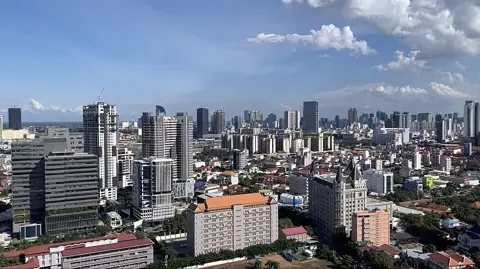
A museum in town and a field outside it look like two separate sights, but they were two stages of one system. UNESCO's World Heritage listing describes the former S-21 prison at Tuol Sleng as the "apex" of the Khmer Rouge security apparatus and Choeung Ek as its "final elimination stage", and Cambodia's war-crimes court tried both as crime sites in the same case. Seeing them in that order lets the second visit make sense of the first.
What are Tuol Sleng and Choeung Ek?
Tuol Sleng was a school. The museum's history of the site names Ponhea Yat High School, later Tuol Svay Prey, and Tuol Sleng Primary School, four buildings around an open rectangle. After the Khmer Rouge took Phnom Penh on 17 April 1975, the campus became the S-21 security centre. The museum estimates that 15,000 to 20,000 people were imprisoned there between 1975 and 1979; when the regime fell in January 1979, 12 people, four of them children, were found alive on the site. It opened as a museum that same year.
Choeung Ek lies about 15 km southeast of the centre, in Dangkor. The ICOMOS evaluation prepared for the UNESCO listing records some 129 mass graves on its 1.33 hectares, remains of 8,985 people exhumed from 86 of them, and a memorial stupa built at the centre in 1988. Choeung Ek is the best known of many such sites: the Documentation Center of Cambodia's mapping project, carried out from 1995 to 2007, recorded 19,733 mass burial pits, 196 prisons and 81 memorials built by survivors across almost every province.
The two sites are run differently. According to the ICOMOS evaluation, Tuol Sleng is managed by the museum itself under the Ministry of Culture and Fine Arts, while Phnom Penh Municipality has contracted a private firm, JC Royal Company, for Choeung Ek's daily operation. In practice, the two sites sell separate tickets.
Which site should you visit first?
Tuol Sleng first, for three reasons. The chronology runs that way: the court record of Case 001 at the Extraordinary Chambers in the Courts of Cambodia lists Choeung Ek among the crime sites connected with S-21. The museum's archive gives faces and names to what Choeung Ek shows only as ground and memorial. And Tuol Sleng keeps fixed hours, 8:00 am to 5:00 pm every day, so a morning there leaves the afternoon for the drive out.
At Choeung Ek, the site's audio tour map marks 19 stops, flags a shorter route for visitors with less time, and suggests paying respects at the Memorial Stupa at the beginning of the visit rather than only at the end. It asks visitors to dress modestly, speak quietly and not smoke.
We could not find Choeung Ek's current entry fee, audio-guide price or opening hours on an official page; the prices quoted online come from tour sellers and reviews. Carry small US dollar notes and confirm the price at the gate. Our guide to paying in Cambodia with dollars and riel explains how change works.
What should you wear and bring to Tuol Sleng?
The museum's visitor terms admit guests only in clothing that covers arms and legs; its contact page adds that shorts and sleeveless shirts are not considered respectful. The museum is on Street 113 in Boeung Keng Kang.
| Ticket or service | Price for international visitors |
|---|---|
| Adult, 18 and over | USD 5 |
| Child, 10 to 17 (with ID) | USD 3 |
| Child under 10 (with ID) | Free |
| Audio guide, 11 languages | USD 5 |
| Personal guide | By contribution |
For two adults with the audio guide, that is USD 20. Cambodian citizens enter free.
Inside the exhibition buildings, food, alcohol, smoking and mobile phone use are not allowed. The practical effect is that an audio guide or a personal guide replaces reading your phone, so choose one at the entrance.
Is Tuol Sleng suitable for children?
The museum itself says its exhibits may not be appropriate for visitors aged 14 or younger. That is guidance, not a ban: children under 10 enter free and those aged 10 to 17 pay USD 3, with ID in both cases. The rooms include original cells and prisoner photographs, and the museum's history notes that family members were held there together.
Why the numbers you see do not match
You may notice different figures on panels, in guidebooks and in court reports. None of them is necessarily wrong. They measure different things. The museum estimates 15,000 to 20,000 people imprisoned. UNESCO's Memory of the World entry for the Tuol Sleng archives, registered in 2009, says over 15,000 prisoners were held and that the archive holds photographs of more than 5,000 of them. The court's historical summary gives "at least 11,742" executed, a minimum proven from surviving records.
Those records shaped justice as well as memory. The ECCC was created by a 2004 agreement between Cambodia and the United Nations. Its first case, against Kaing Guek Eav, known as Duch, who chaired S-21 from 1976 to early 1979, ended with a trial judgment on 26 July 2010 and a life sentence in the appeal judgment of 3 February 2012. In a later case the court convicted senior leaders Nuon Chea and Khieu Samphan of crimes including genocide in 2018.
What the 2025 World Heritage listing changes for visitors
On 11 July 2025 the World Heritage Committee, meeting in Paris, inscribed the Cambodian Memorial Sites under a single criterion, (vi). The listing joins Tuol Sleng and Choeung Ek with a third component, the former M-13 prison, which UNESCO describes as the "initial phase" of the system from the civil war years, and covers abuses from 1971 to 1979. UNESCO noted it was Cambodia's fifth World Heritage site, and said Korea's development agency KOICA had provided about USD 4.15 million for a Tuol Sleng archives preservation and digitisation project implemented by UNESCO and the Ministry of Culture and Fine Arts.
For a visitor, the listing mostly affects the setting. On the first anniversary, Cambodia's state news agency reported, the Prime Minister instructed ministries to protect the sites and prevent inappropriate construction around them. Visitor numbers were high even before the listing: ICOMOS recorded 500,000 at Tuol Sleng in 2019 and more than 250,000 a year at Choeung Ek before COVID-19. Expect company, not solitude, and give other visitors the same quiet you would want.
Before you set out
Check that everyone has covered shoulders and legs, bring ID for any child, and carry small US dollar notes for Choeung Ek's gate. Arrive at Tuol Sleng soon after 8:00 am, pick up an audio guide, and leave the second site for the afternoon or another day if the first has been enough.