Getting from Calgary to Banff without driving
Scheduled coach services connect Calgary International Airport and downtown Calgary to the Town of Banff throughout the year, operated by private companies rather than by a public transit authority. Because the operators, routes and schedules change, Parks Canada maintains a directory rather than endorsing individual carriers: it directs visitors to CarFreeBanff.ca for a complete list of commercial transportation operators in Banff National Park. That site is filterable by origin, including Calgary Airport, and by service type, which is the practical way to compare what is running on your dates.
Book the coach before you fly rather than on arrival. Parks Canada's own guidance for the park is that Banff is busy in summer, that many attractions can be full and inaccessible without planning, and that booking transportation in advance is the only way to ensure you get where you want to go. Airport departures are timed against flight banks rather than running continuously, so a late arrival can mean a long wait or an overnight in Calgary.
Roam Transit inside the park
Roam Public Transit is the local bus network for Banff, Canmore and Lake Louise, and it is what replaces a car once you are in the valley. The route that matters most to a visitor without a car is Route 8X, the Lake Louise–Banff Express, which Roam describes as a year-round daily service departing from the downtown Banff High School Transit Hub with stops at Lake Louise Village and the Lake Louise Lakeshore. Roam states 2026 fares between Banff and Lake Louise as CAD 12.50 for an adult and CAD 6.25 for seniors and youth, with children under 12 travelling free.
Reservations are available on Route 8X and Roam recommends them, particularly in the busy May to October period. Roam also sells day passes and system-wide day passes, and tickets can be bought with exact cash from the driver, through the Token Transit or Transit apps, at ticket vending machines, or in person at the Banff Visitor Centre on Banff Avenue. Local Banff routes cover Sulphur Mountain, Tunnel Mountain, Cave and Basin and Lake Minnewanka, and a separate regional route links Banff and Canmore.
Park entry passes and whether bus passengers need one
A national park pass is required to enter Banff National Park and is charged per person, not per vehicle, so arriving by bus does not exempt you. Parks Canada's Banff fee schedule lists daily admission at CAD 12.25 for an adult, CAD 10.75 for a senior and CAD 24.50 for a family or group of up to seven people arriving in a single vehicle, with youth aged 17 and under admitted free. It also lists a commercial group rate of CAD 10.42 per person, which is the category that applies to coach passengers.
An annual Parks Canada Discovery Pass costs CAD 83.50 for an adult, CAD 71.50 for a senior and CAD 167.50 for a family or group, and covers admission at more than 80 Parks Canada destinations for twelve months. For a single day trip it does not pay for itself; for a trip that also takes in Jasper, Yoho or Kootenay over several days, it can.
One date-sensitive point applies right now. The Government of Canada offered free admission to Parks Canada places from 19 June to 7 September 2026 inclusive, during which no entry pass or ticket was required. That period ends on 7 September 2026, so normal admission fees apply to visits from 8 September 2026 onward. Camping, reservations, the Banff Upper Hot Springs, parking and third-party services were never covered by the free-admission period.
The Lake Louise and Moraine Lake vehicle restrictions
Moraine Lake Road is closed to personal vehicles year-round, and this is a permanent restriction rather than a seasonal one. Parks Canada permits access only for its own shuttles, licensed commercial operators holding a Moraine Lake Road Licence of Occupation, and registered guests of Moraine Lake Lodge. Everyone else, including people who have driven from Calgary, arrives by bus.
Lake Louise itself remains open to personal vehicles, but Parks Canada's own framing is discouraging: it lists driving as an option "for visitors with flexible plans as finding parking is unlikely", with payment required from May to October, and warns that visitors without a confirmed shuttle, Roam or commercial reservation are unlikely to find parking at the Lakeshore. For a car-free traveller this is good news, because the constraint that frustrates drivers does not apply to you.
There are two distinct shuttle systems and it is worth being clear about which one you are using.
| Service | Starts from | Reservation |
|---|---|---|
| Parks Canada shuttle | Lake Louise Park and Ride | Required, book in advance |
| Roam Route 8X | Banff High School Transit Hub | Recommended in summer |
| Lake Connector | Lake Louise Lakeshore | Included with the relevant ticket |
The Lake Connector is the link between the two lakes and runs from 1 June to 12 October 2026, every 30 minutes, from 7am to 6pm. Parks Canada states that visitors holding a Roam Reservable Super Pass can connect onto the Lake Connector to reach Moraine Lake during those dates, showing the pass to Parks Canada staff at Lake Louise to receive a boarding pass, with restrictions that Roam publishes on its own site. That connection is the mechanism by which a car-free visitor reaches Moraine Lake from Banff.
Season limits and booking windows
The shuttle season is short and the reservation system opens months ahead. For 2026 Parks Canada published a Lake Louise Lakeshore shuttle season of 15 May to 12 October and a Moraine Lake shuttle season of 1 June to 12 October, weather permitting, both running every 30 minutes with departures from 6:30am to 5pm and a last return at 7:30pm. Reservations opened on 15 April 2026, with 40% of seats released on launch day and the remaining 60% at 8am Mountain Daylight Time two days before departure.
Parks Canada's own advice is that seats typically sell out well in advance and that trying to secure one on the day of travel is not recommended, and that visitors should expect to wait at least 30 minutes for a shuttle, or up to an hour during periods of high ridership. Outside the shuttle season, Roam Route 8X still runs daily and reaches the Lake Louise Lakeshore year-round, so a winter visit to Lake Louise without a car is possible even when Moraine Lake is not reachable at all.
Calgary itself, and what a weekend there looks like
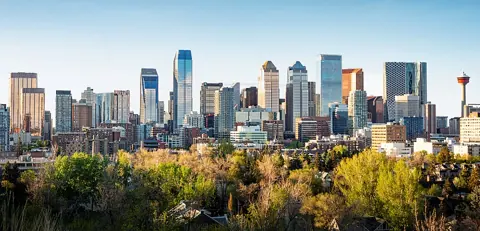
Calgary's downtown is an office district built around the energy industry, and that shapes what you find there outside working hours. The clearest physical expression of it is the Plus 15, an elevated indoor walkway system threaded between office towers: the City of Calgary describes it as having grown since 1969 to 86 bridges and over 16 kilometres of enclosed, climate-controlled walkways in downtown Calgary. Its published hours tell you who it was built for, running 6am to 9pm on weekdays but only 9am to 7pm at weekends and on statutory holidays, with individual bridges permitted shorter hours or weekend closures. If you have a spare Saturday in Calgary before or after the mountains, expect the downtown core to be quiet, plan around the Bow River pathways, the Beltline and Inglewood rather than the office blocks, and do not count on crossing downtown indoors the way you would midweek.
Before you book
Sequence the bookings in the order that things sell out. Fix your Calgary-to-Banff coach first, because airport departures are timed and limited. Then, if your trip falls inside the shuttle season and you want Moraine Lake, secure the Roam Route 8X reservation and the pass that gives you the Lake Connector connection, checking Roam's current restrictions rather than assuming the connection is automatic. Buy the national park pass separately, for every adult and senior in the group, and confirm the current fee for your travel date, since the 2026 free-admission period ended on 7 September 2026. Finally, check Roam's live service updates on the morning you travel, since holiday traffic in the valley regularly delays the buses.