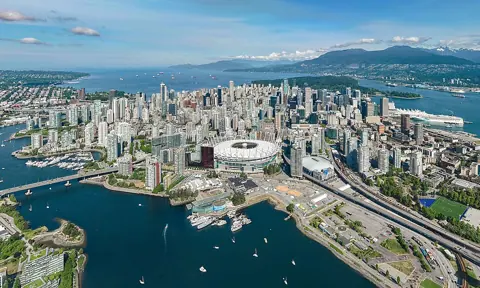
Why production concentrated in British Columbia
British Columbia's film industry is built on a tax mechanism rather than on climate or scenery alone. The Province operates a production services tax credit, which it describes as a refundable corporate income tax credit for accredited production corporations producing film or video in B.C., available to both domestic and foreign producers with no Canadian content requirement. That last clause is the structural reason a US studio can shoot an American-set series in Vancouver and still claim the credit.
Two other factors compound it. British Columbia is in the same time zone as Los Angeles, which makes a shooting day in Vancouver run on the same clock as a studio office in California. And the province's locations are versatile in a specific commercial sense: mountains, coastline, forest, suburb and dense downtown are within a short drive of the same crew base, so a production can shoot several looks without relocating.
The economics have been stated plainly by the provincial government. Its own announcement of the 2025 credit changes noted that in British Columbia, foreign productions make up more than 80% of total production spending on average, and cited Creative BC figures of more than 37,000 provincial jobs supported by the motion-picture industry in 2022 against 26,000 in 2023, a fall the release attributes to the 2023 strike action and a decline in global production.
What the tax credits actually pay for
The credits are calculated on labour, not on total budget. A production multiplies its qualified British Columbia labour expenditure by the applicable rate, so the incentive rewards hiring local crew rather than simply spending money in the province. The production services tax credit programme consists of five separate credits: the base production services credit at 36%, regional and distant location credits at 6% each, a digital animation, visual effects and post-production credit at 16%, and a major production credit at 2%.
Those rates were raised deliberately. The Province announced that for productions with principal photography starting on 1 January 2025, the production services tax credit would rise from 28% to 36% and Film Incentive BC, which supports Canadian-content productions, from 35% to 36%, with an additional 2% for projects whose B.C. production costs exceed CAD 200 million.
What a visitor can actually see
Location filming in Vancouver happens on ordinary public streets, and that is the part you can genuinely encounter. Downtown blocks, Gastown, the West End, the Downtown Eastside's older brick frontages, university campuses and suburban residential streets across Metro Vancouver are all used, and a production takes over a street with trailers, lighting trucks, catering and traffic control that are visible from a block away. You will usually notice the equipment before you notice any filming.
What you see is a working operation rather than a performance. Much of a shooting day is setup and waiting, actors are held out of sight between takes, and the visible portion is crew moving cable and vehicles. Treating a location shoot as a spectator activity generally disappoints; treating it as something you may walk past while doing something else is realistic.
Checking what is shooting right now
Creative BC publishes the only public list of current productions, and it is updated weekly. The agency states that every week it publishes a list of current productions that are shooting or about to shoot in British Columbia, assembled from industry sources including productions registered with the Directors Guild of Canada's BC District Council. The version read on 7 September 2026 was marked current as of 4 September 2026.
Read it for what it is. Creative BC states that the list may not include all productions being made in the province, such as lifestyle productions, documentaries or animated projects, and that inclusion is not an endorsement. Critically, the list gives productions rather than addresses: it tells you what is in production, not where the unit will be parked tomorrow morning. There is no public map of daily shooting locations.
Reading a filming notice on the street
Filming notices are the closest thing to a public announcement of a specific shoot, and they are a permit condition rather than a courtesy. The City of Vancouver requires productions to notify affected areas in advance using City-approved templates, stating that neighbourhoods in which filming will take place should receive notification with at least two full business days to read it and provide feedback, with a two-stage neighbourhood polling process for higher-impact activity such as late-night work or repeated use of the same location. Permit applications must be made at least ten working days before filming starts.
Creative BC's guidance for the wider province is similar in shape, advising that properties affected by filming receive written notice two to five days beforehand and that a location representative speak directly to residents and businesses about the expected impact. A notice taped to a lamp-post or a shop window will typically name the production company, the dates and times, and a contact. It is the one document on the street that reliably tells you a shoot is happening and who is running it.
The City also states that permits are public record and can be shown to anyone who asks, to confirm that the activity has been permitted. That is a right of confirmation, not a published database: the City does not appear to publish a searchable list or map of issued permits online, so there is no way to look up tomorrow's locations in advance.
Etiquette around an active set
An active set is a workplace with safety rules, and the boundary is physical. Cones, tape, barriers and parked equipment vehicles mark where the production's permitted area begins, and inside it you are in the way of moving vehicles, cable runs, lighting stands and, on some permits, stunts, special effects or pyrotechnics, all of which require separate approval and additional notice.
A short list covers most of what is expected of a passer-by:
- Stay on the public sidewalk outside the marked area, and cross the street rather than walking through a taped-off block.
- Follow instructions from traffic control and location staff without arguing; they are managing a permitted road closure.
- Do not use flash or a light source that could appear in a shot, and expect to be asked to pause briefly during a take.
- Do not approach performers, and do not try to enter a trailer area or a base camp.
- Take concerns about a production's conduct to the City's film complaint route or to Creative BC's industry and community affairs contact rather than to the crew on the day.
What is not open to the public
Studio facilities in the region are private industrial premises and are not visitor attractions. There is no public tour equivalent to a major Los Angeles studio experience, and stages are booked by productions rather than programmed for audiences. Base camps, holding areas, interior sets and any location inside a production's permitted boundary are equally closed, and a permitted street closure gives the production temporary control of that space.
The honest summary is that Vancouver's film industry is highly visible and almost entirely inaccessible. You can stand near it, read the notice explaining it, and look up what is shooting this week, but the parts a visitor imagines seeing, the set, the shot and the cast, are the parts that are deliberately kept behind the barrier.