Why distance misleads here
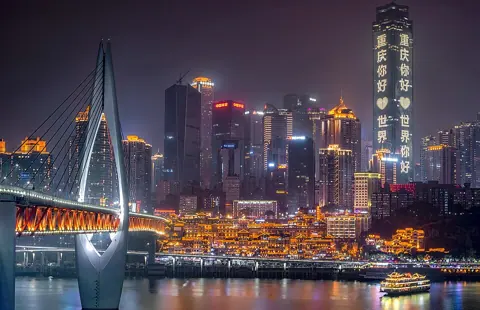
Chongqing's central peninsula sits on steep ridges above the point where the Jialing and Yangtze rivers meet, and the city has built upward and downward in response rather than spreading flat. A route that looks like a ten-minute walk on a map can mean descending several storeys to a riverside walkway, then climbing back up to a road level to catch transport. Buildings routinely have entrances on more than one floor, so the address you are heading to might open onto a street at one level and a plaza three floors below at another. Planning by walking distance alone will underestimate both the time and the physical effort of moving between sights.
Hongyadong after dark
Hongyadong is a large stilt-style (diaojiaolou) complex built into the cliff face above the Jialing River, and it is best known for its illuminated facade after dark. The lighting effect is the main draw, so arriving as dusk sets in gives you the transition from daylight to full illumination rather than just the end state. At peak evening hours, walkways inside the complex and the viewing points around it can get physically crowded, and movement in and out slows accordingly. If the density at the main viewpoint is more than you want to deal with, viewing the illuminated facade from the opposite bank of the Jialing or from a bridge nearby gives a calmer, wider view with more room to stand still and take photographs.
Liziba and the monorail through a building
Liziba station is where a Chongqing monorail line runs directly through a residential tower, and it has become one of the city's most photographed pieces of infrastructure. What actually happens is brief: a train passes through the building's lower floors in a matter of seconds, so if your plan is built entirely around this one moment, temper your expectations accordingly. There is a viewing area near the station where people gather to watch trains pass, and this is a different experience from riding through on the monorail yourself, since a passenger inside the train has a much shorter and less dramatic view of the moment than someone watching from outside. Decide in advance whether you want the outside view, the inside experience, or both, since queuing for photo positions can take longer than the event itself.
Crossing on the Yangtze River Cableway
The Yangtze River Cableway is a 1,166-meter aerial gondola crossing between Yuzhong and Nan'an districts, with a one-way trip of five to six minutes, that has shifted from everyday public transit into mainly a tourist attraction. Because it is a fixed-capacity ticketed attraction, queues build at peak times, particularly in the early evening when both sightseers and commuters may be using it. Booking ahead, where the operator's current system allows it, reduces the risk of standing in a long line during the window when you also want to be watching the light change over the water. Check the operator's current page for hours and any online reservation option before you build it into your evening.
Sequencing an evening
Rather than fixing exact clock times, it helps to think of the evening in blocks tied to light and location. A practical structure looks like this.
- Late afternoon: start on the Jialing River side, giving yourself time to walk Hongyadong's upper levels while there is still daylight.
- Dusk: stay at or near Hongyadong as the lights come on, since this transition is the most photogenic window.
- Early evening: move toward Liziba if the monorail sight is on your list, allowing extra time for the level changes between the riverside and the station.
- Dinner: slot a meal in wherever your route naturally pauses, rather than adding a separate cross-city trip for it.
- Night: finish with a Yangtze River Cableway crossing if you want an elevated night view over the water, since the illuminated skyline is a different sight from the riverside views earlier.
A connecting thread through all of this is that each block assumes some walking, some stairs, and possibly a change between metro and monorail, so build in more transition time than the straight-line distances suggest.
Weather and season
Chongqing summers bring extreme heat and humidity, which makes the stairs and climbs between levels considerably more tiring than they would be in cooler weather, and it is worth pacing an evening itinerary with that in mind. The city is also frequently overcast or foggy, which can flatten long-distance views from bridges or the cableway even when the illuminated sights up close still look sharp. If a hazy evening threatens the wider skyline views you were hoping for, it can be worth shifting your emphasis toward close-up sights like Hongyadong, where the lighting effect works regardless of how far you can see.
Before you set out
A few checks before you head out will save time once you are moving between levels.
- Confirm current opening hours and any ticketing requirements for the Yangtze River Cableway on the operator's page, since these can change.
- Wear comfortable, secure footwear, since the evening involves repeated stairs, escalators and uneven walkways rather than flat pavement.
- Load your transit and payment apps in advance so you are not troubleshooting a QR code at a crowded turnstile.
- Carry a small amount of yuan cash as backup, since acceptance of mobile payment is not universal everywhere.
- Check the current weather and haze forecast, since it affects which sights will reward the effort of climbing to a viewpoint versus staying at ground level.
This evening plan covers the sights most visitors ask about first; it does not attempt to cover Ciqikou old town or the Kuixinglou pedestrian bridge, which sit on different parts of the city and are better treated as separate outings rather than squeezed into the same night.