Getting from the airport to the city
Marseille Provence Airport connects to Marseille-Saint-Charles station by a dedicated shuttle bus. The airport's own access page states the journey takes approximately 30 to 50 minutes under normal traffic conditions, with departures every 10 minutes during peak hours (7:00-20:00) and every 20 minutes outside that window, including a last departure from the airport at 1:50am. Tickets can be bought online, at the counter, by contactless payment aboard the bus, or from the driver outside counter hours. The airport's page does not display the current fare directly - confirm it on the operator's fares section before you travel, since it is not listed on the access page itself.
Saint-Charles station sits above the city center on a monumental staircase and connects directly into the metro network, which is the fastest way onward to the Vieux-Port or most central neighborhoods.
Metro, tram and getting around centrally
Marseille's public transport network, run by RTM (Régie des Transports Métropolitains), includes two metro lines and a tram network covering the central city, with Saint-Charles as a key interchange point. This guide could not confirm current single-ticket or day-pass fares from RTM's fare pages at the time of research - RTM's tariffs page lists monthly and annual passes but did not display standard single-fare pricing in the section available - so confirm the current single-ticket and day-pass prices directly on RTM's own tariffs page before you travel, rather than relying on a fare quoted elsewhere.
The Vieux-Port and the neighborhoods you'll actually use
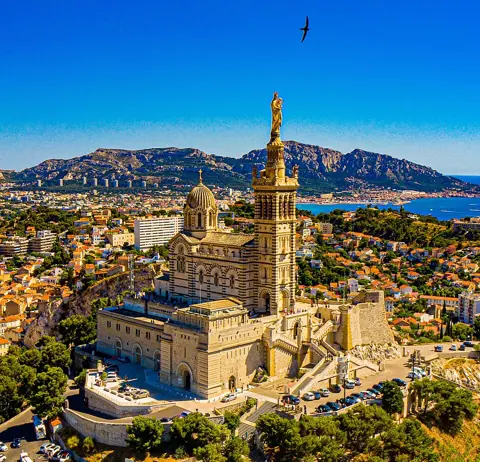
The Vieux-Port (Old Port) is Marseille's central reference point: a working harbor surrounded by cafés, the fish market, and the boat departure points covered below. Le Panier, the old town on the port's northern edge, is the compact, walkable historic quarter most first-time visitors explore on foot. Notre-Dame-de-la-Garde, the hilltop basilica overlooking the city, and the Longchamp and Cours Julien areas further east round out the neighborhoods that see the bulk of first-time visitor traffic. These central and immediately surrounding districts are functionally separate, both geographically and in the safety picture below, from the outer northern arrondissements discussed later in this guide.
Taking the boat to the Frioul islands
Maritime shuttles to the Frioul archipelago and Château d'If depart from the Vieux-Port. The City of Marseille's own page states the departure point is 1, quai de la Fraternité, with boats running daily starting at 6:30am, operated by a dedicated ferry company using vessels built to handle the mistral wind common to the bay. This is a short, frequent crossing rather than a full-day excursion, which makes it workable as a half-day add-on to a Vieux-Port-based stay.
Taking the boat to the Calanques
Regular boat tours to the Calanques - the dramatic limestone inlets east of the city - also depart from the Vieux-Port, run by operators authorized to enter the Calanques National Park. According to Marseille's tourism board, these tours visit multiple calanques including Sormiou, Morgiou, Sugiton and En Vau, with some summer packages including a swim stop or a snack on board.
What the official crime data actually shows
Marseille's reputation for crime is a genuine consideration, not pure stereotype, but the official picture is more specific - and more geographically concentrated - than a blanket "is Marseille safe" framing suggests. A 2024 report from the Cour des comptes, France's national audit court, found Marseille's burglary rate substantially above other major French cities studied, and drug-related offenses markedly elevated, alongside a sharp rise in drug-trafficking-linked homicides - 47 in 2023, up from 33 in 2022, with the report describing this as territorial conflict between rival trafficking networks.
The same report is specific about where this concentrates: roughly three-quarters of drug-dealing points and about 70% of narcotics-related homicides in 2022 were located in the city's northern arrondissements - the 3rd, 13th, 14th, 15th and 16th. Wealthier southern arrondissements, by contrast, see a different pattern of crime weighted toward property offenses like burglary rather than trafficking-related violence.
That distinction matters for how you plan: ordinary travel precautions - watching belongings in crowded tourist areas, being alert around the station at night, the same baseline caution due in any large European city center - are reasonable in central Marseille. Treating the whole city as uniformly dangerous because of statistics concentrated in specific outer districts is not what the official data supports.
Before you leave the airport
Buy your shuttle ticket and confirm the current RTM fare structure before you need either on the ground, since neither operator displays every price on the pages linked above. From there, Saint-Charles station puts you within a short metro or tram ride of the Vieux-Port, where both the Frioul and Calanques boats depart and where most of a first visit will actually happen.