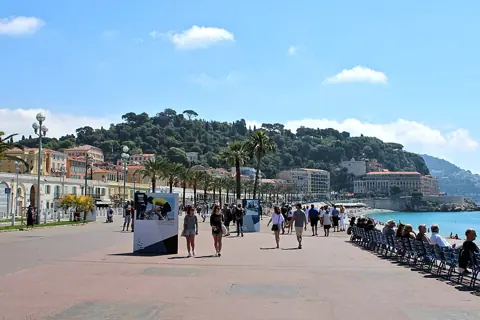
Nice's beachfront is not a solid row of private beaches: the City's own list names 23 public beaches on the Promenade des Anglais and 14 sub-conceded ones. And a private operator does not own its patch of shore; the ministry for ecological transition says the natural maritime public domain, which runs up to the highest tide line, is inalienable and can only be occupied under temporary authorisations.
This guide sets out which beaches are public and which are private, what one private beach charges, what the flags mean, how water quality is checked, and the rules on smoking, pebbles and dogs. It relies on the City of Nice, Service Public, the ministry for ecological transition, the Nice Côte d'Azur tourist office and one beach operator's own prices.
Public and sub-conceded beaches
The City of Nice's beach page states the split plainly: "Le long de la promenade des anglais s'étendent d'Ouest en Est de nombreuses plages publiques mais également 14 plages sous-concédées et deux bases nautiques". Along the Promenade, from west to east, there are many public beaches, 14 sub-conceded beaches and two water-sports bases.
"Sous-concédée" translates as sub-conceded. The City's page does not explain the arrangement further, but the ministry for ecological transition sets out the general principle for the shore: any installation on the natural maritime public domain needs a domain authorisation that is paid for with a fee, and that authorisation is "toujours temporaire, précaire et révocable", always temporary, precarious and revocable.
Management sits with the State. The ministry says the prefect of each département manages the natural maritime public domain through the departmental territories and sea directorate, and a 2012 circular requires environmental and landscape issues to be weighed when occupation requests are examined.
The same ministry page says the maritime public domain is inalienable and imprescriptible, so long occupation by private operators gives them no ownership rights. It also says the domain is not meant for permanent buildings, and occupied areas must be returned to their natural state when authorisations end.
For you, the basic rule is from Service Public, the government's information site: "L'usage des plages est libre et gratuit selon le Code de l'environnement". Using beaches is free under the Environment Code. On a sub-conceded beach, you pay for the operator's equipment and services; on a public beach, you bring your own towel and pay nothing.
The City's two lists overlap in a confusing way. Castel Plage, Opéra Plage, Beau Rivage Plage, Ruhl Plage and Blue Beach appear both among the public beaches and among the sub-conceded ones, which suggests a public stretch and a concession share each name. Check whether you are on the public part or the operator's part before you spread a towel.
The table compares the two types using what the official sources state.
| Question | Public beach | Sub-conceded beach |
|---|---|---|
| Number on the City list | 23 names | 14 |
| Cost to use the beach | Free | You pay for loungers and services |
| Examples named by the City | Plage de la Réserve, Centenaire, Lenval, Carras, Lanterne | Régence Plage, Hôtel Amour à la Plage, N la Plage (Negresco), Ruhl Plage, Castel Plage |
| Smoking | Banned; all public beaches smoke-free since summer 2024 | National ban on beaches in the bathing season |
| Lounger booking | Not applicable | Varies; Blue Beach says mattresses are booked on site |
| Services named in official sources | Lifeguard post and flags where supervised (Service Public) | Lounger and parasol rental, restaurant (tourist office, Castel Plage and Ruhl Plage) |
The public list runs, in the City's order, from the Plage de la Réserve and the Bains militaires, past the Ponchettes, Centenaire, Lido, Sporting, Neptune, Forum, Voilier, Florida, Poincaré, Magnan, Lenval, Fabron, Sainte-Hélène and Aubry-Lecomte, to the Carras and Lanterne beaches at the end of the list.
The full sub-conceded list on the City's page is Régence Plage, Les Canailles Plage, Cocoon Beach, La Véla Plage, Hôtel Amour à la Plage, N la Plage (Negresco), Blue Beach Plage, Le Temps d'un Été Plage, Bocca Mar, Ruhl Plage, Le Galet Plage, Beau Rivage Plage, Opéra Plage and Castel Plage.
What a private beach costs
No official source publishes private-beach prices in Nice. The tourist office's pages for the beaches carry a "Tarifs" heading that lists only payment methods, such as cards, cash and American Express, not amounts.
One operator publishes its own. Castel Plage, at 8 quai des États-Unis according to the tourist office, lists on its website "Transats 30€", "Parasols 5€" and "Location Serviette 7€", towel hire at €7, as read in September 2026. The same page also offers a "Transat & Parasol" package at €30 for a half-day and €35 for a full day, so the headline lounger price and the package price do not line up.
Other operators do not publish prices on the pages we read. Blue Beach's reservations page says only that "la réservation des matelas s'effectue sur place", mattresses are booked on site. Treat the Castel figures as one example, not a market rate.
What you get for the money is described by the tourist office rather than priced. It lists supervised bathing, lounger and parasol rental and a restaurant for both Castel Plage and Ruhl Plage, and says Ruhl Plage offers mattresses and double beds under a lifeguard's watch and is accessible to wheelchair users, with or without help.
Opening seasons differ as well. The tourist office lists Castel Plage as open from 1 May to 1 October 2026, from 9am to midnight; Ruhl Plage from 28 February to 28 November 2026, from 9am to 11.45pm; and the Hôtel Amour beach as open all year but closed in the evenings between 15 September and 1 June.
The City also lists two water-sports bases on the seafront, Riviera Nautic Sport and Nikaïa Watersports, and a Base Nautique at 50 boulevard Franck-Pilatte.
The City runs its own paid beach club for children. The Li Rateta beach club at 71 promenade des Anglais, for 6- to 12-year-olds from Monday to Saturday in July and August, charges €12.75 for a morning, €15.80 for an afternoon and €20.90 for a full day, card only, according to the City.
The decoder table covers the words you will see on signs and menus. Prices are the only ones stated in the sources read.
| Name | Local name | What it is | Price range |
|---|---|---|---|
| Public beach | plage publique | Free beach open to all | Free |
| Sub-conceded beach | plage sous-concédée | Stretch run by a private operator under a concession | Operator's prices |
| Sun lounger | transat / matelas | Lounger or mattress rented on a private beach | €30 at Castel Plage (own site) |
| Parasol | parasol | Sunshade rented on a private beach | €5 at Castel Plage (own site) |
| Lifeguard post | poste de secours | Supervised post; flags and water results are shown here | No fee stated |
| Smoke-free beach | plage sans tabac | Label on every Nice public beach since 2024 | No fee stated |
| Pebbles | galets | The shore material; protected from removal | No fee stated |
| Water-sports base | base nautique | Water-sports base listed by the City | Not published |
Flags and bathing zones
The flags on Nice beaches follow a national system set by decree no. 2022-105 of 31 January 2022, which Service Public summarises. Flags are placed so they can be seen across the bathing area, and on beaches at least one is usually by the lifeguard post.
Three main colours tell you whether to swim. Green means supervised swimming with no apparent danger; yellow means supervised swimming with a limited or marked danger, so take care; red means "la baignade est interdite", swimming is banned, because conditions are dangerous for bathers and for rescues.
Other flags add information. A purple flag signals water pollution, dangerous species such as jellyfish, or a protected marine zone. A black-and-white chequered flag marks an area for water sports such as surfing. A red triangular flag marks a temporary, localised ban outside the supervised zone.
The supervised zone itself is marked by two-colour flags, red on top and yellow below, on either side of it during the lifeguard post's opening hours. Service Public says "vous devez veiller à vous baigner entre ces drapeaux", you should make sure you swim between them.
Before you go in, Service Public recommends finding out whether the spot is supervised, dangerous or off-limits, since rescue teams reach people faster in supervised zones, and asking the lifeguards about currents, natural hazards and the weather.
Two absences matter as much as the colours. If no flag is flying, the lifeguard post is not open and nobody is supervising; if the flag has been lowered, lifeguards are on an intervention and swimming is temporarily unsupervised.
Ignoring a red flag now carries a fine. Service Public says that since 3 August 2026, under decree no. 2026-723 of 1 August 2026, police can issue a fixed fine to anyone who enters the water despite a red flag or swims where a municipal or prefectoral order bans it. The offence is a third-class contravention, which can reach €450 if it goes before a police court.
How the water is checked
Nice samples its bathing water every week in summer. The City says samples are taken weekly from 1 June to 30 September at 26 bathing sites and 3 non-bathing sites, about 500 analyses a year paid for by the City, and that the regional health agency, ARS Alpes-Maritimes, evaluates and classifies the bathing water.
Results take time. The City says they are known at least 36 hours after sampling and are read against thresholds from the national health-safety agency ANSES: for intestinal enterococci, below 370 per 100 ml is good quality, 370 to 1,000 is a vigilance threshold and above 1,000 an alert; for E. coli, the equivalent thresholds are 1,000 and 2,000.
You can see the results where you swim. The City says bacteriological results are posted at each lifeguard post on the beaches and on its website. Its 2026 calendar also lists several "test rapide" entries by beach, including Beau Rivage, Opéra, Blue Beach, Réserve, Galion and Lanterne, without explaining them.
The City also cleans the water. It says boats collect floating waste daily in summer and a seawater cannon washes the beaches, and that each year it has the seabed cleaned over the first 10 metres, removing about 8 cubic metres of waste.
Nice has applied for the Blue Flag every year since 2009, the City says, and the label is awarded for one year at a time by an international jury after a French national jury has examined the application.
Seven Nice beaches carry the Blue Flag eco-label for 2026, according to the City: Bambou, Carras, Castel, Forum, Poincaré, Sainte-Hélène and Galion. The City says the label requires excellent bathing water with five checks per season, a drinking-water point and bins on the beach. Service Public reports 85 labelled beaches and 27 marinas across the Sud (Provence-Alpes-Côte d'Azur) region in 2026, out of 384 beaches, 100 marinas and one boat labelled nationally.
Smoking, pebbles and dogs
Nice moved early on smoke-free beaches. The City says the place du Centenaire beach became France's first smoke-free beach in 2012, under an agreement signed with the national cancer league on 20 February 2012, and that "100% des plages publiques niçoises" have been labelled smoke-free since summer 2024, with signs at beach entrances.
The City gives two reasons for the policy: protecting non-smokers from passive smoking, and the environment, since cigarette butts are among the waste most often found on beaches. It says nearly 30 billion butts are thrown away in the streets of France each year, and that a butt dropped on the ground and carried off by water is likely to reach the sea.
National law now covers beaches too. Service Public's page on smoking bans, checked in April 2026, lists "plage pendant la saison balnéaire", a beach during the bathing season, among places where smoking is banned and where no smoking area can be set up. It gives a fine of up to €750 for smoking in a collective-use place outside a designated area, without a separate beach figure.
The tourist office describes the Hôtel Amour beach on the Promenade as a "plage de galets", a pebble beach. Service Public warns that pebbles "protègent la faune et la flore de la houle et de l'érosion", protect wildlife and plants from swell and erosion, and that gleaning them "peut donner lieu à une amende de 1 500 €", can lead to a €1,500 fine. The same limit applies to taking sand, although Service Public says authorities may tolerate collecting small amounts of windblown sand that has left the beach for the road or pavement. Cutting protected coastal plants is far more serious: Service Public cites fines of up to €150,000.
Dog rules vary by beach. The tourist office's page for the Plage de la Lanterne says category 3 dogs may go off the lead and swim, category 1 dogs are banned, and category 2 dogs must be muzzled and on a lead. We did not find a city-wide dog rule on the pages we read.
The City also gives heat advice. Its smoke-free page recommends factor 50+ sun cream renewed every two hours and after swimming, drinking 1.5 litres of water, and avoiding the sun between noon and 4pm. If you are travelling along the coast, our guide to the Riviera by train covers getting between beaches.
Accessible and family beaches
Two public beaches are set up for people with disabilities. The City says the Centenaire beach (1 promenade des Anglais) and the Carras beach (285 promenade des Anglais) are labelled "Handiplages" with the "3 bouées" level, and that the service is "gratuit, sans réservation, ni justificatif", free, with no booking or proof required.
The service is seasonal, in summer. The City says it offers supported bathing with qualified lifeguards and adapted equipment such as amphibious wheelchairs, an access ramp and path to the sea, a lifeguard post within 60 metres, shade for the whole season, and accessible showers, toilets and changing space. Older people with mobility or balance difficulties are also welcome. For getting there, the City points to Mobil'Azur, a public on-demand transport service for people with reduced mobility that runs door to door, seven days a week, after registration and booking.
The Li Rateta club, run by the City, describes an area of more than 1,000 square metres with its own supervised beach and a 300-square-metre bathing area watched by a lifeguard, plus activities from kayaking and paddleboarding to beach volleyball. Enrolment is taken only from 9am to 10am and from 1.30pm to 2.30pm.
Families have options on both sides of the public-private line. Besides the City's Li Rateta club for children aged 6 to 12, the tourist office describes Ruhl Plage as having a seawater pool for children with a lifeguard. When you are hungry after the beach, our guide to socca and Niçois cuisine explains the local label.
What this guide does not cover
We could not verify the national rule, often attributed to a 2006 decree, on how much of a conceded beach must remain free of equipment. Légifrance refused automated access and no official page we read states the figure, so this guide does not give one.
No official list of private-beach prices exists, and only one Nice operator's own prices are quoted here; they may change. We did not read the concession contracts or the City's beach police order, so rules on alcohol, barbecues, nudity or city-wide dog access are not covered.
The City's 2026 water-sampling calendar lists "test rapide" entries without explaining them, and the same page refers to both the DDASS and the ARS; we report the ARS as the body responsible, as the page states elsewhere. We did not read the texts of decrees no. 2022-105 and no. 2026-723 directly, only Service Public's summaries.