You notice it before you know why: on the museum's top floor, the walls no longer line up with the floors below. The rest of the building sits square to the streets of the Makrygianni district. The top floor doesn't. It has been turned to face a different direction entirely, and that turn is not an accident of architecture — it's the building's whole argument, made in concrete and glass instead of words.
The top floor isn't aligned to the building below it
The Acropolis Museum, designed by Bernard Tschumi Architects with Michael Photiadis, stands on stilts above an active excavation site in central Athens. Its lower levels follow the practical logic of the plot: a ramp mimicking the Acropolis slope, then archaic-era galleries arranged around the excavated ruins the builders found beneath the foundations. According to the museum's own description of the building, the top floor — the Parthenon Gallery — is "devoted exclusively to the sculptures of the Parthenon" and is where the museum's design finally breaks from the grid the rest of the structure follows.
That top floor is a glass-walled rectangular hall built to the same proportions as the Parthenon's inner chamber, the cella. The museum's page on the Parthenon Gallery describes it as "a glass-walled chamber that wraps around a rectangular core" matching "the orientation and dimensions" of that original inner room. Because the actual Parthenon on the rock above sits at its own angle relative to the modern street grid — a temple built for the Acropolis, not for the city that grew up around it centuries later — matching that orientation means turning the gallery away from the rest of the museum. You are standing, without realizing it until someone points it out, inside a room rotated to face the same way the Parthenon itself faces.
Why the architects bothered
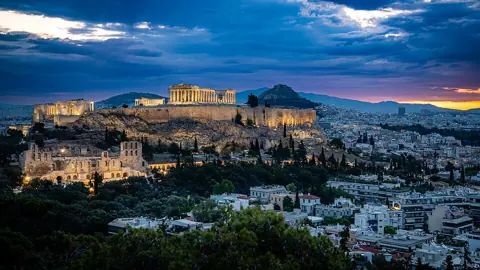
The point isn't a design flourish. The glass walls are structural to the argument the museum is making. Because the gallery is turned to the Parthenon's own orientation and built from floor-to-ceiling glass, you get what the museum describes as "a direct line of sight between the sculptures and the monument from which they come." Standing among the frieze blocks, you can look sideways through the glass and see the actual Parthenon on the rock, roughly 300 metres away, sitting at the same angle as the room you're standing in. The building is designed so the sculptures and their source monument are never fully separated, even indoors.
Inside the gallery, the frieze blocks are "mounted in the same position as they held on the monument," and the pediment figures are arranged so they can be seen "from all directions," reproducing something closer to how they would have read on the building itself rather than as isolated objects in cases.
The gaps, and what fills them
Not every piece of Parthenon sculpture is here. A substantial portion of the frieze, several metope panels, and one pediment figure have been in the British Museum in London since the early nineteenth century, when Lord Elgin's agents removed them from the standing ruin under a permit from the Ottoman authorities then controlling Athens — a removal Greece has disputed the legitimacy of ever since. Rather than leaving blank walls or skipping those sections in the display, the Acropolis Museum fills them with plaster copies, arranged in their correct position in the sequence.
The museum's own description is direct about this: "The exhibition combines the original marble sculptures with plaster copies of those retained in the British Museum or other foreign museums." Walking the gallery, you can usually tell which pieces are original marble and which are plaster substitutes — the surface, colour and weathering differ — and the layout makes the absence itself part of what you're shown, rather than something smoothed over.
Reading the room as an argument, not just an exhibit
None of this requires you to take a side to notice what's being communicated. The architecture puts three things in front of you at once: the sculptures that stayed, a visible reminder — via the plaster stand-ins and the sightline through the glass — of the sculptures that didn't, and the real Parthenon itself, visible through the wall exactly where you'd expect a missing piece to belong. Few museums make their central argument through orientation and glazing rather than a wall label, which is part of why the top floor is worth slowing down for rather than treating as one more gallery to move through.
The museum sits about 300 metres southeast of the Parthenon in the Makrygianni neighbourhood, connected to the Acropolis and the wider archaeological area by the Dionysiou Areopagitou pedestrian walkway, so the walk from the gallery to the monument itself is short enough to do immediately afterward, while the sightline from the top floor is still fresh.
What to check before you go
Opening hours, ticket prices and any combined-ticket arrangements with the Acropolis site change by season, so confirm current details on the museum's own ticketing page before you plan your visit around a specific time slot. This guide covers what the top floor's design is doing and why; it does not cover admission prices, photography rules inside the galleries, or the museum's rotating temporary exhibitions, which are worth checking separately closer to your visit date.