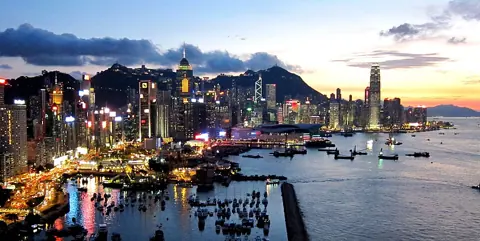
A Chinese visa does not admit you to Hong Kong, and a Hong Kong entry does not admit you to mainland China. Hong Kong is a Special Administrative Region of the People's Republic of China that runs its own immigration control, its own currency, its own customs territory and its own courts, and all four are set out in one document: the Basic Law, which took effect on 1 July 1997 (GovHK, Hong Kong - the Facts, last revised July 2026, checked 16 September 2026). The consequences are concrete. You clear Hong Kong immigration against a rule set published nationality by nationality, you spend Hong Kong dollars, you walk through a red or green customs channel, you keep to the left on the road, and if you go on to Shenzhen you clear a second, entirely separate border whose requirements Hong Kong does not set.
What the Basic Law sets out
The Basic Law is the constitutional document of the Hong Kong Special Administrative Region, and it is where every practical difference a traveller meets is anchored. GovHK describes it as enshrining "one country, two systems", "Hong Kong people administering Hong Kong" and a high degree of autonomy. Article 2 authorises the Region to enjoy "executive, legislative and independent judicial power, including that of final adjudication" (Basic Law Chapter I, checked 16 September 2026). Article 5 states that "the socialist system and policies shall not be practised in the Hong Kong Special Administrative Region, and the previous capitalist system and way of life shall remain unchanged for 50 years".
Article 8 explains why a contract you sign in Hong Kong reads the way it does: it provides that "the laws previously in force in Hong Kong, that is, the common law, rules of equity, ordinances, subordinate legislation and customary law shall be maintained", subject to the Basic Law and to amendment by the legislature (Chapter I, checked 16 September 2026). GovHK names the Court of Final Appeal as Hong Kong's highest court.
Article 154 is the authority behind the counters you queue at (Basic Law Chapter VII, checked 16 September 2026). It is why staffed immigration control exists not only at the airport but at Lo Wu on the rail line north and inside West Kowloon station, and the Article covers departure from the Region as well as entry into it.
The visa you need for Hong Kong
Hong Kong publishes its own visa requirements, nationality by nationality, and they do not track mainland China's list. The Immigration Department's chapter on visit visas states plainly that "even where all immigration requirements set out in this chapter are met, travellers should not assume that they can gain automatic entry", and that the immigration authorities may refuse permission to land (Visit Visa / Entry Permit Requirements for the HKSAR, information updated August 2026, page dated 26 August 2026, checked 16 September 2026).
The table below compares the visa-free periods for a sample of passports, taken from that same Immigration Department table. It is a sample, not the full list, which runs to more than 220 entries.
| Passport | Visa-free visit not exceeding | Extra step |
|---|---|---|
| Britain (British citizens) | 180 days | None |
| U.S.A., Canada, Australia, Japan, Korea (Republic of), Singapore, France, Germany, Ireland, Italy, Netherlands, Spain | 90 days | None |
| Indonesia, Thailand, South Africa | 30 days | None |
| India | 14 days | Pre-arrival registration online |
| Philippines, Russian Federation | 14 days | None |
| Vietnam | Not applicable | Visa required |
Two conditions attach to visa-free entry and people overlook both until a counter officer asks. The Immigration Department states that visitors must have adequate funds for the stay without working and, "unless in transit to Chinese Mainland or the Macao Special Administrative Region", must hold onward or return tickets. It adds that visitors may not take up employment, paid or unpaid, establish or join a business, or enter school as a student.
There is no single pan-China visa covering both jurisdictions. A mainland Chinese visa is not an entry document for Hong Kong, and entering Hong Kong visa-free gives you nothing at a mainland counter.
Money, tariffs and the red channel
The Hong Kong dollar is the legal tender of the Region, and Article 111 of the Basic Law provides that it "shall continue to circulate", with the authority to issue currency vested in the Hong Kong Government, backed by a 100 per cent reserve fund (Basic Law Chapter V, checked 16 September 2026). Article 112 adds that no foreign exchange control policies apply and the currency is freely convertible.
The banknotes look inconsistent for a reason worth knowing before you are handed change. The Hong Kong Monetary Authority states that the HKD 20, 50, 100, 500 and 1,000 notes are issued by three note-issuing banks, that the Government has issued the HKD 10 paper note since 2002 and the polymer version since 2007, and that HKD 10 notes issued by two note-issuing banks in the 1990s remain legal tender although no longer printed (HKMA, Hong Kong Currency, checked 16 September 2026). The Government issues the coins, and the older Queen's portrait series remains legal tender alongside the bauhinia series.
On the goods side, Article 114 keeps Hong Kong a free port that "shall not impose any tariff unless otherwise prescribed by law", and Article 116 makes it a separate customs territory. The Customs and Excise Department puts the same point operationally: "HKSAR is a free port and does not levy any Customs tariff on imports and exports", with excise duties on only four commodities, namely liquor, tobacco, hydrocarbon oil and methyl alcohol (Duty-free Concessions, checked 16 September 2026). A passenger aged 18 or above may bring in 1 litre of liquor above 30% alcohol by volume, and 19 cigarettes or 1 cigar or 25 grams of cigars or 25 grams of other manufactured tobacco.
Arrivals are sorted by a two-channel system at every entry point. The Red Channel is for prohibited or controlled items, dutiable goods over the exempted quantities, and currency and bearer negotiable instruments totalling more than HKD 120,000 or the foreign-currency equivalent; the Green Channel is for everyone else, and the Department states that passengers using it "are not exempted from any Customs examination" (Red and Green Channel System, checked 16 September 2026).
Plugs, driving side and phone numbers
Hong Kong's everyday infrastructure runs on its own standards, and three of them will reach you within an hour of landing. The table below lists the ones that change what you pack and how you cross a street.
| Item | What applies in Hong Kong |
|---|---|
| Mains voltage | 220V single phase (380V three phase) |
| Plug | 3-rectangular-pin 13A to BS 1363 |
| Road | Keep to the left |
| Visitor driving | Own licence or IDP valid for 12 months from last entry |
| Country code | 852, for routing international calls into Hong Kong |
The plug standard is a legal requirement, not a convention. The Electrical and Mechanical Services Department states that plugs on products supplied in Hong Kong "shall generally be 3-rectangular-pin 13A plugs to BS1363 or 3-round-pin 5A or 15A plugs to BS546" (Outline of Electrical Products (Safety) Regulation, checked 16 September 2026), and that "at present, the voltages in Hong Kong are 220V (single phase) and 380V (three phase)" (EMSD Electricity Classroom, checked 16 September 2026). A UK-shape adaptor works; a two-round-pin European one does not.
Traffic keeps left. The Transport Department's Road Users' Code instructs drivers to "keep to the left except when traffic signs or road markings indicate you may do otherwise; when intending to overtake or turn right; or when you have to pass stationary vehicles or pedestrians on the road" (Transport Department, On the Road, checked 16 September 2026). If you come from a drive-on-the-right country, the first vehicle in a one-way street reaches you from the side your reflexes are not watching.
Telephone numbering is separate too. The Office of the Communications Authority's numbering plan assigns 852 as the country code "for routing international calls into Hong Kong", with 8-digit local numbers (The Numbering Plan for Telecommunications Services in Hong Kong (SAR), China, checked 16 September 2026). Check your operator's roaming terms for Hong Kong by name rather than assuming a bundle labelled for China includes it.
Crossing into mainland China
Crossing from Hong Kong into mainland China is a full immigration crossing at a named control point, not an internal transfer. The Immigration Department operates 13 control points covering air, land and sea, and nine of them are land boundary crossings to the Mainland: Lo Wu, Lok Ma Chau, Lok Ma Chau Spur Line, Man Kam To, Sha Tau Kok, Shenzhen Bay, Express Rail Link West Kowloon, the Hong Kong-Zhuhai-Macao Bridge and Heung Yuen Wai (Control Point Locations, page dated 26 June 2026, checked 16 September 2026).
Opening hours differ and they decide what time you can leave. Lok Ma Chau and the Hong Kong-Zhuhai-Macao Bridge run 24 hours; Lo Wu and Shenzhen Bay passenger clearance run 06:30 to midnight; Express Rail Link West Kowloon runs 06:30 to 23:30; Lok Ma Chau Spur Line runs 06:30 to 22:30; Man Kam To and Heung Yuen Wai run 07:00 to 22:00. Clearance at Sha Tau Kok is suspended until further notice, so treat that crossing as closed.
The Immigration Department's own visitor conditions show the separation in operation: the onward-ticket requirement is waived only where a visitor is "in transit to Chinese Mainland or the Macao Special Administrative Region", which the Department lists as destinations distinct from Hong Kong.
What this guide does not cover
This guide covers Hong Kong's legal status and the practical items that follow from it, and stops at the boundary. It does not state mainland China's visa requirements, exemptions, transit rules or ports of entry, because the mainland authorities set those and they were not verified here. It does not cover the Macao Special Administrative Region's own entry rules, nor Hong Kong employment, study, investment or residence visas, which the Immigration Department handles under separate chapters.
It also does not reproduce the full visa-free table, which runs to more than 220 nationalities and travel-document types and carries its own note that "there may be subsequent changes". Look up your exact passport type on the live page rather than a country name, because several entries split by document: British citizens get 180 days while British Overseas Territories citizens, British Overseas citizens, British subjects and British Protected persons get 90.
Before you book, do three things in this order. Check your own passport's row on the Immigration Department's visit visa page and note the number of days, not just the words "visa free". If anywhere on the mainland is in the plan, sort that entry document separately and early, because it has nothing to do with the Hong Kong one. Then pack a UK-shape plug adaptor, and carry your driving licence only if you genuinely intend to drive on the left.