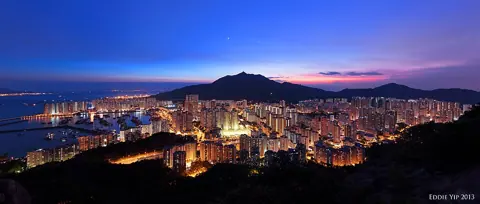
Most Hong Kong itineraries treat everything past Kowloon as countryside. The population figures disagree. Yuen Long District alone holds more people than Sha Tin, and nearly three times as many as Central and Western, where most visitors spend their days.
What changes out here is not the scale of the place but the rules it runs on. Several systems that behave one way downtown behave differently in the northwest, and each of them is a thing a visitor can get wrong.
The Light Rail has no gates, and that is not a free ride
The MTR Light Rail serves the northwest New Territories across about 36.2 kilometres and 68 stops, carrying roughly 423,000 passenger trips a day in 2025. Its platforms are open — there are no turnstiles, and nothing physically stops you boarding.
Fare collection happens at free-standing processors instead. You tap your card at the entry fare processor before boarding and again at the exit fare processor when you leave, and the journey must be completed within two hours. Staff carry out random ticket inspections on platforms and inside train compartments.
One further quirk: if your journey returns you to the same station you started from, you must reconfirm with your Octopus or buy an additional ticket rather than simply tapping out.
The Light Rail interchanges with the Tuen Ma Line — the heavy rail line running Tuen Mun to Wu Kai Sha — at Tuen Mun, Siu Hong, Tin Shui Wai and Yuen Long. Trains on that line run every 2.7 to 3.0 minutes in the weekday morning peak, but stretch to as much as 12 minutes early in the morning and late at night, and some Light Rail routes to as much as 25 minutes.
Minibuses split into two systems out here
Both green and red minibuses are public light buses carrying up to 19 seats, and the territory-wide fleet is capped at 4,350 vehicles. The legal difference between them matters more in the New Territories than downtown, because red minibuses are a larger part of how people actually move.
| Green minibus | Red minibus | |
|---|---|---|
| Route and fare | Fixed, approved by the Transport Department | Not subject to approval |
| Scheduled service | Yes, with scheduled headway | No |
| Licensed vehicles | 3,357 on 361 main routes | 707 |
| Daily passengers | About 1,329,100 | About 135,100 |
Those fleet figures are Transport Department provisional numbers as at September 2025. The practical consequence for a visitor is straightforward: a green minibus route can be looked up before you travel, and a red one cannot. If you are unsure of a fare or a destination, take the green one.
Village housing law explains what you are looking at
The uniform three-storey houses that fill the valleys around Yuen Long are not a vernacular style. They are the product of a specific legal regime.
The New Territories Small House Policy, implemented since December 1972, permits an indigenous villager — defined as a male person at least 18 years old descended through the male line from a resident in 1898 of a recognised village — to erect, once in his lifetime, a small house. The house must not exceed 65.03 square metres of roofed area, three storeys, or 8.23 metres in height.
Those three numbers produce the landscape. Once you know them, the repeated form stops looking like a lack of imagination and starts looking like a rule being followed 700 square feet at a time.
The policy is under continuing litigation and review, so its future is genuinely uncertain — but its imprint on the built environment is not going anywhere.
The border is closer than the airport, and much busier
Three of Hong Kong's control points sit in or beside the northwest New Territories, and they are not minor crossings.
| Control point | Operating hours |
|---|---|
| Lok Ma Chau (road) | 24 hours |
| Lok Ma Chau Spur Line (rail) | 6:30am – 10:30pm |
| Shenzhen Bay | Passengers 6:30am – midnight; goods 24 hours |
On 15 September 2026, a midweek day, those three crossings handled about 305,000 passenger movements in both directions between them. Hong Kong International Airport handled about 101,000 the same day.
That is the fact that reframes the district. This is not Hong Kong's edge; it is one of its main doors, and the volume passing through shapes the transport, retail and street life on the Hong Kong side of it.
What is actually worth the journey
Two destinations here justify the trip on their own, and they operate on very different terms.
Hong Kong Wetland Park in Tin Shui Wai opens 10:00 to 17:00, closed on Tuesdays except public holidays, with tickets sold until 16:00. Standard admission is HK$30 and the concession rate HK$15, covering children aged 3 to 17, full-time students, people with disabilities and their carer, and people aged 65 or above.
Mai Po is not a walk-in site at all. Entering the roughly 800-hectare restricted area without a permit from the Director of Agriculture, Fisheries and Conservation is an offence under the Wild Animals Protection Ordinance, with a maximum fine of HK$50,000. Permits go to experienced birdwatchers, conservationists and researchers; ordinary visitors go on guided tours organised by WWF-Hong Kong, booked in advance.
For walking, Tai Lam Country Park covers 5,412 hectares extending from Tsuen Wan to Tuen Mun, designated in 1979 and the second largest country park in Hong Kong after Lantau South. Tai Mo Shan Country Park, 1,440 hectares, holds the territory's highest peak at 957 metres, though it sits largely in the districts adjoining Yuen Long rather than inside it.
Planning the day so it ends well
Give the northwest a full day rather than an afternoon, and treat the return journey as the constraint rather than the outbound one. Frequencies stretch considerably late in the evening on both the Tuen Ma Line and the Light Rail, and the difference between a three-minute wait and a twenty-five-minute one is felt most when you are tired.
Carry cash. The mix of red minibuses, village shops and small restaurants out here is exactly the segment of Hong Kong retail where card acceptance is least predictable.
What this guide does not cover
Journey times from Hong Kong Island or Kowloon to Tuen Mun and Yuen Long are not given here. MTR publishes them only through its trip planner, which was unavailable at the time of checking, and a guessed figure would be worse than none — check the operator's planner for your own origin and date. Last train times are unavailable for the same reason.
All other figures were confirmed against government and operator sources on 17 September 2026. Minibus fleet counts are Transport Department provisional figures for September 2025, and daily border crossing numbers change from day to day, so treat both as illustrative of scale rather than as current counts.