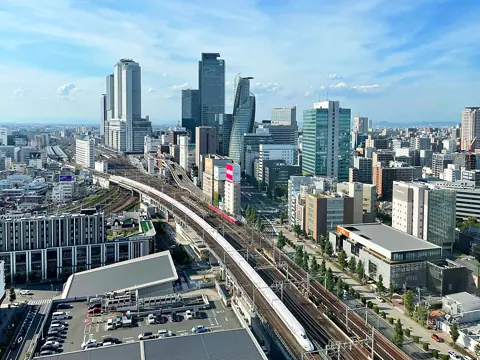
Nagoya's morning service is not a promotion, not a coupon and not a limited-time campaign: at Komeda Coffee it is the standing breakfast menu, printed on the chain's own menu page, and the condition for getting toast and a boiled egg at no extra charge is simply that you ordered a drink (Komeda, checked 11 September 2026). The second assumption to drop is that you have to be in Nagoya for it — Komeda runs the same offer at every branch in the country, Tokyo included, and the only regional exception its page names is Okinawa.
What does not travel is the density. Aichi Prefecture has one kissaten per 1,220 residents against 2,254 in Tokyo, and Nagoya households have been recorded spending roughly two and a half times the national average in them. The custom is real, it is measurable, and the part of it worth flying for is the part the chains did not export.
This guide covers the morning offers that named chains publish on their own pages, and the official statistics behind the custom. It does not cover independent shops, whose terms it cannot verify, and it does not rate food quality.
What is morning service?
Morning service is a pricing convention, not a dish. You order a drink; before a stated hour, food arrives with it and the bill shows only the drink. Aichi Prefecture's official tourism body describes it in exactly those terms — "ドリンクを注文すると、朝食がついてくるオトクなサービス", a service where breakfast comes with a drink order (Aichi Now, checked 11 September 2026).
Three consequences follow, and they are what separates this from a set menu anywhere else in Japan. First, the coffee is not discounted and is not cheap — you are paying an ordinary kissaten drink price, and the food is what the margin buys. Second, there is usually no way to decline the food for a lower price, because there is no lower price. Third, the offer is competitive rather than promotional: where shops sit close together, the food escalates, which is why the Ichinomiya version includes shops serving salads and desserts alongside the toast (Aichi Now, checked 11 September 2026).
The vocabulary is worth decoding before you read a menu board, because the words on it are not interchangeable.
| Term on the board | Japanese | What it actually means |
|---|---|---|
| Morning service | モーニングサービス | Food included in the drink price, within a time window |
| Morning set | モーニングセット | A set at a stated supplement, as at Konparu |
| Ogura-an | おぐらあん | Sweetened red bean paste, offered as a toast topping |
| Yamashoku-pan | 山食パン | The thick-cut loaf toast used as the default bread |
| Robe-pan | ローブパン | Komeda's alternative bread to the toast |
Which chains still serve it?
Three Nagoya-founded operators publish a morning offer on their own pages, and only two of them include the food in the drink price. The table below uses nothing but what each company states on its own site, checked 11 September 2026; where a company does not publish a time window, the cell says so rather than guessing.
| Chain | Morning window | What comes with the drink | Source |
|---|---|---|---|
| Komeda Coffee (コメダ珈琲店) | Opening until 11:00, every morning | Bread (yamashoku toast or robe-pan) plus one of boiled egg, handmade egg paste or ogura-an, plus one of butter or margarine, strawberry jam or warm soy milk — drink price only | komeda.co.jp |
| Okagean (おかげ庵), Komeda's Japanese-style brand | Until 11:00 | Your choice of onigiri set, ocha-no-ko set, toast set or ochazuke set — "ドリンク料金のみ", drink price only | komeda.co.jp |
| Konparu (コンパル), Nagoya, founded 1947 | Not published on its own site | Morning set of ham-and-egg toast, priced as "お好きなドリンク+200円" — the drink plus JPY 200 | konparu.co.jp |
| Ranpu (珈琲屋らんぷ), Yokkaichi and Inabe branches, Mie | 7:00 to 12:00, daily | Contents not stated on the page | ranpu.net |
Two of those rows deserve reading twice. Konparu is the oldest name in the table — its own site dates the business to 1947 — and it is the one that charges. Its morning set is a supplement on top of the drink, which is a useful correction to the idea that every Nagoya kissaten hands over breakfast for free. Ranpu's page gives a wider window, 7:00 to 12:00, than either Komeda brand, but names only its Yokkaichi and Inabe branches and does not say what the service contains, so this guide states the hours and stops there.
Komeda's own footnotes matter as much as its menu. The page ends with "販売は店舗により異なります" — availability differs by store — and names one substitution, Okinawa stores offering a honey yogurt instead (Komeda, checked 11 September 2026). Okagean's page carries the equivalent line, that some menu contents and prices differ by store (Komeda, checked 11 September 2026). Treat both tables as the chain's default, not a guarantee at a specific address.
The scale behind the Komeda row is the reason this is the chain you will actually meet. Komeda Holdings, headquartered at 3-12-23 Aoi, Higashi-ku, Nagoya, reported 1,171 stores across all its brands as of February 2026, of which 1,079 are Komeda Coffee and 18 are Okagean (Komeda Holdings, checked 11 September 2026).
Does the spending data agree?
Household spending data is the strongest evidence that this is a regional pattern rather than a marketing story, and it comes from the Statistics Bureau rather than from any coffee company. The Bureau's own statistical topic on kissaten states plainly that Nagoya, Aichi, recorded JPY 14,301 against a national average of JPY 5,770 and ranked first in the country (Statistics Bureau, 統計トピックスNo.10, checked 11 September 2026).
Read the definition carefully, because the number is narrower than it looks. It measures 喫茶代 — money spent in coffee shops and tearooms — per household per year, for households of two or more people, averaged over 2013 to 2015 rather than taken from a single year. It is not per person, not per visit, and not a measure of coffee bought to drink at home.
The ranking is not permanent, and Nagoya's own city government publishes the update that dislodges it. Using the 2017-2019 average of the same survey, Nagoya City puts Gifu City first at JPY 14,522 and Nagoya second at JPY 12,768 (City of Nagoya, checked 11 September 2026). The custom is a Nagoya-and-Gifu phenomenon on the numbers, and the city itself says so.
Supply matches demand in the same region. The 2021 economic census, republished by the All Japan Coffee Association with resident-register populations from 1 January 2022, gives these densities (All Japan Coffee Association, checked 11 September 2026).
| Prefecture | Kissaten, 2021 census | Residents per kissaten |
|---|---|---|
| Gifu | 2,393 | 834 |
| Aichi | 6,171 | 1,220 |
| Osaka | 6,758 | 1,302 |
| Tokyo | 6,121 | 2,254 |
| Japan | 58,669 | 2,146 |
Aichi has roughly the same number of kissaten as Tokyo with well under half the people. Within Aichi, the city figure is 3,111 kissaten in Nagoya as of 1 June 2016, the ward with the most being Naka-ku at 394 (City of Nagoya, checked 11 September 2026).
One further line from the Statistics Bureau sharpens the point about staffing rather than shop counts. In its 2014 figures, Aichi ranked first nationally for kissaten employees per 1,000 residents at 5.38, ahead of Tokyo at 5.09 and Gifu at 4.94, while Gifu led on shops per 1,000 at 1.43 against a national 0.55 (Statistics Bureau, checked 11 September 2026). Aichi's shops are not merely numerous; they are staffed to serve food at breakfast.
What time should you arrive?
The cut-off is 11:00 at both Komeda brands, and that single number decides most of your morning. The table below maps arrival time to what the chains' own published terms will still give you; it assumes an Aichi branch and does not account for individual store opening times, which Komeda does not publish in a single list.
| You arrive | What you can still get | Why |
|---|---|---|
| Before 08:00 | Komeda and Okagean morning service, if that branch has opened | Komeda states the window as "opening until 11:00", so opening time governs |
| 08:00 to 11:00 | Everything in this guide, including Konparu at its Osu main store | Konparu's Osu main store opens at 08:00 per the city visitors bureau |
| 11:00 to 12:00 | Ranpu's Yokkaichi and Inabe branches; Konparu's paid morning set | Komeda and Okagean windows have closed; Ranpu runs to 12:00 |
| After 12:00 | No morning service verified at any chain here | No chain page read for this guide runs past 12:00 |
Konparu's Osu main store opens at 08:00, closes at 19:00 and has no regular closing day, at 3-20-19 Osu, Naka-ku, Nagoya (Nagoya Convention & Visitors Bureau, checked 11 September 2026). Two other Konparu branches extended closing from 19:00 to 21:00 during 2026, which the company posted as notices on its own site, but neither notice touched morning hours (Konparu, checked 11 September 2026).
Where did morning service start?
The origin is an unresolved claim, and the bodies that promote it say so by disagreeing with each other in detail. The strongest single claimant is Ichinomiya, a textile city in Aichi about 25 km north of Nagoya, whose chamber of commerce and morning council run a dedicated site stating that in the early 1950s a kissaten proprietor began adding boiled eggs and peanuts to coffee for textile workers who used the shop for business talk (一宮モーニング公式サイト, checked 11 September 2026).
Aichi Prefecture's tourism association tells a version with one extra mechanism: that factory machinery made conversation impossible, so merchants moved their discussions into coffee shops, and the proprietor started providing eggs and peanuts to those regulars (Aichi Now, checked 11 September 2026). Ichinomiya City's own tourism site gives the least specific account of the three — an owner added light food to coffee, it caught on, and it became morning culture — and stops short of asserting that Ichinomiya invented it, saying instead that the culture spread nationwide from the city (IchinomiyaNAVI, checked 11 September 2026).
None of those three pages cites a document, a dated shop record or a named first shop. They are official promotional pages published by bodies with an interest in the claim, and this guide treats them as claims attributed to their claimants rather than as established history.
The scale of Ichinomiya's present-day version is better evidenced than its past. Aichi's tourism association puts about 500 coffee shops in Ichinomiya offering morning service, with 95 featured on the official morning map and three principles recommended by the advisory council — that the service be offered at local establishments, that it include an egg dish in tribute to the origin story, and that local ingredients be used where possible (Aichi Now, checked 11 September 2026). The Ichinomiya morning site itself currently lists 106 participating shops (一宮モーニング公式サイト, checked 11 September 2026). The two counts are published by different bodies at different times and this guide does not reconcile them.
What could not be verified?
Several things central to this subject resisted verification, and naming them is more useful than papering over them. The origin story is the largest. No source consulted here — prefectural, municipal, chamber of commerce or corporate — provides evidence for when, where or by whom morning service was first offered; every account is a narrative published by a promoter of the custom, and at least three Aichi bodies publish overlapping but non-identical versions. Treat "Ichinomiya invented it" as a claim by Ichinomiya, not a fact.
Chain rules do not generalise to independent shops, and this is the practical warning. Everything in the comparison table above is a company's published policy for its own outlets. The several thousand independent kissaten in Aichi set their own windows, their own contents and their own prices, and there is no register of them: no official source publishes individual shops' morning hours, what they include or whether they charge. A shop may end its service at 10:00, may run it all day, or may not have one. You cannot infer any of it from Komeda.
Two named chains published less than expected. Silvia Coffee (支留比亜珈琲店), a Nagoya-headquartered chain often grouped with the others, publishes food and drink menus on its own site but no morning service page that this guide could read, so it does not appear in the table (Silvia Corporation, checked 11 September 2026). Konparu publishes a morning set price but no time window anywhere on its site, so the window cell in the table is blank rather than filled with a plausible guess.
The statistics have gaps of their own. The household survey figure most often quoted for Nagoya is a 2013-2015 average, and the most recent ranking this guide could read from an official page is the 2017-2019 average published by the City of Nagoya. The Statistics Bureau publishes a newer 2023-2025 city ranking, but distributes it as a spreadsheet that could not be read for this guide, so no figure from it is quoted here. Nor does any statistic measure morning service itself: 喫茶代 counts money spent in kissaten at any hour, and no official series separates the breakfast trade from the rest.
Finally, Nagoya's own tourism bureau does not document the custom. Its feature on retro kissaten refers repeatedly to "名古屋のモーニング" as something visitors come for, but gives no definition and no origin account (Nagoya Convention & Visitors Bureau, checked 11 September 2026). The city that the custom is named after in English has left the documenting to Ichinomiya.
How do you use a Nagoya morning?
Treat the morning as the meal you build the day around, not a snack you fit in afterwards. The economics only work before 11:00, the supply is densest in Aichi and Gifu rather than in central Nagoya specifically, and the interesting version is at shops that publish nothing at all. Work through these in order.
- Decide chain or independent before you leave the hotel. A chain gives you a published, checkable offer; an independent gives you the version worth travelling for and no way to confirm anything in advance.
- If you want certainty, go to Komeda or Okagean and arrive before 11:00. Both include the food in the drink price and both state it on their own menu pages.
- If you want the dense version, go north. Gifu Prefecture has one kissaten per 834 residents against 1,220 in Aichi, and Ichinomiya is about 25 km from Nagoya on the Tokaido Main Line.
- Order a drink and nothing else at first. At Komeda and Okagean the food is triggered by the drink order, so adding a food item to be safe simply adds cost.
- Expect to choose. Komeda asks for a bread, a topping and a spread; Okagean asks which of four sets you want. Knowing that ogura-an is sweet red bean paste prevents the most common surprise.
- Do not assume the same offer at a second branch. Both Komeda brands print a store-variation footnote, and Komeda names Okinawa as an outright substitution.
- Check whether your shop charges. Konparu, the oldest name here, sells its morning set as the drink plus JPY 200, which is a legitimate local version of the custom and not a trick.
The number to carry is not the free egg. It is JPY 14,301 against JPY 5,770 — what a Nagoya household spent in kissaten in a year against what the average Japanese household spent, in the same survey, over the same three years. That gap is the custom. The toast is only how it shows up on your table.