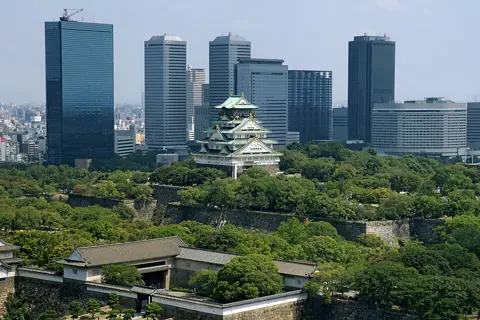
It is tempting to read the nickname as praise for takoyaki and okonomiyaki, but Osaka's own tourism bureau defines it differently. Its page on the Kuroda warehouse gate says that in the Edo period Osaka was called "the nation's kitchen" and was "the centre of Japan's commerce, distribution and finance", with produce from every province gathered, sold and shipped on again.
Food culture grew out of that trade, and the bureau says so too, but the order matters. First came warehouses, rice bills and wholesale markets; the reputation for eating well, summed up in the word kuidaore, sits on top of that commercial base. This guide follows the chain from warehouse to market to table, and shows which parts you can still visit.
What the nickname actually meant
The phrase was about where things went, not what people cooked. The Osaka Convention & Tourism Bureau writes that produce from the provinces "was gathered in Osaka, sold there and then carried back out to the provinces, or exported abroad through Nagasaki". In other words, Osaka worked as a national clearing house.
The key goods were rice and regional products collected as tax. The Osaka Museum of Housing and Living, a city museum, explained in its 2017 exhibition that each domain gathered the rice and specialities it collected as annual tax into its Osaka warehouse, "watched the market and sold them, turning them into cash".
The same text links the warehouses directly to finance. "From this economic activity, futures trading was born in Osaka ahead of the rest of the world," the museum wrote, adding that Osaka's economic growth came from goods from across Japan being concentrated around the warehouses.
The Osaka Dojima Exchange, today's successor exchange, describes the mechanics. Domains sent rice to Osaka and Edo for cashing, the rice was sold to brokers by auction, and "rice bills" issued for exchanging the rice were traded actively; the exchange says "it can be said rice was securitized".
The decoder table below sets out the terms you will meet on plaques, museum captions and market signs. Prices are listed only where a source gives one.
| Name | Local name | What it is | Price range |
|---|---|---|---|
| The nation's kitchen | 天下の台所 | Edo-period name for Osaka as trade and finance hub | Not applicable |
| Domain warehouse residence | 蔵屋敷 | Warehouse and office where a domain stored and sold its rice | Not applicable |
| Dojima Rice Market | 堂島米市場 | Rice exchange, authorised by the shogunate in 1730 | No fee stated (monument only) |
| Spot and futures trading | 正米商 / 帳合米商 | Physical rice trade and book-entry futures trade at Dojima | Not applicable |
| Tenma vegetable market | 天満青物市場 | Vegetable and fruit market on its site from 1653 to 1931 | No fee stated (monument only) |
| Zakoba fish market | 雑喉場 | Fish market moved to Kyomachibori in 1772 | Not published |
| Kuromon Market | 黒門市場 | Shopping street of about 150 shops, begun around 1822 | Not published |
| Kizu market | 木津市場 | Wholesale market; Edo licence 1811, today privately run | Not published; cash only |
| Kuidaore | 食い倒れ | Saying: ruining yourself through spending on food | Not applicable |
Warehouses along the rivers
The domain warehouses were the physical heart of the system. The Museum of Housing and Living counted 81 of them at the end of the 17th century and "more than 110" at their peak in the early 19th century, most of them around Nakanoshima, a location the museum says had good water transport and gave the city a townscape fitting a "city of water"; the tourism bureau adds that they lined the Dojima, Tosabori and Edobori rivers.
Other official sources give different counts, so treat any single number with care. The Osaka Museum of History's 2025 exhibition page puts the figure at "about 120" around the Tenpo era, while the tourism bureau's page says the warehouses increased from the Genroku era (1688–1705) and reached 124 during the Tenpo years (1830–1844), and 135 when the domains were abolished.
That tourism bureau page contains a slip worth knowing about. It dates the abolition of the domains to "Meiji 5 (1916)", but Meiji 5 does not fall in 1916, so the year given there cannot be right. We quote the counts with their sources and leave out that date.
The Museum of History exhibition, which ran from 11 January to 3 March 2025, showed about 500 excavated items. According to its page, digs revealed very different compounds, from full residences with boat docks, storehouses and halls to sites with no dock at all, and the exhibition concluded that the warehouses supported domain finances across Japan while driving Osaka's growth, including the birth of the Dojima market.
Almost nothing of this stands where it stood. One gate you can still see is the former Kuroda (Fukuoka) domain warehouse gate, which the tourism bureau describes as one of the few surviving mid-Edo warehouse remains. It stood near today's Nakanoshima Mitsui Building, was donated to Osaka City in 1933 and now stands in Tennoji Park, south of the Osaka City Museum of Fine Arts.
From Yodoya's street stall to Dojima
The rice market began on a street, not in a trading hall. Osaka City's page on the Dojima site says early Edo rice trading "took place on the street at Kitahama along the Tosabori River", centred on the merchant house of Yodoya, so it was known as Yodoya's rice market.
Yodoya's story shows how rich that trade made one family. The same plaque says the first head, Joan, made his fortune on embankment works on the Yodo River while Hideyoshi held Fushimi Castle, sided with the Tokugawa in the Osaka campaigns and worked on the development of Nakanoshima. Osaka City's plaque text for the Yodoya residence site says the second head, Koan, opened a seafood market at Utsubo, handled the tax rice of western domains and set up a rice market, building an estate about 100 ken square, roughly 33,000 square metres, near Kitahama.
It ended abruptly. In 1705, under the fifth head, Tatsugoro, the family's lavish life was judged to exceed a townsman's status, and together with lawsuits this led to the confiscation of all its property and banishment. The site marker stands at Kitahama 4-chome, Chuo-ku, on the south-west side of Yodoya Bridge, about 50 metres west of Yodoyabashi Station.
Around 1697 the market moved across the river to Dojima, according to both Osaka City and the Osaka Dojima Exchange. Osaka City gives the reasons as promoting development of the new Dojima district and relieving obstruction of traffic on the street.
In 1730 the shogunate formally authorised two kinds of trade at Dojima: 正米商, dealing in physical rice, and 帳合米商, dealing in book-entry futures. Osaka City says the Dojima market, also called Hamakata or the Osaka rice market, "is regarded as the origin of exchanges in Japan and is widely known as a pioneer of organised futures exchanges in the world".
The exchange that carries the name today goes further. The Osaka Dojima Exchange calls Dojima "the world's first futures trading market" and says the Chicago Board of Trade "is said to have been developed based on the Osaka Dojima market". Those are the exchange's claims about its own history; the city's wording is more cautious.
The old market did not survive modern Japan in one piece. The exchange's timeline records that the Meiji government abolished the Dojima Rice Exchange in 1869, permitted its revival in 1871, and saw it abolished again in 1939 under the Rice Distribution Control Law. Rice futures returned in 2011, the company took the name Osaka Dojima Exchange in August 2021, and it opened a rice index market in August 2024.
Three markets that fed the city
Rice was only one of Osaka's great markets. Osaka City's history of the central wholesale market says trade began informally around the temple town of Ishiyama Honganji, grew into the Tenma vegetable market under shogunate protection, and later spread to specialised fish markets.
The Tenma vegetable market moved to its site in 1653, according to Osaka City, and supplied vegetables and fruit with a strong influence on prices across the city. It kept trading until it was absorbed into the new central wholesale market in 1931, and its site marker is in Minami-Tenma Park, Tenma 3-chome, Kita-ku, about 200 metres north-west of Tenmabashi Station.
Fresh fish needed to be closer to the water. The same Osaka City column says the Zakoba fish market moved to Kyomachibori 3-chome in 1772, salted and dried fish traders gathered at Utsubo, and in 1811 a market in Kizu received shogunate permission as a vegetable and fish market.
The modern system replaced all of these. Osaka City says the central wholesale market, which it says was billed as the finest in the Orient, was completed on 28 March 1931 and began trading on 11 November that year, later joined by the Nanko market in 1958 and the Eastern market in 1964.
Kuromon and Kizu today
If you want to shop where Osaka still buys its fish, two markets you can visit today are Kuromon and Kizu. They are very different places, and neither is the Edo-period "nation's kitchen" itself.
Kuromon Market (黒門市場) began later than the Tenma and Zakoba markets. Its own timeline says fish traders began dealing at Nippombashi around 1822, the Osaka prefectural government recognised it as a public market in 1902 under the name Enmyoji market, and it came to be called Kuromon, "black gate", after the black gate of Enmyoji temple.
Kuromon has been rebuilt more than once. The same timeline records that it burned in the Namba fire of 1912 and again in the air raid of 14 March 1945, reopened in November 1946 with 100 barrack-style stalls, and received a steel arcade between 1960 and 1965 and a new arcade for its 180th anniversary in 2002.
The tourism bureau's two Kuromon pages give today's scale. They describe about 150 shops along an arcade about 580 metres long, some 18,000 visitors on a weekday and about 150,000 at the end of the year, and say the market has been called "Osaka's kitchen" and "Osaka's stomach". Hours and closing days vary by shop, and the nearest station is Nippombashi.
The bureau's guide page also describes the market's old daily rhythm. In the Showa era, it says, chefs came first thing in the morning, ordinary shoppers until about 3 p.m. and restaurant professionals after that, and at the year's end families crowded in to have a whole fugu prepared for tecchiri hotpot or to buy ingredients for New Year osechi dishes.
Kuromon is formally a shopping street, and the bureau directs enquiries to the Kuromon Ichiba Shopping Street Promotion Association (黒門市場商店街振興組合); that makes it part of a wider question about Osaka's covered arcades; our guide to counting empty shopping arcades looks at what official counts show.
That local nickname is where many visitors mix things up. "Osaka's kitchen" is a name for one market; "the nation's kitchen" is a name for the whole Edo-period city. The bureau also notes that Kuromon has many fugu and fresh-fish shops because restaurant chefs have long bought there, and that eat-in counters now serve sushi and seafood bowls to visitors.
The Osaka Kizu Wholesale Market (大阪木津卸売市場) is a working wholesale market with public hours. Its FAQ says shops start trading around 6:00 and most close by about 11:00, with 8:30 to 10:30 recommended for shoppers, and that it is closed on Sundays, national holidays and some Wednesdays, so check its calendar.
Kizu is friendlier to individual buyers than the word "wholesale" suggests. The FAQ says you do not have to buy by the case, that shops will sell one fish or one daikon, and that most will scale or fillet fish for you. It also says payment is in principle cash only and there is no bank or ATM inside the market.
The market also makes room for non-professionals. Its asaichi, held on the second and last Saturday of each month from 9:00 to 12:00, is aimed at the general public, with lotteries, auction experiences and tastings, according to the FAQ. The same page says aisles are wide enough for wheelchairs and pushchairs, there are three multipurpose toilets, and there is a Kuroneko Yamato office just north of the market.
The market's operator page names Gourmet Kineya Co., Ltd. and its Osaka Kizu Market Company, which took over running the local wholesale market in 1999 and opened the first phase of the new market building in April 2008.
The comparison below helps you decide which traces of the nation's kitchen to fit into a day. It lists only what the official sources state.
| Place | What you see | When | Cost | Nearest access given |
|---|---|---|---|---|
| Dojima Rice Market monument | A monument on the site | Not stated | No fee stated | NE end of Nakanoshima Garden Bridge; Dojima bus stop |
| Yodoya residence site | Site marker | Not stated | No fee stated | About 50 m west of Yodoyabashi Station |
| Kuroda warehouse gate | Relocated Edo-period gate | 7:00–22:00 daily | Free | 5 min walk from Tennoji Station |
| Tenma vegetable market site | Marker in Minami-Tenma Park | Not stated | No fee stated | About 200 m NW of Tenmabashi Station |
| Kuromon Market | About 150 shops, eat-in counters | Varies by shop | Not published | Nippombashi Station |
| Osaka Kizu Wholesale Market | Fish and produce stalls | About 6:00–11:00; asaichi 9:00–12:00 on set Saturdays | Cash in principle | 3 min from Daikokucho Station exit 1 |
From trade to kuidaore
The tourism bureau does connect trade and food, and it does so explicitly. Its kuidaore page quotes the saying "Kyoto ruins itself on clothes, Osaka ruins itself on food" and explains it as a teasing reference to Osaka's love of spending on eating, while praising a habit of using good ingredients without waste.
The same page gives the chain of causes in the bureau's own words. Osaka Bay was so rich in fish that it was called 魚庭, "fish garden", read naniwa; in the Edo period, ingredients from all over the country gathered in a city "praised as the nation's kitchen"; Sakai made sharp knives; wealthy merchants used restaurants for business talks; and nearby Ikeda, Itami and Nada supplied good sake.
Kombu shows the trade route on the plate. The bureau's dashi page says Hokkaido kombu came by Kitamae ships along the Sea of Japan and through the Inland Sea to "the nation's kitchen", Osaka and Sakai, that Osaka chose ma-kombu while Kyoto used rishiri kombu, and that Sakai had about 150 kombu processors at the peak in the Taisho and early Showa periods.
The bureau goes as far as saying "Osaka's consumption of kombu is the highest in Japan". We report that as the bureau's statement; the page does not cite a statistic.
The bureau's dashi page also says large volumes of sake from the three provinces of Settsu, Kawachi and Izumi were shipped to Edo and prized there as "kudari-zake", sake sent down from the Kamigata region.
What this guide does not cover
No official source read for this guide says who first used the phrase "the nation's kitchen" or in which year, so this guide gives no origin date for the words themselves. It also does not repeat the tourism bureau's "Meiji 5 (1916)" date for the abolition of the domains, which does not add up.
Current opening hours for the Dojima, Yodoya and Tenma markers are not published on the Osaka City pages read, and Kuromon's hours vary by shop. The Osaka City pages were read through a fetch service because direct downloads were blocked, and the city's historical compilation office page could not be opened because of a certificate error.
This guide also does not cover the Osaka Central Wholesale Market's visitor rules or the Museum of History's current exhibitions, both of which change, and it makes no claim that Osaka has more restaurants than any other city, because no source read here says so.