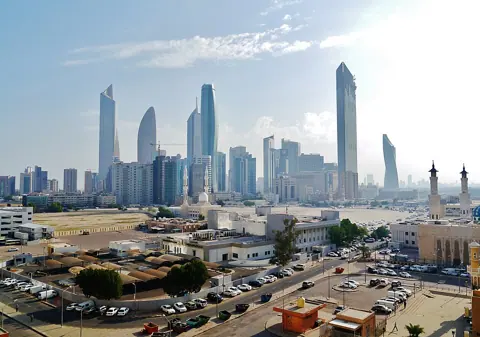
The Grand Mosque is a working state mosque before it is a sight. The ministry's About page says it was built on the initiative of the late Amir Sheikh Jaber Al-Ahmad Al-Jaber Al-Sabah because the older Grand Bazaar Mosque (Masjid Al-Souq Al-Kabir) became overcrowded when officials attended prayers on state occasions. That origin explains the visitor model: there is no ticket window or open sightseeing hour, but a visits section at the Ministry of Awqaf's Grand Mosque that schedules guided tours around the building's religious use.
Can non-Muslim visitors go inside Kuwait's Grand Mosque?
Yes, on a guided tour. The individual tour request form asks for your name, gender, country, phone, email, preferred date and start time, language and group size. It has no field for religion, and the country list covers the whole world.
The ministry's own records show who uses it. The June 2026 activity report documents tours for visitors from the Philippines, India, China, Germany, Sweden, Argentina, Indonesia, Pakistan and Nigeria, among others, covering the mosque's features and architecture and an Arabic calligraphy exhibition. The report for July and August 2024 records 13 tour dates over those two months, with groups from Korea, Japan, Slovakia, Britain and elsewhere. Diplomats take the same route: the mosque's news page reports that the British Ambassador was received on 14 June 2026, in coordination with the Ministry of Foreign Affairs, for a tour of the building and the calligraphy exhibition.
Walking in unannounced at an arbitrary hour is a different matter. The ministry's pages describe booked tours, not general opening hours for sightseeing, so plan on a booking.
How do you book a Grand Mosque tour?
The visits section's direct line is +965 22342367 and its email is zeyarat.fm@awqaf.gov.kw, both given on the booking page. Separate forms exist for schools and clubs and for government and non-government organisations. The form says a tour may take 45 to 90 minutes, so allow up to two hours on site. Neither the booking page nor the form mentions a fee; if you are asked to pay, check with the visits section.
Timing around prayers and Fridays
Regular tours are not offered on Friday, the day of the congregational midday prayer, or on Saturday. Within Sunday to Thursday, the form fixes the start times but does not say how tours fit around the daily prayers, whose times shift through the year. The afternoon slots in particular can fall close to a prayer time depending on the season, so if your time is tight, ask the visits section whether your slot will pause for a prayer.
During Ramadan, the UK Foreign Office advises visitors not to eat, drink or smoke in public in daytime and to check the opening hours of shops and restaurants. Confirm directly that tours are running on your date in that month.
What should you wear, and can you take photos?
This is the part we could not confirm from the mosque itself. The booking page and form read for this guide do not state a dress code for visitors, and do not say whether robes or head coverings are lent to women. Ask when the visits section confirms your booking, and dress on the assumption that nothing will be provided.
The government-wide guidance is clear enough to plan around. For US citizens, as of September 2026, the State Department's Kuwait page notes that "many public places have dress codes for women requiring shoulders and knees to be covered". The UK Foreign Office asks visitors to dress and behave modestly, especially downtown and in conservative areas, and not to show piercings or tattoos that could be seen as extreme or offensive. For a mosque visit, that points to long sleeves and long trousers or skirts for everyone, plus a scarf women can put on if asked.
On photography, the form mentions only professional filming, which has its own number, +965 22980800. Ask your guide before photographing inside, and do not photograph worshippers: both governments say filming or photographing people without their consent is prohibited. Outside, remember where you are standing: the same guidance says photographing government buildings is illegal in Kuwait, and the mosque faces the Seif Palace complex.
Where is it, and what are you looking at?
The mosque stands on Arabian Gulf Street, across from Al-Seif Palace, according to the inventory entry by IRCICA, the Organisation of Islamic Cooperation's research centre for Islamic history, art and culture. The mosque's own map page links to a Google Maps pin and lists the ministry hotline, 1810111.
IRCICA's entry gives the numbers behind what a guide will show you. Construction ran from 1979 to 1986. The site covers 45,000 square metres, of which the building takes 20,000, with a 6,500-square-metre courtyard on the eastern side. The main prayer hall is 72 metres on each side under a dome 26 metres across and 43 metres high. The minaret at the northwest corner is described as Andalusian in style, and the design draws on local and wider Gulf building traditions, with natural stone outside and marble and stone inside. The official pages read for this guide did not give a worshipper capacity, so we have left that figure out.
If you are in Kuwait City on a Friday or Saturday only, a standard tour is not available; email the visits section early in the week to ask about other times, and use the weekday afternoon slots if you arrive on a Thursday.