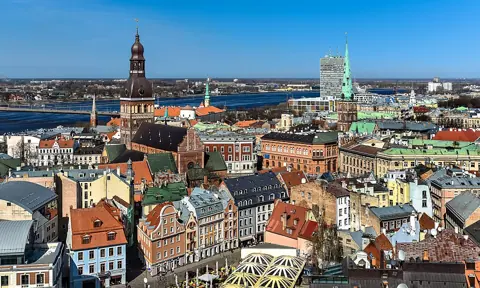
Riga has more Art Nouveau architecture than any other European city, and that is not a marketing line — it is the specific claim UNESCO makes in the city's World Heritage listing. Reading why it exists here in this concentration changes how you look at the buildings.
Why the numbers are what they are
According to UNESCO's listing for the Historic Centre of Riga, the city "became the European city with the highest concentration of Art Nouveau architecture," with around 50 Art Nouveau buildings of high architectural value inside the medieval part of the city and more than 300 across the rest of the historic centre. UNESCO describes this concentration and quality as "unparalleled anywhere in the world."
The reason is timing. Riga went through a major building boom in the late 19th and early 20th centuries, driven by rapid industrial and commercial growth as a Baltic port city within the Russian Empire. UNESCO's account notes that the city's 19th-century expansion began with wooden buildings in a neoclassical style, before permanent stone construction became more widely permitted and the newly fashionable Jugendstil (the German-language term for Art Nouveau, and the one most commonly used locally) style took over as the dominant idiom for new construction. Riga was, in effect, building at scale during exactly the years Art Nouveau was the style architects reached for.
What you are actually looking at
Art Nouveau architecture is often described loosely as "ornate" or "decorative," which tells you almost nothing about how to read an individual building. A few specific things distinguish it and are worth looking for directly on a facade:
- Asymmetry as a design principle, not a flaw. Unlike the symmetrical classical facades common in earlier Riga buildings, Art Nouveau facades frequently place windows, balconies and decorative elements unevenly across the front of a building, following the internal layout rather than an external symmetrical ideal.
- Organic and natural forms worked into stone and plaster — stylised flowers, vines, flowing lines and occasionally human or mythological faces, cast or carved directly into the facade rather than applied as separate ornament.
- Applied colour and material contrast, including tilework, decorative ironwork on balconies and stairwells, and facades that mix plaster colours or textures rather than presenting a single uniform surface.
- A vertical emphasis, with elongated windows, narrow balconies and decorative elements that draw the eye upward along the building rather than across it.
Where the concentration is highest
Alberta iela, a short street just north of the Old Town in the Quiet Centre district, holds some of the most elaborate examples, several of them associated with Mikhail Eisenstein, whose facades combine sculptural ornament, dramatic colour and stylised faces in a way that is more theatrical than the average Jugendstil building elsewhere in the city. Nearby streets in the same district — Elizabetes iela and Strēlnieku iela among them — extend the same building boom outward with a wider range of styles, from the highly ornamented to the more restrained National Romantic examples.
This concentration in one district, rather than scattered evenly across the whole city, is itself informative: it reflects where the city expanded and who was building during the specific years the style was dominant, largely a prosperous residential and professional quarter being developed just outside the old walled town.
Reading a street rather than a single building
Rather than treating Art Nouveau buildings as individual landmarks to photograph, reading a whole street at once shows the pattern more clearly than any single facade can: the repetition of vertical window bays, the variation in applied ornament from building to building despite a shared underlying style, and the occasional plainer, later infill building that shows where the boom eventually cooled or where later, simpler tastes took over. The contrast between buildings tells you as much about the district's construction timeline as any single ornate facade does on its own.
The economic and social context behind the boom
Riga's late-19th and early-20th-century building boom coincided with the city's rise as one of the Russian Empire's most significant industrial and trading ports, drawing capital, professionals and a growing merchant and industrial class who wanted housing that reflected their new wealth and status. This is a key reason the Art Nouveau district reads as a prosperous residential quarter rather than civic or religious architecture — most of the buildings were originally built as apartment houses for this newly wealthy urban class, commissioned by property developers and individual owners competing to build the most fashionable and eye-catching facade on their street, rather than a single coordinated civic building programme.
What happened to the district afterward
Like much of Riga, the Art Nouveau district went through Soviet-era neglect — the same decades of deferred maintenance visible around the Central Market's zeppelin-hangar pavilions elsewhere in the city — when private property ownership was abolished and many grand apartment buildings were subdivided into communal housing without the resources for facade maintenance, leading to decades of visible decay in some buildings' stonework and plaster despite the underlying structures surviving intact. Restoration efforts accelerated after Latvia's independence in 1991 and Riga's UNESCO listing in 1997, with many of the district's most significant facades receiving conservation work in the years since — meaning the vivid, well-maintained appearance of buildings like those on Alberta iela today reflects relatively recent restoration investment on top of building fabric that is well over a century old.
What this guide does not cover
This guide does not cover the interior museum experience at any specific Art Nouveau building open to visitors, ticket prices, or opening hours — those change independently of the architectural facts above and are worth checking directly with each site before you go.