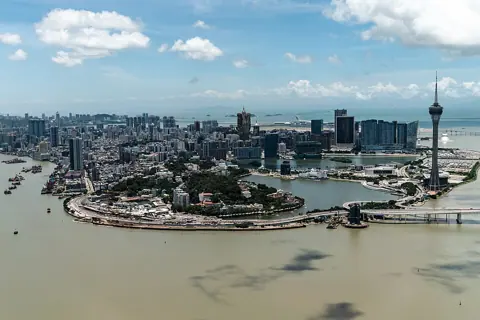
A useful rule for reading any market: the chains you can count are the ones owned by listed companies elsewhere. Macau makes that unusually stark.
Which group runs the most Macau shops?
DFI Retail Group, and by a wide margin. Its 2025 annual report breaks Macau out as its own row, which most Hong Kong parents do not.
| DFI division | Macau brand | Outlets, 31 Dec 2025 |
|---|---|---|
| Health and Beauty | Mannings | 20 |
| Convenience | 7-Eleven | 49 |
| Food | San Miu | 21 |
| Home Furnishings | IKEA | 1 |
| Restaurants | Maxim's brands | 21 |
| Total | — | 112 |
The total fell by six over the year, from 118 at the end of 2024. For scale, DFI's Hong Kong total was 2,464 outlets and its group total 7,580 across 12 markets.
Note what is absent from that table. Wellcome, DFI's Hong Kong food banner, does not operate in Macau — the group's own market map assigns Wellcome to Hong Kong and San Miu to Macau.
Which parents refuse to break Macau out?
A.S. Watson and its parent CK Hutchison, which is why Watsons and ParknShop store counts for Macau do not exist in public.
CK Hutchison's 2025 annual report charts Health and Beauty stores by market with "Hong Kong & Macao" as a single fused entry, within an Asian total of 4,478 stores. Its Other Retail segment — ParknShop, Fortress, Watson's Wine and manufacturing — reports "348 retail stores in three markets" without naming the markets.
A.S. Watson's own brand pages do the same thing at a finer grain: ParknShop is described as operating "around 260 outlets in Hong Kong and Macau", combined, and Watsons is described only at the global level of 8,000 stores in 16 markets.
| Chain | Parent | Macau count published? |
|---|---|---|
| Mannings | DFI Retail Group, Hong Kong | Yes — 20 |
| 7-Eleven | DFI Retail Group, Hong Kong | Yes — 49 |
| San Miu | DFI Retail Group, Hong Kong | Yes — 21 |
| Circle K | Alimentation Couche-Tard, Canada | Yes — 33 |
| Watsons | A.S. Watson, Hong Kong | No |
| ParknShop | A.S. Watson, Hong Kong | No — combined with Hong Kong |
| Fortress | A.S. Watson, Hong Kong | Macau not mentioned |
Is Circle K a Hong Kong chain?
No, and this is the most commonly mistaken ownership in Macau retail. Circle K Hong Kong's own site records that at the end of 2020 Alimentation Couche-Tard acquired the franchise business of Circle K Hong Kong, and that the operation would "become an important base for ACT's expansion into Asia."
Couche-Tard's corporate site publishes 33 Macau stores and 387 Hong Kong stores as of 19 July 2026, listing Macau among 12 territories in its international footprint operated mostly under licensing agreements. That makes a Canadian company the only one of these parents publishing a clean Macau-only number.
What about the restaurant chains?
Thinner than the retail side, and one major Hong Kong name is absent entirely. Fairwood Holdings' results for the year ended 31 March 2026 report 150 Fairwood outlets, six specialty restaurants in Hong Kong under three brands, and 28 mainland stores including two new ones in Zhuhai — and the word Macau does not appear anywhere in the 29-page announcement.
Tsui Wah does operate in Macau, but as an equity-accounted joint venture rather than a wholly owned network. Its 2026 annual report states that the group's footprint spans Hong Kong, the mainland, Macau and Singapore, names the Tsui Wah at Galaxy Macau as having closed for renovation during the year, and records a newly opened Shanghai-style outlet at The Venetian Macao — but publishes no Macau restaurant count.
Café de Coral's official site states "500 Outlets in Hong Kong & Chinese Mainland" and does not mention Macau. Maxim's, half-owned by DFI, lists Macau on its footprint map, and DFI's 21 Macau restaurant outlets are the only number attached to it — though which Maxim's brands those 21 carry is not disclosed by either company.
What is genuinely Macau's own?
Royal Supermarket, verifiably. Its official site states it was founded in 1997 and describes itself as the largest local supermarket chain in Macau, with the credo "born in Macau, grown in Macau, serving Macau." Its own branch page lists 32 branches, including Taipa, Coloane and the Qingmao checkpoint.
That is a short list, and the shortness is the finding rather than a gap in the research.
How big is the market they are all competing in?
Smaller than the visitor numbers suggest, and losing money. The Statistics and Census Service recorded 4,930 restaurants and similar establishments in 2024, down 49 year on year, employing 37,809 people on receipts of MOP 15,046 million — against expenditure of MOP 15,101 million, a gross loss of MOP 40 million.
| Segment | Establishments, 2024 |
|---|---|
| Restaurants and eating and drinking places | 2,470 |
| Takeaway shops | 2,380 |
| Cooked-food stalls in municipal markets | 80 |
| Total | 4,930 |
Receipts split by cuisine as Chinese restaurants 34.9 per cent, local-style cafés, congee and noodle shops 19.5 per cent, takeaway shops 14.9 per cent, western restaurants 8.6 per cent, fast food 6.4 per cent, Japanese and Korean 5.2 per cent, and others 10.5 per cent.
On the retail side, 2024 brought 7,666 retail establishments within a wholesale and retail total of 16,923, on retail receipts of MOP 72,426 million — down 17.5 per cent year on year.
What this guide does not cover
Store counts are missing wherever the company does not publish one, and they are not estimated here. That covers Watsons, ParknShop and Fortress in Macau, Café de Coral, Tsui Wah, Saint Honore and Arome Bakery.
Macau's own snack chains are the largest gap. Neither Koi Kei Bakery nor Choi Heong Yuen Bakery has a readable official site — the first returns a security challenge to every request, the second does not resolve — so nothing is stated about their origin, founding or store counts, despite both being household names in the territory.
No official statistic separates chain from independent establishments. The restaurant and retail surveys break down by activity and cuisine but never by ownership structure, and the statistics service publishes no chain-store or franchise series at all. Any chain-versus-independent share you see quoted for Macau is someone's own calculation, not an official figure.
One caution about a related statistic: Macau Pass publishes no merchant directory, so its acceptance network cannot be used as a proxy for which chains are locally embedded, as it can in some other markets.