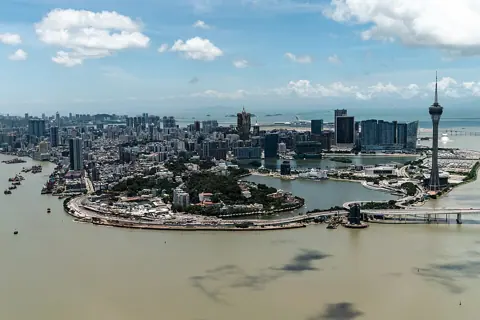
Macao's (Macau's) currency law is unusually blunt on the point most visitors get backwards. Article 2 of Law No. 10/2023, the Regime jurídico da emissão monetária, states that the currency with legal tender in the Macao Special Administrative Region is the pataca. Article 8 gives money issued under that law poder liberatório — discharging power — and says it may not be refused as a means of payment at its face value; Article 16 makes refusal an administrative infraction punished by a fine of MOP 1,000 to MOP 10,000 for an individual and MOP 5,000 to MOP 100,000 for a company (Lei n.º 10/2023, Boletim Oficial n.º 25/2023 of 19 June 2023, checked 16 September 2026). The Hong Kong dollar appears nowhere in that framework. It is accepted in Macao by habit, and refusing it breaks no law.
Which currency is legal tender in Macao
The pataca, and only the pataca, is legal tender in Macao. The constitutional basis sits in Article 108 of the Basic Law, which provides that the Macao pataca, as the currency with legal tender in the Macao Special Administrative Region, continues to circulate, that the authority to issue Macao currency belongs to the MSAR Government, and that the issue must be covered by a reserve fund of not less than 100 per cent (Lei Básica da RAEM, Portuguese official text, checked 16 September 2026). Law No. 10/2023 develops that article into the working rules.
Those working rules have three edges worth knowing before you hand over cash. Nobody can be made to accept more than 50 coins in a single payment, whatever their face value; anyone may refuse a stained or damaged note; and the duty to accept notes and coins does not apply to internet transactions or to sales made without human intervention, such as a vending machine (Law No. 10/2023, Article 8).
The table below sets out what each way of paying actually obliges the other side to do.
| Means of payment | Legal position in Macao | What it means at the till |
|---|---|---|
| Patacas in cash | Legal tender under Law No. 10/2023, arts. 2 and 8 | Cannot be refused at face value; no more than 50 coins per payment |
| Hong Kong dollars in cash | Not legal tender; no Macao statute mentions it | Accepted by choice, at whatever rate the shop applies |
| Card or payment terminal | Must be settled in patacas under Decree-Law No. 16/95/M, art. 2 | Charged in MOP, with no extra fee permitted for that |
Two silences matter here. Neither the Basic Law nor the currency law confers any status on the Hong Kong dollar in Macao, and no Macao authority publishes a rate that a shop is obliged to use when it chooses to accept one — because no such obligation exists.
How the peg actually works
Macao runs a currency board, not an exchange-rate policy that someone adjusts. The Monetary Authority of Macao (AMCM) explains the mechanism directly: the pataca issue is 100 per cent backed by foreign exchange reserves, and the note-issuing banks must pay AMCM an equivalent amount of Hong Kong dollars at a fixed rate of HKD 1 to MOP 1.03 in return for an interest-free certificate of indebtedness, held as the legal cover for the notes they put into circulation (AMCM, The Pataca, checked 16 September 2026). The two issuing banks are Bank of China, Limited and Banco Nacional Ultramarino, S.A. (AMCM, Currency in Circulation in Macao, page updated 1 February 2024, checked 16 September 2026).
So the Hong Kong dollar is not merely a convenient neighbour's currency in Macao. It is the reserve asset sitting behind every pataca note in your wallet, which is why AMCM describes the pataca as fully convertible into its reserve money and why the pataca is indirectly pegged to the US dollar at an exchange rate of about USD 1 to MOP 8. AMCM's declared policy objective is monetary and exchange stability, defined by the pataca's link to the Hong Kong dollar and its full convertibility (AMCM, Monetary Policy, checked 16 September 2026).
What one-to-one actually costs you
Paying in Hong Kong dollars at parity hands a Macao merchant roughly 3 per cent of the bill. The arithmetic is short. A price tag reads MOP 100. You pay HKD 100 and the till treats it as settled. At AMCM's interbank middle rate on 16 September 2026, HKD 100 was worth MOP 103.00; at the rate the tourism office publishes, MOP 103.20. Either way you handed over about MOP 3 more than the price. That calculation is ours from the published rates rather than a figure any authority issues, and the real gap depends on the rate the individual shop applies. We also found no Macao government page that describes the one-to-one habit at all, so treat it as a counter convention to check rather than a rule to expect.
Three per cent sounds negligible until it compounds across a trip. On a MOP 3,000 hotel bill settled in Hong Kong dollars at parity, the same arithmetic gives up roughly MOP 90. The second, quieter cost is change: pay with an HKD note, receive MOP coins and small notes, and you have converted spendable money into a currency you can only use on this side of the border.
Prices, cards and the pataca rule
Macao law also tells merchants what currency to print on the price tag. Article 1 of Decree-Law No. 16/95/M of 3 April 1995 requires every natural or legal person offering goods and services for sale in local commerce to indicate the price clearly in patacas, while permitting them to show it cumulatively in one or more other currencies. The same article forbids using any device in displaying or advertising those prices that induces the public to pay in a currency other than the local one (Decreto-Lei n.º 16/95/M, Boletim Oficial n.º 14/1995, as adapted by Law No. 27/2024, checked 16 September 2026).
Article 2 of the same decree-law is the one that quietly protects you. All payments for goods and services made in Macao using credit or debit cards issued locally or abroad, electronic payment terminals at points of sale and other similar instruments must be made in patacas, and it is not permitted to invoke that obligation to add any charge to the agreed price or the transaction value. Breaches carry fines of MOP 500 to MOP 5,000 for an individual and MOP 5,000 to MOP 100,000 for a company (Article 7). The first paragraph of Article 2, which used to deal with refusal of the local currency, was repealed when Law No. 10/2023 took over that ground.
The practical reading is simple. Whatever the shop says at the counter, the number on the tag is a pataca number, and paying by card converts at your bank's rate rather than the shop's. Government offices and public-service concessionaires cannot use another currency at all: Article 3 bars Macao's public administration, public enterprises and concessionaires from contracting, settling or receiving in anything but the local currency.
Where to change money in Macao
Money changing in Macao is a licensed financial activity, not an informal trade. AMCM supervises "money changers" regulated by Decree-Law No. 38/97/M and, separately, "local institutions with authorization to operate foreign exchange counter in casinos" regulated by Decree-Law No. 39/97/M. On the AMCM page listing them, updated 18 August 2026, there were 10 licensed money changers and 6 institutions authorised to run casino foreign-exchange counters (AMCM, Other Licensed Financial Institutions, checked 16 September 2026).
Banks do the same job, and the tourism office notes that exchange services are available at airports, docks and most hotels, with money changers "almost everywhere" (MGTO, Practical Info, checked 16 September 2026). Article 109 of the Basic Law states that no exchange-control policy applies in Macao and that the pataca is freely convertible, so nothing restricts how much you change — the only variable is the counter's spread.
Compare the counter's quote against AMCM's published interbank middle rate before you commit, and ask for the all-in figure rather than the headline rate. A rate with a commission bolted on is a different price from the same rate without one, and only the amount of patacas you walk away with tells you which is better.
Patacas you cannot spend afterwards
Pataca notes carry discharging power in Macao and nowhere else. Article 8 of Law No. 10/2023 confines that power to the MSAR, and the pataca's free convertibility under Article 109 of the Basic Law is a statement about exchanging it, not about anyone abroad having to take it. Outside Macao it is a currency you have to change rather than spend, which makes converting it back a problem to solve before you leave rather than after.
Coins are the worst offender. Macao issues circulation coins of MOP 0.10, MOP 0.20, MOP 0.50, MOP 1, MOP 2, MOP 5 and MOP 10 (AMCM, Circulation coins, checked 16 September 2026), and a coin is not something you can count on an exchange counter taking back. Banknotes come in MOP 10, 20, 50, 100, 500 and 1,000 (AMCM, Banknotes in circulation, checked 16 September 2026).
Before you cross back out of Macao
Spend down your patacas on the last day rather than changing them, starting with coins: convenience stores, bus fares and food counters absorb small denominations that an exchange desk will not. Keep card payments for anything large, since the law puts those in patacas at no extra charge anyway, and keep only enough cash for places that do not take cards.
If you are carrying serious money, the declaration rule is an obligation rather than an option. Under Law No. 6/2017, in force since 1 November 2017, a person arriving in Macao with cash or bearer negotiable instruments — travellers' cheques, cheques, bills of exchange, payment orders, promissory notes — totalling MOP 120,000 or more must declare to a customs officer, complete a declaration form and use the red channel. Departing passengers must answer truthfully if asked, on pain of a fine of MOP 1,000 to MOP 500,000, and transit passengers making a brief stop are not required to declare (澳門海關, 監管攜帶現金和無記名可轉讓票據出入境, page last revised 2 February 2026, checked 16 September 2026).
This guide covers the legal position of the currency and the cost of the parity habit. It does not cover casino chips, gaming or anything you might do with either; it does not cover the rules on the Hong Kong or Zhuhai side of the border, which are set by different authorities; and it does not quote a rate for any particular bank, hotel or exchange counter, because those are set commercially and change daily. For the reference rate, AMCM's interbank middle rates page is the number to check against.