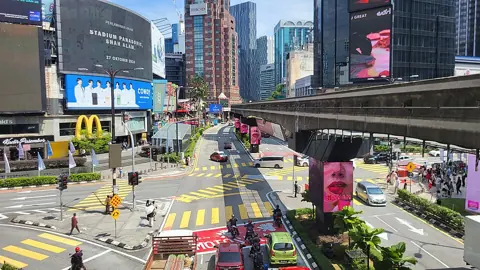
The usual assumption about Malaysian signage runs backwards. The languages stacked on a Kuala Lumpur signboard are not there because the law asks for variety; they are there because the law asks for one language and permits the rest. Article 152 of the Federal Constitution sets Malay as the national language, the National Language Acts 1963/67 set Rumi as its script while leaving Jawi open, and a Kuala Lumpur advertisement licence then requires Malay to be visually dominant. Everything else on the board is a commercial decision inside that frame. The practical warning is narrow: English will carry you through hotels, malls and ride-hailing, but no rule puts it on a sign for you.
What Article 152 actually says
Article 152 of Malaysia's Federal Constitution is short, and its first clause does two things at once. It states that "the national language shall be the Malay language and shall be in such script as Parliament may by law provide", then attaches a proviso: no person shall be prohibited or prevented from using — otherwise than for official purposes — or from teaching or learning any other language, and nothing in the clause prejudices the right of the Federal or a State Government to preserve and sustain the use and study of the language of any other community (Federal Constitution, Reprint as at 15 October 2020, Article 152, checked 16 September 2026).
The hinge is the phrase "official purposes", which Clause (6) defines as any purpose of the Government, whether Federal or State, including any purpose of a public authority. That is a boundary rather than a blanket: inside it Malay governs, and outside it the proviso protects the use of any other language.
Clauses (2) to (5) deal with English, and they are drafted as temporary permissions rather than as a status. Each begins "for a period of ten years after Merdeka Day, and thereafter until Parliament otherwise provides", covering English in Parliament and the State Legislative Assemblies, in the authoritative texts of Bills and Acts, and in court proceedings. Parliament did then provide. The National Language Acts 1963/67 state in section 2 that the national language shall be used for official purposes, in section 4 that the Yang di-Pertuan Agong may permit continued use of English for such official purposes as may be deemed fit, and in section 6 that laws are texted in both languages with the Malay text authoritative unless otherwise prescribed (Laws of Malaysia, Act 32, National Language Acts 1963/67, reprint incorporating amendments to 1 January 2006, checked 16 September 2026).
Rumi, Jawi and the other two
The national language has two scripts in Malaysian law, and only one of them is the alphabet you are reading now. Section 9 of the National Language Acts 1963/67 states that "the script of the national language shall be the Rumi script: provided that this shall not prohibit the use of the Malay script, more commonly known as the Jawi script, of the national language". Rumi is the Latin alphabet; Jawi is an Arabic-derived script for the same language. A Jawi line and a Rumi line on the same board can be the identical Malay words written twice.
That accounts for two of the four scripts a visitor meets. Chinese characters and Tamil script are not scripts of the national language at all: they appear under the Article 152 proviso, as other languages used for purposes that are not official purposes, on private commercial signage rather than on anything the state issues.
So the four scripts have two different legal reasons for being there: Rumi and Jawi are the national language in its permitted forms, while Chinese and Tamil are protected uses of other languages. Once you know which is which, a crowded board reads as a stack with a fixed bottom layer.
What the Kuala Lumpur rules require
Kuala Lumpur City Hall attaches a language condition to every advertisement licence it issues, and it is the reason Malay sits at the top of so many shopfronts. DBKL's licensing department divides these licences into three categories — premises signboards, temporary advertising such as buntings and banners, and outdoor displays such as billboards and LED — and states as the first basic condition for all of them that the visual must give priority to the use of Bahasa Melayu, whether in word size, colour or position (DBKL, Jabatan Pelesenan Dan Pembangunan Perniagaan, checked 16 September 2026). The same page requires, among the supporting documents, one colour visual of the signboard already verified by Dewan Bahasa dan Pustaka.
That verification is a separate step with its own standard. DBP's published conditions state that where another language is used, the wording must be translated into the national language or made bilingual with the national language given priority in letter size (larger than the other language), in colour (bright, clear, easy to read) and in position (placed above the other language) (DBP, Syarat Pengesahan Bahasa Melayu Dalam Iklan, dated 23 June 2022, checked 16 September 2026). The same document describes DBP's role as verifying language only, with the local authority approving the licence.
The national planning guideline behind those conditions puts a number on "priority". PLANMalaysia's Garis Panduan Perancangan Papan Tanda Premis Perniagaan states that Bahasa Malaysia must be used in every primary brand name on a signboard, alone or with other languages, except for special business brands such as TOSHIBA or SAMSUNG; that the letter height of any other language must not exceed three quarters of the Bahasa Malaysia lettering; that both must be correct in wording, word order, spelling and grammar; and that DBP verification must be obtained first (PLANMalaysia, Garis Panduan Perancangan Papan Tanda Premis Perniagaan, 2018, checked 16 September 2026).
We could not read DBKL's own detailed advertisement guideline PDFs: the files indexed at the older eLesen addresses now return the rebuilt portal's page rather than a document. This section therefore rests on DBKL's departmental page, DBP's conditions and the national guideline DBP cites. DBKL's Garis Panduan library (checked 16 September 2026) lists its current downloads.
Who the census counts
Malaysia's census counts people by ethnic group, which is not the same as counting languages. The Department of Statistics Malaysia publishes population tables in which census-year values are adjusted census data and intercensal years are estimated by the cohort-component method (DOSM, Population Table: States, checked 16 September 2026). The table below sets the national composition at the 2020 census against the Federal Territory of Kuala Lumpur in the same year.
| Group | Malaysia, 2020 | Kuala Lumpur, 2020 |
|---|---|---|
| Malay | 16.91 million (52.1%) | 824,600 (41.6%) |
| Other Bumiputera | 3.74 million (11.5%) | 21,700 (1.1%) |
| Chinese | 6.89 million (21.2%) | 737,200 (37.2%) |
| Indian | 2.00 million (6.2%) | 178,100 (9.0%) |
| Non-citizens | 2.69 million (8.3%) | 208,400 (10.5%) |
Figures from DOSM's Population Table: Malaysia and Population Table: States, 2020 values, both checked 16 September 2026. Totals are 32.45 million for Malaysia and 1.98 million for Kuala Lumpur; "other citizens" is omitted, which is why the columns do not sum to 100 per cent, and the percentages are calculated from the published values.
What the census does not give you is a language table. We found no DOSM census output for language spoken at home, so there is no official figure for how many people in Kuala Lumpur use Malay, English, a Chinese language or Tamil day to day. Anyone quoting you one is quoting something other than the census.
The education system is where the law attaches languages to schools rather than to speakers. The Education Act 1996 makes the national language the main medium of instruction in all institutions in the National Education System except a national-type school, which it defines as a government or government-aided primary school using Chinese or Tamil as the main medium, with the national and English languages as compulsory subjects (Laws of Malaysia, Act 550, Education Act 1996, sections 17 and 2, checked 16 September 2026).
Malay words on a signboard
A short list of Malay words does more for a visitor in Kuala Lumpur than any amount of grammar, because the same handful organise addresses, doorways and notices. The table below covers the ones you meet on day one.
| Malay | Meaning | Where it appears |
|---|---|---|
| Jalan (Jln) | road, street | the first word of most KL addresses |
| Lorong, Persiaran | lane, avenue | smaller and larger roads |
| Masuk, Keluar | entrance, exit | doors, car parks, highway junctions |
| Dilarang | prohibited | notices, as in dilarang merokok, no smoking |
| Awas | caution | warning and hazard signs |
| Tandas | toilet | with lelaki for men and wanita for women |
Two more are worth memorising because they change what you pay: percuma is free of charge and harga is price. Buka and tutup are open and closed, and they are what a shutter notice says rather than any English equivalent.
Menus follow the same pattern: a small set of nouns and a smaller set of cooking words, recombined. The six below get you through most of a stall board.
| Malay | Meaning | Note |
|---|---|---|
| Nasi | cooked rice | as in nasi lemak, nasi goreng |
| Mi, mee | noodles | as in mi goreng |
| Ayam, ikan | chicken, fish | the two most common proteins listed |
| Sayur, telur | vegetable, egg | usually side or add-on lines |
| Goreng, bakar | fried, grilled | the cooking method follows the noun |
| Pedas, manis | spicy, sweet | often written as a warning or a choice |
To check a word rather than guess it, Dewan Bahasa dan Pustaka runs the Pusat Rujukan Persuratan Melayu portal, which searches its dictionaries and terminology databases (PRPM, Dewan Bahasa dan Pustaka, checked 16 September 2026). It is a language reference, not a phrasebook: expect definitions, not pronunciation.
Where English runs out
English has no protected place on a Malaysian signboard, and knowing that changes what you expect from one. The permissions for English in Clauses (2) to (5) of Article 152 concern Parliament, legislation and the courts, and the National Language Acts 1963/67 route continued official use through a permission of the Yang di-Pertuan Agong rather than through any status of its own. None of that reaches a shopfront: where English appears on a Kuala Lumpur signboard, it is an "other language" under the proviso, subject to the same three-quarter letter-height limit as any other.
English is widely used in Kuala Lumpur's transport, hotel and retail signage, and a visitor who speaks only English is not stranded. The gap opens at the edges: a government counter, a form, a handwritten notice on a shutter, a stall board, a street nameplate. There, the Malay word is the only word.
One boundary is geographic. Advertisement licences are issued by local authorities, so the conditions quoted here are DBKL's and apply in the Federal Territory of Kuala Lumpur, even though the PLANMalaysia guideline and the DBP step are national. This guide does not cover Penang, Johor, Sabah or Sarawak, and the last two have their own constitutional language provisions we have not examined.
Before your first taxi ride
Write your accommodation's address the way it is printed on the building, including the word Jalan and the number format, and photograph the signboard itself. A driver reading the Malay street name off your screen needs no translation; a driver reading an English paraphrase of it may.
Then expect three things. Official paperwork will be in Malay, because that is what "official purpose" means under Article 152 and section 2 of Act 32. Commercial signage will lead with Malay, because DBKL's licence condition requires it. And the script you cannot read may be the same Malay sentence in Jawi rather than a different language. If a word stops you, look it up on DBP's PRPM portal rather than guessing from a similar-looking English one.