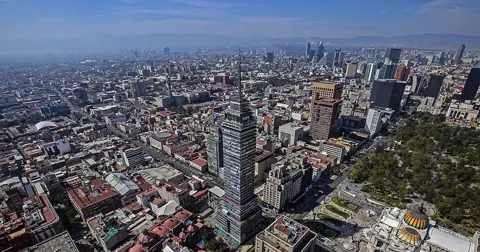
Alcaldia and colonia are two different levels of address
Mexico City is divided into 16 alcaldias, the administrative units the city's constitution establishes as its demarcaciones territoriales, each governed by an elected alcalde and a council. Each alcaldia contains dozens or hundreds of colonias, which are the named neighbourhoods people actually use. Cuauhtemoc is an alcaldia; Roma Norte, Juarez, Santa Maria la Ribera and the Centro Historico are colonias inside it.
The same constitution recognises the level below as well, providing for partial planning programmes for colonias, pueblos and barrios originarios and for indigenous communities resident in the city. That is why some places, Coyoacan's centre and San Angel among them, feel like absorbed villages rather than planned districts: administratively, they partly are.
A Mexican address is written street name, then number, then colonia, then postcode, then alcaldia and city. Street names repeat across the city, so the colonia is the field that makes an address unique. When you book accommodation, copy the colonia and the postcode from the confirmation, not just the street.
What each colonia was built as, and what it is now
Reading the city by colonia means reading its layers of construction. The list below sets out what the main visitor-relevant colonias were built for and what a traveller meets there now.
- Centro Historico (Cuauhtemoc): the colonial and pre-Hispanic core, laid out over Tenochtitlan and today a dense working district of government buildings, wholesale trade and major museums. It empties of residents at night in parts and stays busy in others.
- Roma (Roma Norte and Roma Sur, Cuauhtemoc): an early 20th-century residential development of wide, tree-lined streets and eclectic mansions, now the city's most concentrated area for restaurants, galleries and cafes.
- Condesa (Cuauhtemoc): built in the 1920s and 1930s around the oval of a former racetrack, which is why its streets curve; art deco apartment blocks, two large parks, and a nightlife and dog-walking culture that runs late.
- Juarez (Cuauhtemoc): a Porfirian-era district between Reforma and Roma, long semi-commercial, now a compact area of small bars and design shops with the Zona Rosa on its western side.
- Polanco (Miguel Hidalgo): a planned mid-century upper-income district next to Chapultepec, home to the Museo Nacional de Antropologia's neighbourhood, luxury retail on Presidente Masaryk and the city's most expensive hotels.
- Coyoacan (Coyoacan): a colonial town absorbed by the city, with cobbled streets, two central squares, the Frida Kahlo museum and a covered market. Quiet in the evening and a long way from Roma by road.
- San Angel (Alvaro Obregon): another absorbed colonial town in the south-west, steep and cobbled, known for its Saturday art market and stone-walled houses.
- Doctores (Cuauhtemoc): a working district of mechanics' workshops, hospitals and the city's courts, immediately east of Roma and considerably rougher-edged; cheap, central and not a first-visit base.
- Santa Maria la Ribera (Cuauhtemoc): a late 19th-century neighbourhood north-west of the centre, built around the Alameda and its Moorish kiosk, now a low-key residential area with a strong local market and far fewer visitors than Roma.
What that means for where you sleep
Where you sleep in Mexico City mostly determines how much of your day you spend in traffic. Roma, Condesa and Juarez form one continuous walkable zone with the Centro Historico reachable by metro or a short ride, and staying anywhere in that block means most evenings need no vehicle at all. Polanco is well connected but oriented around driving and formal dining. Coyoacan and San Angel are genuinely pleasant to stay in and genuinely far: budget 40 to 70 minutes each way to the centre depending on traffic, and plan them as day bases rather than as touring bases.
The trade-offs differ enough to be worth setting out side by side.
| Base | Suits | What you give up |
|---|---|---|
| Roma / Condesa | Walking, eating, late evenings | Quiet; street noise is constant |
| Centro Historico | Museums, early starts, low cost | Calm evenings in some blocks |
| Coyoacan / San Angel | Quiet, families, slower days | Time; long trips to the centre |
Walking at night, read honestly
Night-time comfort in Mexico City varies block by block rather than colonia by colonia, and any blanket safety claim about a whole neighbourhood is unreliable. The pattern most residents describe is about activity: streets with open businesses, restaurant terraces and pedestrian traffic stay comfortable late, while the same colonia's emptier residential edges do not. Roma, Condesa and Juarez have long stretches of the first kind. The Centro Historico's tourist spine is busy well into the evening but its side streets thin out quickly after the shops close, and Doctores and the wholesale streets around La Merced are working areas that empty at night.
Practical behaviour matters more than neighbourhood choice: use a ride-hailing app rather than hailing a taxi in the street late at night, keep your phone out of sight while walking, and treat the last few hundred metres to your accommodation as the part worth planning.
The arrivals-and-rents debate, and what the data actually shows
Mexico City has been arguing publicly about rising rents in its central colonias, the growth of short-term rentals, and the arrival of remote workers, particularly in Roma, Condesa and Juarez. The dispute is real and both sides make claims that a visitor is likely to encounter, from protest signage to press coverage. VoyageWindow could not verify colonia-level rent figures from an official statistical series, so what follows is limited to what national statistics do establish.
Three findings from INEGI's Census of Population and Housing 2020 frame the argument. First, Mexico City's population was 9,209,944, and the city lost a net 248,495 residents to internal migration over the preceding five years, mostly to the surrounding State of Mexico. Second, of 3,035,125 dwellings in the city, 207,026 were unoccupied and 71,780 were recorded as being in temporary use. Third, the central alcaldias are already among the densest: Iztacalco, Cuauhtemoc, Benito Juarez and Iztapalapa each exceed 16,000 inhabitants per square kilometre.
Those numbers support both arguments in part. Residents' organisations point to a stock of dwellings not permanently lived in and to displacement pressure in specific colonias. Others point out that the city as a whole has been losing residents to its periphery for years, that the central colonias were losing population before any recent arrivals, and that the relevant policy question is housing supply rather than visitors. A traveller does not need to settle this, but should know it is live, that it has produced street protest in Roma and Condesa, and that being conspicuous about it, for example treating the neighbourhood as a backdrop, lands badly.
Markets as the practical test of a colonia
The quickest way to understand a colonia is to find its market, because every one of them has one. The Congress of Mexico City counts 329 public markets and more than 70,000 stalls across the capital, administered by the alcaldias, with Cuauhtemoc and Venustiano Carranza holding the most. A market tells you what a neighbourhood actually buys and at what price, which is more informative than its restaurant list. Santa Maria la Ribera's market and Coyoacan's covered market read very differently from the small market on Calle Medellin in Roma Sur, and the difference is the neighbourhood.
Choosing your base before you book
Decide in this order: first pick between the walkable central block (Roma, Condesa, Juarez, Centro Historico) and a quieter southern base (Coyoacan, San Angel), because that decision sets your daily travel time. Then check the exact colonia on the listing, not just the alcaldia, and look at where it sits relative to a metro station and a main avenue. Then copy the full address, including colonia and postcode, into your phone before you land, since that is the form a driver will need.
What this guide does not cover
Coverage here is limited to how Mexico City's colonias differ and what that means for choosing a base. It does not rank neighbourhoods for safety, which varies by block, hour and behaviour rather than by name, and it does not quote rents, accommodation prices or short-term-rental rules, which change and are set by the city government rather than by any operator. It also does not cover the metropolitan area beyond the city's 16 alcaldias, including the parts of the State of Mexico that many residents commute from.