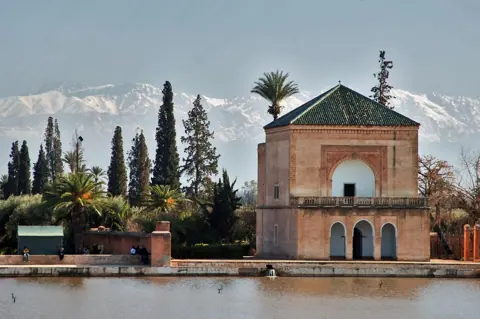
UNESCO lists Jemaa el-Fna as a "cultural space" rather than a monument: the storytellers, musicians, healers and snake-charmers who work there, and the crowd that keeps them there. That changes how a visitor should behave. You are not in a museum with a ticket at the door; you are in the audience of people whose income depends on that audience.
What does UNESCO actually protect in Jemaa el-Fna?
The square carries two separate UNESCO listings, and they protect different things.
| Listing | What it covers | Year |
|---|---|---|
| Medina of Marrakesh (World Heritage) | The walled city founded in 1070–72 by the Almoravids, 1,107 ha, including the Koutoubia with its 77 m minaret | 1985 |
| Cultural space of Jemaa el-Fna Square (intangible heritage) | The practices in the square | Proclaimed 2001, inscribed 2008 |
The intangible heritage listing names what it means. It lists performances by storytellers, poets, snake-charmers, Berber musicians (mazighen), Gnaoua dancers and senthir (hajouj) players, alongside services such as traditional medicine, dental care, fortune-telling, preaching and henna tattooing, and people selling water, fruit and traditional food. It records that the square has been protected as part of Morocco's artistic heritage since 1922.
The same page is frank about the risks. It names urbanisation, real-estate speculation and road building as serious threats to the space, and warns that the practices "may suffer acculturation, also caused by widespread tourism." Visitors are part of both the square's economy and one of the pressures on it.
A 2006 count of who works there
The most detailed picture we found is a sociological study for the UNESCO Office in Rabat by Ouidad Tebbaa of Cadi Ayyad University and anthropologist Ahmed Skounti, dated September 2006; the copy we read is hosted on Skounti's own website. It counted about 251 people animating the square, aged 14 to 70 and mostly men, about half of them from Marrakesh itself. Among them were 47 snake charmers, 30 Gnaoua musicians and 25 acrobats. Storytellers were already scarce: about ten, of whom seven performed only intermittently.
Those figures are twenty years old, so read them as history rather than a current headcount. The direction they describe, with performers of popular music and song in darija increasing while the old storytellers aged and dwindled, is the context for what you see today.
How do the performers get paid?
Through the circle. Performers mark out their stage as a halqa, a circle that the 2006 study describes as symbolically traced and blessed with water. At the end of the show, the performer or an apprentice passes a bowl ("la sébile") among the spectators. The study notes that apprentices help set up, manage the crowd and collect donations in exchange for being taught.
We did not find a ticket, a fee schedule, or any municipal or ministry tariff for tips. The study calls the storytellers "Trésors vivants" (living treasures) living in the greatest precarity. When you stand in a circle long enough to be entertained, the bowl is how you pay for it.
Can you take photos of performers?
Yes, with permission, and expect it to cost something. The UK Foreign Office's Morocco safety advice, updated 15 September 2026, tells British travellers to "always ask permission before taking pictures of people, especially children." That applies to performers, stallholders, henna artists and people simply crossing the square.
A practical sequence that respects both the advice and the performers:
- Watch first. A wide shot of the square is different from a close portrait of one person's face.
- If you want a portrait or a posed photo, ask before you raise the camera and agree what you will pay.
- If you filmed a whole performance from inside the circle, put something in the bowl when it comes round.
- If someone declines, put the camera away rather than shooting from a distance.
Photographing buildings around the square has its own limits. The US State Department's Morocco information page, under a Level 2 advisory issued 4 September 2026, says visitors should not photograph palaces, diplomatic missions, government buildings or other sensitive facilities, and should ask when unsure.
Why you should decline a photo with a macaque
If you are offered a photo holding a Barbary macaque, know what the animal is. In the CITES proposal of 2016, Morocco and the European Union asked to move the species to Appendix I, the strictest trade category. The document records that the IUCN has listed it as Endangered since 2008, cites wild population estimates of 5,000 to 6,000 (published) and 6,500 to 9,100 (more recent, unpublished), and says most animals in trade are taken from the wild as live animals for the international pet trade.
It also sets out Moroccan law. A 1962 decree prohibits capture, hunting, possession, sale and hawking of the species, and Act No. 29-05 protects listed species from capture, sale or offer for sale without a licence, with fines of €2,000 to €5,000 cited for illegal trade. The proposal does not discuss Marrakesh specifically, and we could not confirm on the CITES appendices page how the species is listed today. The simplest choice is to decline the photo and walk on.
Snake-charming is different in status: UNESCO names snake-charmers among the practices of the cultural space itself. The same rule still applies to your camera. Ask, agree a price, and stand back if you are uncomfortable with the animals.
If you want the square without the photo negotiations, stay at the edge of a circle, watch a full performance, and pay into the bowl when it passes. That is the transaction the halqa was built for.