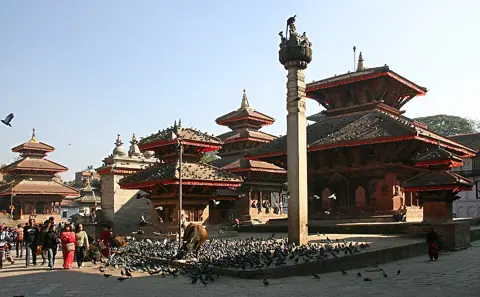
On Monday 21 September 2026, the Pashupati Area Development Trust recorded 35 cremations at the ghats below the temple. Its four tourist ticket counters counted 414 visitors that day. Both figures come from the daily update on the trust's website. The first figure is the one to keep in mind when you visit. Pashupatinath is a working temple and funeral ground, and for most of the people on its riverbank it is a family occasion, not a sight.
A temple complex run by a government trust
The temple complex is managed by the Pashupati Area Development Trust (PADT), a body of the Government of Nepal under the Ministry of Culture, Tourism and Civil Aviation. According to Kathmandu Metropolitan City, the area covers 240 hectares in Ward 8 on the banks of the Bagmati. It is a place of worship for Shaiva, Shakta, Vaishnava, Buddhist, Jain, Nath and Sikh devotees, among others. UNESCO lists the Pashupati complex as one of the seven monument zones of the Kathmandu Valley World Heritage property, inscribed in 1979.
The trust's monuments list runs to more than twenty temples, ghats and groves. It says the main temple is believed to have been built by Supuspdev, a Lichchhavi king. Across the river are the Pandhra Shivalaya, a row of fifteen small Shiva shrines on the eastern bank, and the Kirateshwor shrine on a hillock. The shikhara-style Gorakhnath temple dates from the eighteenth century.
Can non-Hindus enter Pashupatinath?
Non-Hindus can enter the complex, but not the main sanctum. The trust's wording is short: "Main Sanctum: Hindus only. Ghats: Open to all", and "Observation from surrounding ghats is permitted." The Nepal Tourism Board's Pashupatinath page adds that non-Hindu visitors can watch from the terraces across the river to the east. It says the nearby Guhyeshwari temple also restricts non-Hindu entry.
Access to the sanctum depends on religion; the fee depends on nationality. The tourism board's fee list charges foreign nationals NPR 1,000 "per day per entry" and waives the fee for Indian nationals. Its only remark is that "tourists can view the temple from the back premises". The list carries no date. We could not find a fee page on the trust's own website, and the tourism board does not say whether "per day per entry" allows you to leave and come back on the same ticket. If you want to go in the morning and return for the evening aarti, ask at the counter before you leave.
The trust's daily update names four counters where tourists are counted: Guheshwori, Vatsaleshwori, Tilganga and Gate No. 3. On 21 September 2026, Tilganga (217) and Vatsaleshwori (137) handled most of them.
What should you wear, and what should you leave behind?
The UK Foreign Office gives the plainest dress rule for Nepal in its travel advice, updated in September 2026. It advises visitors to avoid shorts and sleeveless tops in temples and other holy places, and to take their shoes off before entering certain holy places. The same advice notes that public displays of affection are seen as inappropriate in Nepal.
The tourism board adds that "leather items that include shoes, belts and cameras are forbidden within the temple complex". The same page says "Photography is strictly prohibited", which is stricter than the trust's own rule below; where the two differ, follow any sign or instruction at the gate.
The cremation ghats below the temple
The trust's services page explains the riverbank. Arya Ghat, built during the reign of Pratap Malla, was "traditionally reserved for royalty, VIPs, and high-status Hindus". Bhasmeshwor Ghat, just south of it, handles wood-fired cremations for the general public, and the ashes are later immersed in the Bagmati. A newer electric cremation house near Arya Ghat completes a cremation in about 45 minutes and handles 10 to 15 a day.
Families register each cremation at the Ghat Service Center, for a fee of Rs 200, before the body arrives. The centre can also arrange a priest and ritual items when relatives cannot. On 21 September 2026, Bhasmeshwor handled 27 of the day's 35 cremations.
When should you go?
The trust's website gives temple hours of 4:00 AM to 9:00 PM daily. Kathmandu Metropolitan City's page lists 10:00 AM to 5:00 PM. Neither page explains the difference, so if you plan to arrive before 10:00 or stay past 17:00, confirm with the counter or your hotel.
The trust's daily schedule for 27 September 2026 showed:
| Time | Ritual |
|---|---|
| 4:00 AM to 7:00 AM | Morning puja |
| 7:00 AM to 12:00 PM | Mahabhishek |
| 5:00 PM to 7:00 PM | Evening aarti |
| 7:00 PM to 8:00 PM | Night aarti |
The same homepage has a second "day schedule" box that lists the evening aarti at 6:30 PM to 7:30 PM. If the aarti is the reason for your visit, arrive by 5:00 PM and wait on the ghats, which are open to all; that covers both versions. The trust names Maha Shivaratri as the most significant festival. The tourism board adds Teej, in mid-September, when women in red saris come to pray. Both draw large crowds of devotees; for Teej in 2026 the trust published a darshan route and a list of urgent notices. The trust's homepage lists Vijaya Dashami, Kojagrat Purnima and Laxmi Puja as the next festivals. It gives their dates in the Nepali calendar, so check the notices section before choosing a day.
Carrying the same habits to other temples
What works at Pashupatinath is a safe baseline for other Hindu temples in the Kathmandu Valley: covered shoulders and knees, shoes off where others take theirs off, and no photos where worship is happening. When a doorway has no sign, watch whether local visitors remove their shoes or stop at the threshold, and do the same. The royal squares follow different rules and charge different fees; our Durbar Squares fee guide compares them.