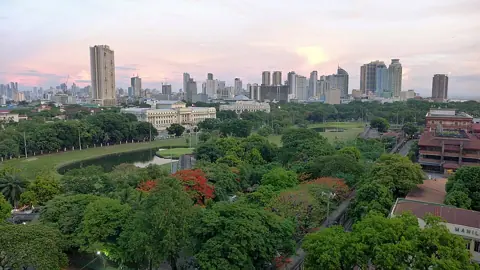
Manila is usually described as a city that lost its heritage in 1945, and that is half true. What survived is concentrated enough to walk in a day, and unusually well documented by the agencies that run it.
What exactly is Intramuros?
The Spanish colonial capital, and the national historical commission's own marker text is the most compact description available: "The historic core of present-day City of Manila. Established by the Adelantado Miguel Lopez de Legaspi on the site of the former kingdom of Rajah Soliman, 1571." It served as "Capital of the Spanish East Indies, 1571 to 1898," with "walls and fortifications constructed to protect the institutions and inhabitants therein, 1590 to 1825."
That two-century span is the point. Intramuros is not one building programme but a fortification continuously rebuilt across the whole Spanish period, which is why its parts carry different dates.
| Site | Built | Note |
|---|---|---|
| Fort Santiago | Palisade 1571; stone fort 1589–1592 | Rebuilt after destruction in 1574 |
| Baluarte de San Diego | 1586–1587 fort; baluarte 1653–1663 | Breached 1762, wrecked 1863, restored 1979–1992 |
| San Agustin Church | Completed 1607 | The oldest stone church in the country |
Fort Santiago was declared a National Shrine and Shrine of Freedom in 1951. The Intramuros Administration itself was created by Presidential Decree No. 1616 in April 1979 and sits under the tourism department.
What does it cost to get in?
Less than most capital-city heritage districts, and with no foreigner surcharge anywhere.
| Site | Hours | Fee |
|---|---|---|
| Fort Santiago | Mon–Fri 8am–10pm; Sat–Sun 6am–10pm | PHP 75, concession PHP 50 |
| Baluarte de San Diego | Daily 8am–5pm | Not stated |
| Casa Manila | Tue–Sun 9am–6pm, closed Mondays | PHP 75, concession PHP 50 |
| Museo de Intramuros | Tue–Sun 9am–6pm, closed Mondays | PHP 150, concession PHP 120 |
| Centro de Turismo | Tue–Sun 9am–6pm, closed Mondays | Visitor centre free |
| San Agustin Museum | Daily 8am–12pm, 1pm–5pm | Not stated |
Discounts apply to children under 18, seniors 60 and over, students, persons with disabilities and government employees with valid ID.
What is the World Heritage part?
One church, inside a four-part inscription. UNESCO listed the Baroque Churches of the Philippines in 1993 under criteria (ii) and (iv), comprising San Agustin in Manila, Santa Maria in Ilocos Sur, Paoay in Ilocos Norte and Miagao in Iloilo.
The citation is worth reading for what it credits: "These four churches, the first of which was built by the Spanish in the late 16th century... Their unique architectural style is a reinterpretation of European Baroque by Chinese and Philippine craftsmen."
The national museum adds the domestic status — "a nationally recognized Cultural Treasure and Historical Landmark" — and the reason it survives at all: San Agustin is "the oldest stone church in the country, being relatively unchanged since its construction" in 1607.
Where does the American layer show?
In the park, the civic buildings and the language. Rizal Park covers 54 hectares — described by the historical commission as "one of the largest and most historic urban parks in Asia" — and is run by the National Parks Development Committee under executive orders 30 and 69.
Its monument is precisely documented. An international design competition ran from 1905 to 1907; Italian professor Carlo Nicoli won first place but "due to contractual issues, the project was awarded to the second-prize winner, Dr. Richard Kissling," whose design "Motto Stella" — Guiding Star — stands 14 metres high and was unveiled on 30 December 1913, Rizal's seventeenth death anniversary. Rizal's remains are interred beneath it.
The site itself predates the monument as a place of consequence: it is where the priests Burgos, Gomez and Zamora were executed, and where Rizal was executed on 30 December 1896.
The Metropolitan Theatre is the other American-era building worth knowing about. It holds two designations — National Historical Landmark in 1973 and National Cultural Treasure on 23 June 2010 — and the culture commission describes it as "the only existing art deco building in its scale and integrity in Asia." The commission bought it on 11 June 2015 for PHP 270 million and intends it as "a center for arts and culture."
What is free?
The largest thing in the city. The National Museum of the Philippines states in its own 2025 visitor guidelines that its museums are "open to the public every day, from Monday to Sunday, except on selected religious holidays, and operate from 9:00 AM to 6:00 PM," and that "Admission is FREE."
The Manila complex, on Rizal Park, comprises the National Museum of Fine Arts, the National Museum of Anthropology, the National Museum of Natural History and the National Planetarium. The Fine Arts building is itself the Old Legislative Building, on the official list of sites declared by the historical commission.
What did American rule leave that you cannot photograph?
The school system, and through it the language. The education department's own history is direct: "A highly centralized public school system was installed in 1901 by the Philippine Commission by virtue of Act No. 74." Staffing it required importing teachers: "the Philippine Commission authorized the Secretary of Public Instruction to bring to the Philippines 600 teachers from the U.S.A. They were the Thomasites."
And on language: "Chaplains and non-commissioned officers were assigned to teach using English as the medium of instruction."
How much heritage is there, officially?
More than any other Philippine city. The historical commission maintains the National Registry of Historic Sites and Structures, "the Philippines' official database of marked historical properties, sites, and structures," and its location filter returns 339 entries for Manila — the highest count of any location in the database.
Manila-area sites on the official list of commission-declared sites include Intramuros and its walls, the Old Legislative Building, the Manila Metropolitan Theater, the Army and Navy Club Building, Malacañang Palace, the Manila Hotel, Rizal Park as Bagumbayan, Liwasang Bonifacio, the Bonifacio National Monument and the University of Santo Tomas.
What this guide does not cover
Several details are absent rather than estimated. No area figure in hectares is given for the walled city, because none appears on any Intramuros Administration page. San Agustin Church's own opening hours, Mass times and admission are not stated, because it is a private Augustinian parish and no government page publishes them — only the adjacent museum's hours are official.
Rizal Park's current opening hours are also missing. The only official statement found is a 2021 pandemic-era notice giving restricted windows, which is plainly not current and is not repeated here.
The Burnham Plan of 1905 gets no building list. The Intramuros Administration's own page on it is a video lecture with no text, and no historical commission, culture commission or museum page lists the buildings attributable to the plan — so the Manila Central Post Office and the Agrifina Circle buildings appear nowhere in this guide's heritage claims. Escolta Street likewise returned no designation in the registry search, which is not the same as having none.
Finally, the Metropolitan Theatre has no published visiting hours or admission. It hosts events rather than opening as a museum; check the culture commission's events calendar. And no annual visitor figure for the National Museum could be found in any of its publications.