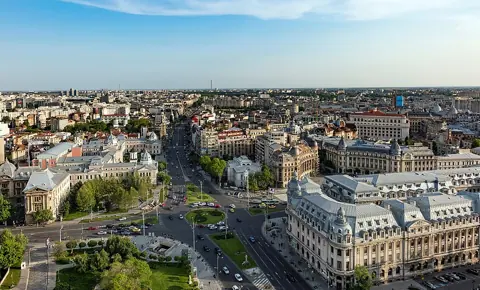
Bucharest earned the nickname "Little Paris" for its early twentieth-century boulevards and Belle Époque architecture, a reputation many visitors arrive expecting to see everywhere. What they find instead, once they reach the city's centre, is one of the largest and most controversial buildings on earth, sitting where an entire historic district used to be. Understanding how it got there changes how you read the rest of the city.
What Ceaușescu built, and what it cost
The Palace of the Parliament (Palatul Parlamentului), originally named the House of the Republic, was commissioned by Romania's communist leader Nicolae Ceaușescu, with major construction running through the 1980s following a devastating 1977 earthquake that Ceaușescu used partly as justification for a much broader urban redevelopment plan. The building is consistently described as one of the largest administrative buildings in the world by floor area, an almost unfathomably large single structure by the standards of most European capitals.
Building it required clearing a vast area of central Bucharest, and that clearance is the part of the story too often left out of a simple "impressive building" description. An estimated substantial portion of Bucharest's historic centre — residential neighbourhoods, churches, and other historic buildings — was demolished to make way for the palace and the surrounding Centrul Civic (Civic Centre) district built around it, including the wide Bulevardul Unirii boulevard leading up to it, reportedly designed to be longer than the Champs-Élysées. Some historic churches in the demolition zone were saved only by being physically relocated on rails to new sites elsewhere in the city, a remarkable and unusual engineering effort undertaken specifically to preserve them from the broader clearance.
Two Bucharests, side by side
The result of this history is a city centre that reads, quite literally, as two different urban plans stitched together. On one side, the areas that survived the demolition — including much of what's now marketed as the Lipscani old town and other pre-communist neighbourhoods — retain the Belle Époque, tree-lined-boulevard character that earned Bucharest its "Little Paris" reputation. On the other, the Centrul Civic area around the Palace of the Parliament presents an entirely different visual and civic logic: monumental scale, wide straight boulevards, and buildings designed to communicate state power rather than to be walked through at a human pace.
Walking between the two is not a subtle transition. You move from a dense, older, commercially mixed streetscape into a deliberately oversized civic zone, and the contrast is one of the most direct ways to physically feel Romania's twentieth-century political history rather than just read about it.
Visiting the palace today
The Palace of the Parliament today houses Romania's Chamber of Deputies and Senate, alongside the National Museum of Contemporary Art in part of the building, and sections of the interior are open to the public through guided tours. The Chamber of Deputies' own visitor centre states the palace can be visited daily between 09:00 and 17:00, with tickets purchased on-site and identification required at check-in. Given the building's scale, tours generally cover only a fraction of the total floor area, and prices and procedures change, so confirm current tariffs and requirements directly with the Chamber of Deputies' visitor information before planning a specific visit time.
Why this history matters beyond the building itself
The Palace of the Parliament is not simply a large, unusual building — it is a physical record of a political choice to erase a historic urban fabric in favour of a monumental one, made by a leader whose broader systematic urban planning policies (including rural "systematisation" affecting villages elsewhere in the country) were part of what made his regime's final years so widely resented before its violent end in the 1989 revolution. Seeing the building without that context reduces it to a curiosity about size; seeing it with the context turns it into one of the clearest single sites in Europe for understanding what state power looked like when applied directly to a city's physical fabric.
A building that keeps generating new uses
Since 1989, various proposals have floated for what to do with a structure this large in a country that no longer needed a monument to a single leader's authority, and the building's current mixed use — parliament, a contemporary art museum, and guided public tours — reflects an ongoing, somewhat improvised answer to that question rather than a single settled purpose planned from the start. This is itself worth noticing: a building conceived as an absolute symbol of centralised state power now houses a democratically elected legislature and a museum of contemporary art, which is its own kind of quiet historical statement, whether or not that was anyone's deliberate intention.
What this guide does not cover
This piece explains the historical context behind the palace and the district around it, not current tour booking procedures, ticket prices or security requirements, none of which were verified here. Confirm those directly with the Chamber of Deputies' visitor information or an authorised tour operator before your visit.