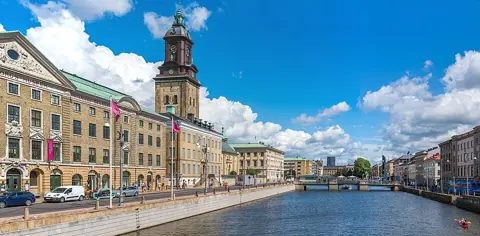
Sweden's biggest global exports are not raw materials; they are products designed to a specific idea of what "good design" and "reliable engineering" should look like, sold at a scale few countries of ten million people manage. IKEA, H&M and Volvo are the three most recognizable names behind that reputation, and each one offers a visitor a different, and differently limited, way to see it in person.
IKEA: the museum is in Älmhult, not Stockholm
IKEA was founded in 1943 in Älmhult, a small town in southern Sweden roughly two and a half hours from Stockholm by train, and the company's furniture showroom concept traces back to that same town. The IKEA Museum sits there today, covering the company's history and design philosophy through exhibitions, historical catalogues, product displays and designer profiles running from the 1940s to the present, including well-known products like the BILLY bookcase and the FRAKTA bag. Adult admission is listed at 60 SEK, and the museum runs an English-language guided tour on weekends alongside a restaurant and shop on site.
This is a company-history museum, not a working factory tour — there is no indication of a public production-line visit at an active IKEA manufacturing site, and this guide did not find one to confirm. What the museum does well is explain the specific design logic — flat-pack, self-assembly, price calculated backward from a target retail figure — that turned a Swedish mail-order furniture business into a household name on five continents, an everyday expression of the same lagom instinct toward sensible, unshowy design that runs through Swedish culture more broadly. Älmhult is a deliberate trip in its own right rather than a stop you fold into a Stockholm or Gothenburg itinerary; plan the rail connection separately if this is the specific reason for your visit. The town's identity is genuinely built around the company in a way few corporate hometowns are — street names, local employment and the town's own self-presentation all trace back to IKEA's decades of headquarters presence there, which is worth knowing before you arrive expecting a generic small Swedish town with a museum attached.
H&M: no public site built around its own history
Hennes & Mauritz, founded in Västerås in 1947 and now one of the largest clothing retailers in the world, does not have a dedicated public museum or factory tour comparable to IKEA's or Volvo's. Its stores are simply retail stores, indistinguishable in format from H&M locations in any other country, and there is no confirmed public visitor site tied specifically to the company's design or manufacturing history. If your interest is Swedish fashion and textile design more broadly rather than H&M as a single company, that is better served by a design museum or fashion-focused institution than by any H&M-branded site — this guide does not have a confirmed H&M-specific attraction to recommend and will not invent one.
Volvo: the museum closed, and what replaced it is different
Volvo — split since the 1990s into separate car and truck/industrial businesses under different ownership — built its reputation in Gothenburg, and for decades the standalone Volvo Museum there told that story through a chronological collection of vehicles from the 1920s onward, including cars, trucks, buses and marine and aircraft engines. According to World of Volvo, that original museum, located in Gothenburg's Arendal area, closed in December 2023.
Its stated successor is World of Volvo, a newer venue at Lyckholms Torg 1 in central Gothenburg, which holds parts of the former museum's vehicle collection and combines it with what the venue itself describes as more interactive, digital exhibits rather than a straightforward continuation of the old chronological format. Its listed hours are Monday to Wednesday and Friday to Saturday 10:00–17:00, Thursday 10:00–19:00, and Sunday 10:00–16:00; confirm current admission pricing directly on the World of Volvo site, since it was not stated on the page consulted for this guide.
What actually ties these together
None of the three companies runs a working factory tour open to casual visitors, and none is a sponsor of this guide or of VoyageWindow. What connects them for a traveler is less about seeing production in progress and more about seeing how a small country's design and manufacturing identity got built and then marketed — flat-pack furniture priced for mass affordability, fast-turnaround retail fashion, and vehicles marketed on safety and durability rather than speed or luxury. The IKEA Museum makes that case directly and in detail. World of Volvo makes a narrower version of it. H&M, at least at present, does not offer a comparable public account of its own.
What this guide does not cover
This is not a shopping guide to current IKEA, H&M or Volvo retail locations, product lines, or prices, and it does not cover other Swedish manufacturers — Ericsson, Scania, Electrolux among them — that have their own separate industrial histories and, in some cases, their own visitor sites worth checking independently if that is your specific interest.