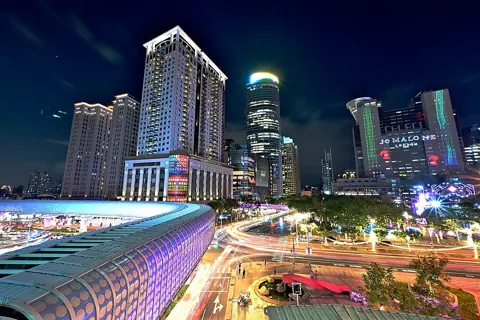
Most travelers who pass through Banqiao Station aren't visiting Banqiao itself. They're connecting onward, into central Taipei, toward southern Taiwan on the high speed rail, or between a regional train and the capital's metro network. That makes Banqiao Station one of the more heavily used interchange points in Taiwan's rail system, and understanding its basic shape before you arrive saves confusion once you're standing in it with a suitcase.
Understanding what's actually at Banqiao
Banqiao Station is a single large station building that houses three different, independently operated transit systems. Taiwan Railway (TRA) is the conventional rail network connecting cities and towns across Taiwan. The High Speed Rail (THSR) is the separate, faster long-distance system connecting major cities along the west coast, including a direct link toward Taipei and southward toward cities like Taichung, Tainan, and Kaohsiung. The Taipei MRT's Bannan line reaches Banqiao as one of its western stations, connecting the area into Taipei's urban metro network.
Because these three systems are run by different operators, they don't function as one seamless network the way, say, connecting between two lines of the same metro system might. Each has its own fare structure, its own ticketing or card-tap process, and in some cases its own physically separate concourse or set of gates within the larger station building.
How the transfer actually works
The core thing to understand is that not every transfer at Banqiao works the same way. Some connections let you move between fare areas without fully exiting the paid zone, effectively staying "inside" the station's controlled area as you move from one system's platform to another. Other connections require you to exit through a ticket gate, walk through a public concourse area, and then enter a different system's paid zone through its own separate gates, essentially treating the transfer as two independent trips joined by a walk through the station.
Taiwan High Speed Rail's own station page confirms that transferring from THSR to TRA at Banqiao means exiting through the B1 level rather than staying inside one paid zone, which is a concrete example of the pattern this guide describes: which situation applies to your specific transfer, say TRA to THSR, or MRT to TRA, depends on the current physical layout and gate arrangement of the station, and that arrangement can change over time as the station evolves. Rather than memorizing a fixed rule that might be outdated by the time you travel, the reliable approach is to follow the station's own directional signage, which is generally color-coded and labeled by system, and to check a current station map, either posted physically inside the station or through the relevant operator's own information page, if you're unsure which route to take.
What changes based on your route
Your experience of the transfer differs meaningfully depending on which two systems you're connecting between, so think about your specific route rather than treating "transferring at Banqiao" as one uniform experience.
| Transfer type | What to expect | Trade-off |
|---|---|---|
| THSR to TRA (or reverse) | Often involves moving between distinct station zones | Can require more walking and clearer wayfinding |
| TRA to Taipei MRT (or reverse) | Generally a more metro-style transfer within the broader station complex | Still a separate fare system and possibly a separate gate |
| THSR to Taipei MRT (or reverse) | Longest walk of the three combinations for most travelers | Budget the most extra time for this pairing |
This table describes the general shape of each transfer type rather than exact walking distances or times, since those depend on the current station layout and where within each system's platforms your specific train arrives or departs.
Traveling through Banqiao with luggage
If you're passing through Banqiao with a suitcase, whether you're arriving from the airport area, continuing on to another city via THSR, or heading into central Taipei, plan for a transfer that may include stairs, escalators, or elevators depending on which route through the station you take. Large stations with multiple rail systems stacked into one building are rarely a single flat walk from one platform to another.
Give yourself more buffer time than you would for a same-system transfer, particularly if you're connecting to or from the THSR, since high speed rail departures run on a fixed schedule and being late to your platform because you underestimated the walk can mean missing your train outright. A TRA-to-TRA or MRT-to-MRT connection is more forgiving if you're a few minutes behind, but crossing between systems is where the time pressure is highest.
Why you're probably not "visiting" Banqiao
For most international travelers, Banqiao functions purely as a hub rather than a destination: a place to change trains on the way to central Taipei, onward to southern Taiwan via the THSR, or between a regional TRA journey and the Taipei MRT network. That's a completely reasonable way to use the station, and there's no need to build extra time into your day to "see" Banqiao itself unless you have a specific reason to explore New Taipei City around the station.
If your itinerary does involve stepping outside the station, New Taipei City has its own areas worth exploring, but that's a separate decision from the transfer itself, and worth treating as its own stop on your itinerary rather than something to squeeze into a transfer window.
Before you rely on this for a tight connection
If you have a tight connection at Banqiao, particularly between the THSR and another system, check the current station layout and your specific platform assignments as close to your travel date as possible, since gate arrangements and concourse routes are the kind of detail that a station map from even a year or two ago might not reflect accurately. Station signage on the day is your most reliable real-time source once you're actually there.