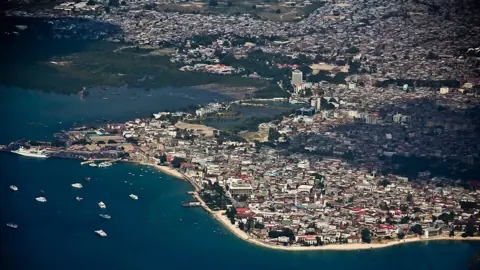
Zanzibar's 1.5 million residents are 99% Muslim, according to a U.S. government estimate in the State Department's 2023 religious freedom report. Stone Town, the old core of Zanzibar City, is where that population lives, trades and prays among the buildings a visitor comes to see. The dress and Ramadan advice below follows from that: most of the historic town is a residential neighbourhood, not a museum, and its rules come from Zanzibar's semi-autonomous government rather than from the resorts on the coast.
What does UNESCO protect in Stone Town?
UNESCO inscribed Stone Town of Zanzibar on the World Heritage List in 2000 as "a fine example of the Swahili coastal trading towns of East Africa", a place where African, Arab, Indian and European influences mixed over more than a thousand years. What is protected is the whole urban fabric: the street pattern and the ordinary houses as well as the landmarks.
The 2000 ICOMOS evaluation explains how the town is built. Walls are coralline ragstone set in thick lime mortar, then plastered and lime-washed. Rooms are long and narrow because the mangrove poles used as beams were usually only 2.5 to 3 metres long, and they are arranged round an open courtyard. Carved wooden doors mark the entrances. Of the buildings surveyed, 32% were shop-front buildings of Indian derivation and 25% Arab-style houses. Many houses have their own enclosed courtyards, which is why the public open spaces are few and the streets narrow.
The Stone Town Conservation and Development Authority (STCDA), set up in 1985, manages the 125-hectare conservation area under a series of laws, starting with the Stone Town Conservation and Development Act of 1994. In 2024 the World Heritage Committee, in Decision 46 COM 7B.24, welcomed amendments to the 2010 Stone Town Development Authority Act and a management plan that now makes building conservation by owners mandatory. The same decision asked Tanzania to halt the loss of public open space and the covering-over of courtyards, and to support residents so they can repair and keep their homes in the town.
That last point is the part visitors touch. UNESCO names tourism development since 1990, traffic and housing shortages among the pressures on the site. Doorways and courtyards are private space in a residential district, even when they appear in every photograph of the town.
What should you wear in Stone Town?
Two government travel advisories give the working rules, and they agree on the substance.
| Source | What it says |
|---|---|
| UK Foreign Office, updated 17 September 2026 | Women wearing shorts or sleeveless tops away from resorts in Zanzibar and Pemba, "particularly in Stone Town", may cause offence; authorities can fine you "700 US dollars or more" for clothing they consider inappropriate in public |
| U.S. State Department | Dress modestly outside the hotel or resort; entering public areas in a bathing suit or clothing locals consider immodest "may attract negative public attention" |
In practice that means trousers, a long skirt or knee-covering shorts, and tops that cover the shoulders, for anyone walking the town. A light scarf or shirt in a day bag lets you cover up after a morning at the beach before you walk into the old town. Neither advisory publishes a detailed list of banned items, and we could not find the regulation behind the fine on an official Zanzibari website. So treat "shoulders and knees covered, no swimwear in the streets" as the safe line rather than a legal definition.
The same UK page says same-sex sexual activity is illegal in Tanzania, including Zanzibar, and that public displays of affection could lead to arrest.
How does Ramadan change a visit to Stone Town?
Ramadan dates follow the lunar calendar and vary by year, as the UK advice notes. During the month, the UK advises visitors to avoid eating or drinking in public, outside hotels or restaurants. The U.S. State Department asks travellers to be mindful and respectful of local culture while Muslims fast during daylight hours.
For a day in Stone Town, that means carrying water but drinking it out of sight of the street, and planning lunch inside a restaurant or your hotel rather than eating while you walk. None of the official sources we read say which restaurants stay open by day during Ramadan, so ask your hotel when you arrive.
What is happening to the House of Wonders and the Old Fort?
Several of the town's best-known buildings are building sites or under review in 2026, which affects what you can see.
- House of Wonders (Beit al-Ajaib). A joint UNESCO/ICOMOS advisory mission in January 2025 described "three consecutive collapses that happened between 2012 and 2020". Shoring and scaffolding were complete, foundation reinforcement was about 40% done, the work was financed by the Sultanate of Oman, and completion was foreseen "towards the end of 2026". The Committee's 2026 Decision 48 COM 7B.61 still describes the works as ongoing.
- Old Fort. The 2025 mission found rehabilitation of the entrance building and amphitheatre under way, with completion waiting on the temporary resettlement of the vendors who trade there. In 2026 the Committee expressed concern at a "major transformation of the Old Fort" and asked for detailed designs and a heritage impact assessment before further work.
- Darajani Bazaar. A redevelopment was halted in 2024 pending a new heritage impact assessment. Tanzania's state of conservation report of November 2025 says a reduced-scope assessment was submitted on 6 November 2025, and the 2026 decision welcomed it.
None of these documents give visitor opening hours, so check on the day whether the Old Fort courtyard is open and expect scaffolding around the House of Wonders.
Before you set out each morning, check two things: whether your clothes cover shoulders and knees, and whether it is Ramadan. If either answer is uncertain, pack the scarf and plan your meals indoors.