Most of what UNESCO protects here cannot be walked at all. The World Heritage listing covers 35,086.81 hectares, and nearly all of that is sea: three offshore oyster beds, a stretch of seashore and the fort at the southern tip of Muharraq Island. The 17 buildings in the town are a small share of the area. The walk is the land end of an economy that took place mostly at sea.
What is the Pearling Path?
It is a route built to join scattered buildings into one story. UNESCO calls the site the last remaining complete example of the pearling tradition, from a time when the trade dominated the Gulf economy. The Bahrain Authority for Culture and Antiquities (BACA), which runs the official Pearling Path site, restored the houses and built new public spaces around them.
The economics explain why these particular buildings survive. According to the authority's history of pearling, pearls made up three quarters of Bahrain's exports in 1877, and an estimated 97.3% of the Gulf's pearl turnover passed through Bahrain in 1904 to 1905. Crews were financed by a chain of loans from merchants to captains to divers, and until the reforms of the 1920s a diver's unpaid debt passed to his next of kin.
The trade peaked in 1911 to 1912. Wars, price crashes, cheap cultured pearls, the Wall Street crash and divers' riots followed, and the authority dates the industry's total collapse to about 1950. Muharraq, Bahrain's capital from 1810 to 1923, lost its role to Manama as oil arrived. UNESCO notes that many buildings were left largely unaltered after the collapse, which is why they can show the period so clearly.
What will I see along the route?
The authority's site-by-site description moves up the social ladder, from divers to merchants:
- Al-Ghus House, a simple single-storey diver's home.
- Badr Ghulum and Turabi houses, a clinic and a residence.
- Murad House and Majlis, a pearl trader's courtyard house once 50 metres from the shore, with the majlis where pearl sales were negotiated.
- Fakhro House, about 3,000 m2, built by a timber and boat merchant with a fleet of up to 50 boats; its eastern half is still a family home.
- Siyadi shops and storehouses, built from 1860 and in use by the Siyadi family ever since.
- Nukhidhah House, the 1920s majlis of boat captain Jassim Ajaj, with rooms for divers arriving for the season.
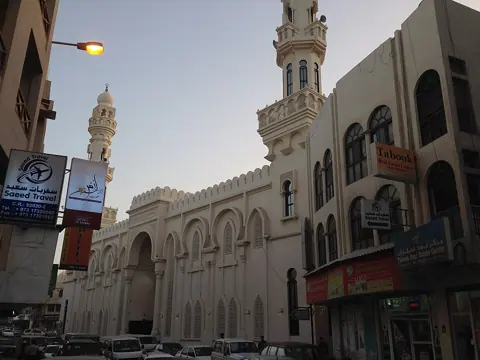
- Siyadi complex: a house, the Siyadi Majlis (described as the pearling era's only four-level building, with a pearl museum holding some of the oldest pierced pearls found in Bahrain), and the Siyadi Mosque of 1865, Muharraq's oldest preserved mosque.
Many of these are private homes or working shops, seen from the street. The authority's visitor page lists only four places as open to visits: the Pearling Path Visitor Centre, Nukhidhah House, the Bu Mahir Visitor Centre and Qal'at Bu Mahir itself. The Siyadi Majlis is not on that list, and we could not confirm whether it is open; ask at the Visitor Centre before planning around it.
How do I walk the Pearling Path?
The Visitor Centre, designed by Valerio Olgiati, is itself part of the visit: the authority describes a single roof over the old buildings with 15 wind towers and a forest of thin columns. Christian Kerez designed the multistorey car parks. The authority's pages did not give a suggested route order or walking time.
Getting to Qal'at Bu Mahir
The fort is where the pearling fleet set out and returned about four months later, according to the authority. Originally a four-towered fort, it was largely destroyed by British naval forces in 1868, and only the southern tower and one defensive wing still stand, with the rest visible as excavated remains. The Bu Mahir Visitor Centre beside it dates from 2014.
The visitor page says boat trips to the fort leave Bahrain National Museum every 45 minutes, daily except Tuesdays, with the last trip at sunset. No boat fare is published, and the pages we read did not say whether you can also walk to the fort from the town section. The simplest plan is to treat the fort as a second stop by boat from the museum, not the end of the walk.
Timing: Tuesdays, heat and Ramadan
Tuesday is the one day to avoid: the town section and the boat both close. The visitor page lists no separate Friday hours, so on paper Friday follows the daily 10:00 to 18:00 schedule, but call +973 17 298 777 if you are planning around Friday prayers.
The US State Department describes Bahrain's summers, from April to October, as extremely hot and humid. With a 10:00 opening, there is no cool early start in summer; visit between November and March if you can, or split the day, with the Visitor Centre, under its large roof, at midday and the fort boat near sunset. The same page says photographing certain buildings is illegal in Bahrain, so ask before photographing anything official, and ask residents before photographing them or their homes.
During Ramadan, the path takes on an evening life. For Ramadan 2026, the authority's events page listed cafes and venues along the path open from the evening until about 1:00 between 19 February and 19 March, with Gergaoon events from 3 to 5 March. The official pages did not publish a dress code; the route passes through a lived-in neighbourhood and a mosque, so dress for a residential area rather than a resort.
The project's reach goes beyond the listed buildings. The Aga Khan Award for Architecture recognised the "Revitalisation of Muharraq" in its 2017 to 2019 cycle, and describes it as an effort to draw residents back to the old town, not only visitors. On the day, if the Visitor Centre staff confirm the Siyadi Majlis is open, end your walk there; if not, end at Nukhidhah House and take the late boat to Bu Mahir from the National Museum.