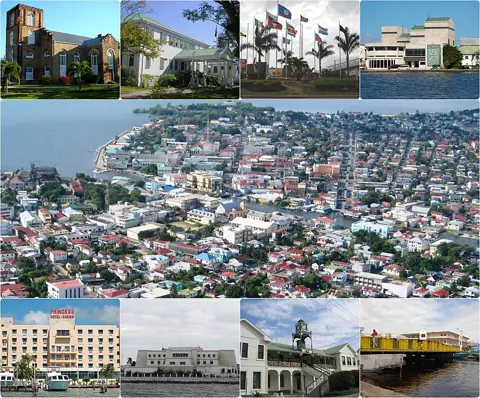
In the 2022 census, Belize's languages add up to well over 100 percent. That is by design: question 1.6 of the census questionnaire asked everyone aged 4 and over which languages they speak "well enough to conduct a conversation", and allowed several answers. The result shows a multilingual country, not an English-speaking one with minorities.
What languages are spoken in Belize?
The Statistical Institute of Belize's 2022 Key Findings Report covers 368,924 people aged 4 and over. These are the national shares for the main languages.
| Language | Share who can converse in it (2022) |
|---|---|
| English | 75.5% |
| Spanish | 54.0% |
| Creole (Kriol) | 49.0% |
| Maya Ketchi (Q'eqchi') | 6.3% |
| Maya Mopan | 3.9% |
| German | 3.1% |
| Garifuna | 2.0% |
English shows the largest change, up from 62.9% in 2010. The census asks what people can speak, not what they speak at home, so it does not tell you anyone's first language.
Language also follows ethnicity only loosely. According to the SIB's census launch release, 51.7% of residents identify as Mestizo/Hispanic/Latino and 25.2% as Creole, yet far more than a quarter of residents report speaking Kriol.
Why is English the language of Belize?
Belize is the former British Honduras. The Belize Tourism Board's history summary dates the first English settlement to 1638 and the territory's status as a British colony to 1862, and notes that the name changed to Belize in 1973. The UK's Belize Act 1981 ended British responsibility on Independence Day, fixed by Order in Council as 21 September 1981. English came with the British administration and remained after independence.
The status of English rests more on practice than on a single clause. The tourism board calls English "Belize's official language" and "the only English-language-speaking country in Central America", and the Embassy of Belize in Washington writes that "English remains the official language". Yet the 1981 constitution, in the text we read, does not name an official language. What it does is guarantee that a person arrested or charged is told why "in a language he understands", and that anyone who cannot follow the language of a trial gets an interpreter without payment.
The embassy's page adds the other half of the picture: "Kriol is the language that we all speak."
Is Kriol just broken English?
No. Even the tourism board's own culture page still calls it "a broken English dialect", which is a common view but not how linguists describe it. The Belize Kriol Project, the language and literacy arm of the National Kriol Council, published The Song of Kriol, a grammar by the SIL linguist Ken Decker. It opens with "Belize Kriol is a real language" and describes a grammar and sound system of its own.
Most Kriol words come from English. The grammar cites a 1977 study by the creolist Holm finding that 88.8% of its vocabulary is shared with English, but it warns that many words "sound like English words" while meaning something different or being used differently. That is why an English speaker can follow the gist of a conversation and still miss the point.
The language grew out of the colonial settlement: the tourism board traces the Creole population to British settlers and enslaved Africans in the late 1700s. The grammar adds that in 1787 most British settlers on Nicaragua's Miskito shore moved to Belize with the people they enslaved, and outnumbered the existing residents nearly five to one. Kriol also has a standard spelling, developed by the Belize Kriol Project and revised in 2002.
Where you will hear Spanish and Maya languages
National averages hide sharp regional differences. According to the census report, Spanish is spoken by 82.5% of residents aged 4 and over in Corozal District and 83.6% in Orange Walk, both on the Mexican border. The tourism board notes that most of Belize's Mestizo population lives in the northern districts.
In Toledo, the southernmost district, 47.0% of residents speak Maya Ketchi, also written Q'eqchi'. The census form also lists Maya Yucatec, Chinese and Hindi, but the report's headline tables do not give national shares for them. The census does not say which variety of German its respondents speak, and we did not find an official breakdown.
Garifuna: the smallest major language, and the one UNESCO flagged
Garifuna belongs to the Arawakan language family, which sets it apart from both Kriol and Spanish. UNESCO first proclaimed the language, dance and music of the Garifuna in 2001 and inscribed them on its Representative List in 2008, for communities in Belize, Honduras, Guatemala and Nicaragua. Its file traces the Garifuna to Saint Vincent, which they were forced to flee in the eighteenth century.
UNESCO's file lists threats to the language, including migration, discrimination and its "complete absence" from the school system, noting it was taught in only one village when the element was documented. The 2022 census suggests the pressure is real. About 4% of Belizeans identify as Garifuna, but only 2.0% of residents aged 4 and over say they speak the language. The two figures use slightly different bases, but the gap is wide.
The Garifuna arrival is marked on 19 November, Garifuna Settlement Day, a public and bank holiday. The NICH's Institute for Social and Cultural Research says the main celebrations, including a re-enactment called Yurumein, take place in Dangriga. It names Hopkins, Seine Bight, Punta Gorda, Barranco, Georgetown and Libertad as the other main Garifuna communities. The tourism board gives 1823 as the arrival year being commemorated; NICH says only that Garifuna communities were established in southern Belize by the early 1800s.