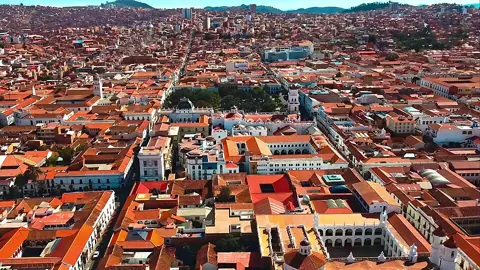
Bolivia does not have two capitals in law. It has one, Sucre, and a government that has operated from somewhere else for more than a century. The constitution names only the capital. We found no mention of a "sede de gobierno" (seat of government) anywhere in the 2009 text, so La Paz's role rests on history and on where institutions actually have their offices.
Which institutions are in Sucre and which are in La Paz?
The split follows the branches of the state, and each institution's own documents show where it sits.
| Institution | City | What shows it |
|---|---|---|
| Tribunal Supremo de Justicia (Supreme Court) | Sucre | Ley 025, article 31, and the court's own address |
| Tribunal Constitucional Plurinacional | Sucre | Ley 027, article 11 |
| Plurinational Legislative Assembly | La Paz, with sessions opening in Sucre each 6 August | Chamber of Deputies address; Constitution article 155 |
| Ministries (e.g. Foreign Affairs) | La Paz | Ministry address on Plaza Murillo |
| Foreign embassies (e.g. US, UK) | La Paz | Embassy addresses on Avenida Arce |
On the judiciary, the law is explicit. The Judicial Branch Law, Ley 025, gives the Supreme Court "sede de sus funciones en la ciudad de Sucre", and the court's website lists its address as Calle Luis Paz Arce 352, Sucre. Ley 027 of 6 July 2010 says the Constitutional Court "tiene su sede en la ciudad de Sucre, Capital del Estado Plurinacional."
The political branches are in La Paz. The Chamber of Deputies gives its address as the new Plurinational Legislative Assembly building on Calle Comercio at Colón, La Paz. The Ministry of Foreign Affairs is on Plaza Murillo in La Paz.
The one day the legislature comes to Sucre
The 2009 Constitution does keep a ceremonial link. Article 155 says the Assembly opens its sessions on 6 August "en la Capital de Bolivia", unless its president calls it elsewhere. In 2026, the Senate president confirmed a Solemn Session of Honour for 6 August at 10:00 in the chamber of the Casa de la Libertad, marking 201 years of independence, with President Rodrigo Paz giving his message to the nation. For that day, the legislature and the president come to Sucre.
Why does the government sit in La Paz?
The short answer is a civil war. Encyclopaedia Britannica summarises it this way: "In 1898 an effort to move the capital to La Paz resulted in a civil war." Its outcome was that "Sucre remained the capital in name and law and the seat of the Supreme Court, but the executive and legislature moved to La Paz." Bolivians call that conflict the Guerra Federal (Federal War), and it left behind the arrangement described above.
Sucre's claim is older. UNESCO's Historic City of Sucre listing calls it "the first capital of Bolivia". The Spanish founded it in 1538 as Ciudad de la Plata de la Nueva Toledo, and it was renamed Sucre in 1839, after independence leader Antonio José de Sucre. UNESCO inscribed the historic centre in 1991 for the way its buildings blend local and European styles.
Visiting the Casa de la Libertad
Bolivia began in this building. According to the museum's description of the Salón de la Independencia, the Deliberative Assembly that created the Republic met in that hall, and the Act of Independence of Upper Peru was signed there on 6 August 1825. The original act is displayed in an urn on a stone column. Before that, the hall was the Jesuits' domestic chapel and then the main hall of the Universidad de San Francisco Xavier. UNESCO dates the building to 1621 and calls it the most important historic monument in Bolivia.
The museum is run by the Fundación Cultural del Banco Central de Bolivia and faces Plaza 25 de Mayo, Sucre's main square. Its visitor information as of September 2026:
- Hours: Monday to Friday 08:30 to 16:30; Saturday and Sunday 09:00 to 13:00. The museum's homepage adds that it closes on national holidays and that the last entry is one hour before closing.
- Tickets: Bs 50 for foreign visitors, Bs 20 for Bolivians.
- Guided visits: every hour, in Spanish, Quechua, English or French.
Two adults from abroad pay 2 × Bs 50 = Bs 100. A couple where one partner is Bolivian pays Bs 50 + Bs 20 = Bs 70. On a weekend, the last entry is at 12:00, so a Saturday afternoon arrival will find it closed. Because it shuts on national holidays and hosts state ceremonies, check before planning a visit around 6 August.
What the split means for travellers
Consular help is in La Paz. The British Embassy is at Avenida Arce 2732 and issues emergency travel documents, with an honorary consulate in Santa Cruz. The US Embassy is at Avenida Arce 2780. If you lose a passport in Sucre, plan for the trip to La Paz, or to Santa Cruz if your country has an office there.
Entry rules depend on your nationality. For US citizens, the State Department says, as of September 2026, that no visa is needed for tourism or business stays under 90 days a year and that passports need six months' validity beyond arrival. Other nationalities should confirm with a Bolivian consulate before booking. If you fly into El Alto, above La Paz, our El Alto airport guide covers the first hours there.
For the question itself, answer "Sucre" in a quiz, a form or a school essay. For anything practical, such as an embassy appointment or a ministry office, look in La Paz.