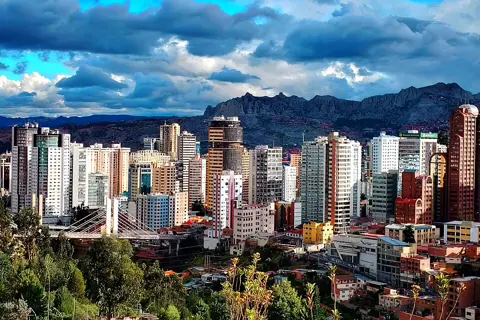
La Paz and El Alto sit on two different levels. The city centre lies in a canyon at about 3,650 metres, while El Alto spreads across the plateau above it at more than 4,000 metres, according to a Global Infrastructure Hub case study. A cable car crosses that slope in a straight line instead of following the streets, and by 2017 an Inter-American Development Bank study was calling La Paz-El Alto the largest urban cable car system in the world.
How the network is laid out
Mi Teleférico has 10 lines, each named after a colour. Their manufacturer, Doppelmayr, lists about 33 km of cableway opened between May 2014 and March 2019. The lines divide into three kinds of job.
Lines that climb the slope carry most of the height difference. The Amarilla (Yellow) line rises 666 metres over 3.7 km from Mirador in El Alto to Libertador. The Roja (Red) line rises 402 metres from 16 de Julio to Estación Central, near the old railway station. The Morada (Purple) line rises 490 metres from 6 de Marzo to Obelisco in the centre.
Lines along the plateau connect El Alto districts with each other and barely climb at all. The Azul (Blue) line runs 4.9 km from Río Seco to 16 de Julio with only 61 metres of rise. The Plateada (Silver) line connects 16 de Julio and Mirador with 34 metres of rise.
Lines inside the canyon tie central and southern La Paz together. The Verde (Green) line runs from Libertador down to Irpavi in the Zona Sur. The Celeste (Sky Blue) line runs from Libertador to El Prado, and the Naranja (Orange) and Blanca (White) lines link Estación Central, Héroes de la Revolución and Avenida del Poeta. The Café (Brown) line is a 714-metre connector between Monumento Busch and Las Villas.
| Line | Terminals (Doppelmayr naming) | Vertical rise |
|---|---|---|
| Roja | 16 de Julio – Estación Central | 402 m |
| Amarilla | Mirador – Libertador | 666 m |
| Verde | Libertador – Irpavi | 130 m |
| Azul | Río Seco – 16 de Julio | 61 m |
| Naranja | Estación Central – Héroes de la Revolución | 307 m |
| Blanca | Héroes de la Revolución – Av. del Poeta | 216 m |
| Celeste | Libertador – El Prado | 180 m |
| Morada | 6 de Marzo – Obelisco | 490 m |
| Café | Monumento Busch – Las Villas | 20 m |
| Plateada | 16 de Julio – Mirador | 34 m |
Stations have both a Spanish and an Aymara name, such as 16 de Julio / Jach'a Qhathu or Estación Central / Taypi Uta, as Doppelmayr lists them, so either may appear on maps.
How much does a ride cost, and how do transfers work?
The fare is charged per line, with a cheaper rate after the first line. A Ministry of Public Works note from 19 December 2025 confirmed that fares had not changed:
- Standard: Bs 3 for the first line, Bs 2 for each transfer.
- Student and preferential: Bs 1.50 for the first line, Bs 1 for each transfer.
Two worked trips at the standard fare:
- Río Seco (El Alto) to Estación Central: Azul to 16 de Julio (Bs 3), then Roja down to Estación Central (Bs 2). Total Bs 5.
- Mirador (El Alto) to El Prado: Amarilla down to Libertador (Bs 3), then Celeste to El Prado (Bs 2). Total Bs 5. Two adults making this trip down and back pay 4 × Bs 5 = Bs 20.
The ministry notes list the Bs 3 and Bs 2 fares without saying whether a transfer has a time limit, or whether a single ticket bought with cash gets the same transfer rate as a card. We could not confirm either point. If you plan to change lines, ask at the boletería before you pay.
The preferential rate is for students and for people covered by the solidarity card for older adults and people with disabilities. A 2017 GIHub summary described it as a 50% discount. The announcements we read do not say whether a foreign visitor's ID qualifies for it.
Cards, the Yala app and paying at the ticket office
Since 16 June 2026 Mi Teleférico has sold new card designs. The family card costs Bs 30 and comes with Bs 5 of credit. The student card and the solidarity card for older adults and people with disabilities cost Bs 20 each. The announcement did not say whether a plain card is still sold for less, so for a short stay compare the card's price with the number of rides you expect to take.
Ticket offices have taken QR payments since 1 April 2026. The ministry said this would be available at all boleterías, with a debit card or a phone QR as alternatives to cash. It confirmed in June that QR payment was in place.
Yala is Mi Teleférico's own app for Android and iOS. Since version 3.5 in February 2026 it lets users top up without registering in person at a ticket office. The ministry describes it as allowing online top-ups and direct entry at the turnstile. Activating the Yala virtual card involves identity checks by facial recognition, and the announcements do not say which identity documents are accepted. A foreign visitor should not rely on the virtual card until it has been activated successfully. Bring cash for the ticket office as a fallback.
When does it run?
According to the ministry, the usual hours are 06:30 to 22:30 Monday to Saturday and 07:00 to 21:00 on Sundays. On public holidays hours are often cut to 07:00 to 21:00, as on 23 January 2026 and over New Year 2026. They are sometimes extended too, as on the Larga Noche de Museos on 11 July 2026, when the system ran until 23:30.
Whole lines close for maintenance. The Morada line was shut from 6 to 8 August 2026 as part of annual technical planning. Closures are announced in advance, so check the ministry's press releases or Mi Teleférico's own channels before a trip that depends on one line.
Is Mi Teleférico step-free?
Mostly, but check that the lift is working. In December 2025 the ministry reported that all stations have wheelchair ramps and tactile floor guidance. It also said that 64 lifts were working and 12 to 14 were being repaired, out of more than 80 across the network. The same note counted more than 115,000 trips by people with disabilities in 2025, about 68,000 of them by wheelchair users.
Why it replaced so much road travel
A trip on a cable car is quicker because it doesn't follow roads. An Inter-American Development Bank study by Ancor Suárez-Alemán and Tomás Serebrisky used surveys from June and July 2015. It found that reported travel times fell by 22% on average, about 9 minutes on a 40-minute trip, when people used the cable car instead of other transport. Doppelmayr now puts ridership at 300,000 or more passengers a day, and the ministry reported a cumulative 700 million passengers in June 2026.
The network also works with buses at its ends. Since August 2026, La Paz BUS feeder routes from Achumani and Chasquipampa have run to Irpavi station on the Verde line, but only at morning and evening peaks. The government has also proposed two more El Alto lines.
Mi Teleférico also runs a tourist cable car in Oruro, priced separately with a higher fare for foreigners. The La Paz fare announcements we read list no separate fare for foreigners.
Planning your first ride
If you land at El Alto, you arrive on the plateau, so the climbing lines take you down, not up. Our El Alto airport arrival guide covers that first transfer and the first hours at altitude. If you are also going to Sucre, our explainer on Bolivia's two capitals explains why government offices are split between the two cities.
Before your first ride, pick your two terminal stations from the table above and see where their lines meet. Carry small notes for the boletería. If a sign at the station says your line is closed for maintenance, look for another route: the Roja and Morada lines both run from El Alto to the city centre, and the Amarilla line runs to Libertador.