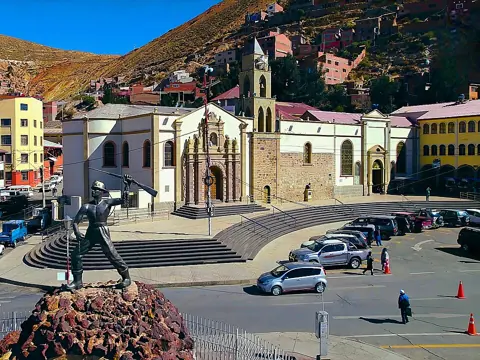
The Carnaval de Oruro is a pilgrimage that happens to look like a parade. Dancers are not competing for a prize. They are keeping a promise to the Virgen del Socavón, patron of the mining town, by dancing about 3.5 to 4 km to her sanctuary, and that shapes how a visitor should plan everything else.
What is the Carnaval de Oruro?
UNESCO's Intangible Cultural Heritage listing traces it to the Uru people's Ito festival. After the Spanish banned Andean rites in the 17th century, the ceremonies carried on inside Christian liturgy, attached to Candlemas on 2 February. The llama llama or diablada, a dance once dedicated to the Uru god Tiw, became the carnival's main dance. UNESCO proclaimed the carnival a Masterpiece of the Oral and Intangible Heritage of Humanity in 2001 (ABI gives the date as 18 May 2001) and moved it onto the Representative List in 2008.
The core event is the entrada, the procession to the Santuario del Socavón. UNESCO describes it as more than 28,000 dancers and 10,000 musicians walking the route for about 20 hours without stopping.
How the fraternities are organised
The Asociación de Conjuntos del Folklore de Oruro (ACFO) groups the dance fraternities. For 2026 the state news agency ABI listed 52 officially recognised fraternities in six blocks. Order goes by institutional seniority, and each block opens with a diablada, followed by a morenada and caporales.
That seniority rule tells you what you will see first. The entrada opens with the three oldest groups: Diablada Auténtica Oruro, Incas Hijos del Sol and Morenada Zona Norte. According to ABI, the 2026 entrada included five diabladas, seven morenadas, six caporales groups, three of tobas, three of tinkus, and two each of kullawada, waca waca and llamerada, among 18 recognised dance styles.
When is the Carnaval de Oruro in 2027?
The entrada follows Christian carnival, so it moves every year. It is always the Saturday before Ash Wednesday, and Ash Wednesday falls 46 days before Easter. The US Naval Observatory explains the Easter rule: the first Sunday after the ecclesiastical full moon on or after 21 March, so never before 22 March or after 25 April.
The calculation for the next two years:
| Year | Easter Sunday | Ash Wednesday | Entrada Saturday |
|---|---|---|---|
| 2026 (held) | 5 April | 18 February | 14 February |
| 2027 | 28 March | 10 February | 6 February |
| 2028 | 16 April | 1 March | 26 February |
The 2026 line matches what happened: ABI reported the entrada on Saturday 14 February, continuing on Sunday 15. The Oruro municipality launched Carnaval 2027 on 21–23 August 2026, but none of the coverage we read gave a date. Treat 6 February 2027 as a calculated date until the municipality or ACFO confirms it, and book around it.
The UNESCO description says the carnival as a whole lasts ten days. For most visitors, Saturday is the reason to come. In 2026, Mass began at 06:30 and the fraternities set off at 07:00.
How do you get a seat to watch the entrada?
Along the route, private operators build tiered wooden grandstands called graderías and sell seats in them. The Gobierno Autónomo Municipal de Oruro licenses and inspects them. For 2026 it capped seat prices at Bs 900 in the central sectors, such as the main square. The municipal culture secretary said seats elsewhere on the route ranged from Bs 100 to Bs 300, and operators who break the cap face fines and can lose their preferential right to build graderías the following year.
What a couple might pay for Saturday at the 2026 prices:
- Two seats in a mid-route gradería: 2 × Bs 100 = Bs 200, up to 2 × Bs 300 = Bs 600.
- Two seats in a central sector at the cap: 2 × Bs 900 = Bs 1,800.
The municipality said it was preparing an official price table so buyers could report overcharging. Ask for it, or ask the municipality, before paying anything above Bs 300 outside the centre.
Safety is part of the licence. Days before the 2026 entrada, the municipality and the Bolivian Police inspected the graderías, their access points and lighting, and the police reported shortcomings that had to be fixed at once. The municipality also checks the strength of the structure, the thickness of the planks and the seats, and each gradería must have a rubbish bin. On the eve of the 2026 entrada, it removed unauthorised cubicles on Avenida Cívica that blocked spectators' view.
Seats and beds run out. The day before the 2026 entrada, ACFO's president said hotels were full and gradería seats were sold out. If you only decide in February, expect to compete for both, and keep a day trip from La Paz as the fallback, accepting that you may end up without a seat.
Getting to Oruro from La Paz
The bus is the default. The La Paz bus terminal said Oruro would be its busiest route from the Friday before the 2026 entrada, with police, immigration and child-protection staff doing joint checks. The terminal manager advised passengers not to accept food or drink from strangers. We did not find an official fare or journey time for the route, so check both at the terminal.
For 2026 there was also a one-off rail option. The Ministry of Public Works and Ferroviaria Andina ran a one-way "Tren Carnavalero" on Friday 13 February, leaving Viacha at 12:00 for a trip of about six hours. It cost Bs 180, including the transfer from Mi Teleférico's Morada line in El Alto to Viacha station. Nothing we read says whether it will run in 2027. If it does, our Mi Teleférico guide explains how to get to the Morada line.
Plan the trip back as carefully as the trip out. On Carnival Tuesday 2026, the Martes de Ch'alla, the La Paz and Cochabamba terminals suspended interdepartmental and international departures, and local media reported services resuming on Wednesday. Aim to be back in La Paz by Monday if you have a flight.
On the day
Be in your gradería before the 07:00 start, and pace yourself: by UNESCO's count the procession runs about 20 hours. Keep valuables close: the US State Department, whose advisory for Bolivia was at Level 2 as of 18 August 2026, notes that pickpocketing and petty theft are common and can occur on buses and in bus stations. It also warns that large demonstrations can happen with little warning and may block transport, so check road conditions the evening before you travel in either direction.