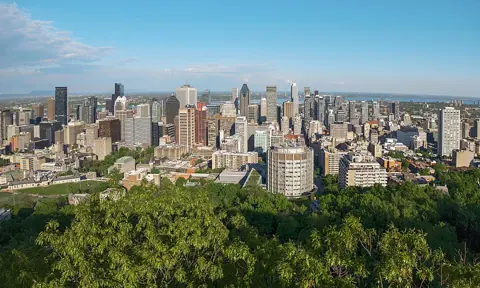
Quebec produces most of the world's maple syrup
Quebec's dominance in maple syrup is a matter of measured production, not marketing. Agriculture and Agri-Food Canada reports that in 2025 Canada accounted for more than 75% of total world maple syrup production, with 90.0% of Canadian production originating in Quebec, 6.1% in New Brunswick, 3.7% in Ontario and 0.2% in Nova Scotia. The United States is the only other commercial-scale producer, at roughly 25% of the global total, concentrated in Vermont, New York and Maine.
The scale is unusual for a food you buy in a gift shop. Canadian producers harvested 113.4 million kilograms of syrup in 2025, of which Quebec accounted for 102.1 million kilograms, and Canadian maple products were exported to 69 countries, with 64.2% of export volume going to the United States. Statistics Canada's own release for the 2025 crop puts national production at 18.9 million gallons and Quebec's share of it at 90.0%, a figure the agency revised down from an initial 90.4% in a published correction notice dated 16 December 2025.
The federation, the quota and the strategic reserve
Quebec's maple output is managed collectively rather than left to individual producers. Agriculture and Agri-Food Canada describes the Federation of Quebec Maple Syrup Producers as an organisation that controls the quantity of production in the province and maintains a strategic reserve of storable maple syrup, held specifically to minimise fluctuations in pricing and in the availability of supply, which are driven by the natural variability of the annual harvest. The same source records the federation adding 5 million taps in 2017, and notes that the number of maple farms in Canada rose 19.2% between the 2016 and 2021 censuses, growth concentrated in Quebec.
For a traveller, this structure has one concrete consequence: the price of Quebec maple syrup is far more stable year to year than the weather that produces it. A bad spring does not empty the shelves or double the price the way it would for an unmanaged crop, because the reserve is released to cover the gap. It also means the price difference you see between two shops in Montreal usually reflects packaging, retail margin and organic certification rather than a difference in the underlying commodity.
What Golden, Amber, Dark and Very Dark actually mean
The four colour classes are set out in Canadian regulation, not chosen by the packer. The Canadian Food Inspection Agency lists the four colour classes for Canada Grade A maple syrup as "Golden, Delicate Taste", "Amber, Rich Taste", "Dark, Robust Taste" and "Very Dark, Strong Taste", each of which must appear in both English and French on qualifying syrup. There are only two grade names for Canadian maple syrup, Canada Grade A and Canada Processing Grade, and colour classes do not exist for processing grade at all.
The classes describe intensity, not quality. Tourisme Montreal explains the pattern behind them: the syrup grows darker as the season progresses and the taste increases in intensity, so a Golden syrup is early-season and a Very Dark one is late-season from the same trees. That leads to a rough buying rule rather than a hierarchy.
| Colour class | Character | Typical use |
|---|---|---|
| Golden, Delicate Taste | Lightest, mildest | Where you want to taste the syrup alone |
| Amber, Rich Taste | Mid-range | General table use, pancakes, yoghurt |
| Dark, Robust Taste | Pronounced maple flavour | Cooking, glazes, strong coffee |
| Very Dark, Strong Taste | Strongest | Baking and sauces, where flavour must survive heat |
If you are buying one bottle to take home and do not know the recipient's preference, Amber is the least specialised choice. If you are buying to cook with, the darker classes carry their flavour through heat better.
Telling real maple syrup from table syrup
The single most reliable check is the common name printed on the front of the container. Under Canadian labelling rules, syrup that meets the standard of identity must use the prescribed common name "maple syrup", and a product that does not meet that standard cannot use it. The CFIA gives the alternatives explicitly: a product made from sugar, water and maple flavouring without any maple syrup can be called "table syrup" or "gourmet syrup", and a blend can be called something like "blended syrup with x% natural maple syrup".
Two further label facts help. Maple syrup is a single-ingredient food obtained only by concentrating maple sap, so its common name is considered to be its ingredient list; a long ingredient list is itself the answer. And imported prepackaged maple syrup in containers of 5 litres or less must carry a country of origin declaration, so "Product of Canada" on a Montreal shelf is a checkable claim rather than a slogan. Canadian syrup packed abroad and re-imported cannot say "Product of Canada" at all and must instead say it was packed in another country from Canadian maple syrup.
Sugar shack season and what a cabane a sucre is
A cabane a sucre is a working sugaring operation that opens for meals during the boiling season, and the season is short. Tourisme Montreal puts the sugaring-off period at roughly late February or early March through to the end of April or early May, which is the only window in which visiting one is possible. Outside those weeks the sap is not running and the shacks that open year-round are running as restaurants rather than as producers.
The meal is fixed in form more than in menu. It is usually taken as brunch or lunch, starts with yellow pea soup, and continues through maple-baked ham, eggs, sausages, tourtiere, baked beans and creton, with syrup poured over most of it. It ends with tire d'erable, hot syrup poured in rows onto fresh snow, left to set for a moment and then rolled onto a stick. If you are in Montreal outside the season and want the same flavours, the maple products themselves are sold year-round; the meal is not.
Carrying syrup home by air
Maple syrup is treated as a liquid at Canadian airport security, with no exception for it being food. The Canadian Air Transport Security Authority lists maple syrup in a can or jar as permitted in carry-on only in a container of 100 ml or smaller, and permitted in checked baggage. Maple spread is classed as a gel and falls under the same carry-on restriction. In practice this means any bottle worth buying travels in the hold.
Two things to settle before you buy. Check your airline's checked baggage weight allowance, because glass bottles of syrup are dense and a one-litre can plus packaging is a meaningful share of a 23 kg allowance; tins are lighter and less likely to break than glass. And check your destination country's own import rules for food, which are set by that country's customs or agriculture authority, not by Canada. Many countries admit commercially packaged, shelf-stable syrup without difficulty, but declaration requirements, quantity thresholds and duty-free allowances differ, and the obligation to declare food on arrival is common. Confirm on your own government's customs page before you fly rather than at the baggage carousel.
Before you pay at the counter
Turn the container around and read three things: the common name, the grade and colour class, and the country of origin. If the front says "maple syrup", the label carries one of the four Canada Grade A colour classes in both languages, and the origin declaration matches what the shop told you, the product is what it claims to be. Then decide the format on the basis of your flight: small enough for carry-on at 100 ml or less, or a tin in checked baggage with the weight allowance checked first.