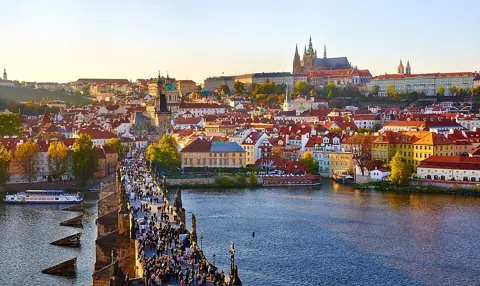
Prague sits in Bohemia, and most first-time visitors to Czechia never leave it. That is a reasonable choice for a short trip, but it also means most visitors experience only half of what "Czech" culture actually contains. Moving east into Moravia changes the food, the drink, the accent and the rhythm of small-town life enough that treating the two as interchangeable undersells both.
Two historical lands, one modern country
Bohemia and Moravia are historical lands, not current administrative units — Czechia's modern regions (kraje) don't follow the old Bohemia-Moravia border exactly, and a third historical land, Czech Silesia, sits in the northeast around Ostrava. Bohemia covers the western and central part of the country, including Prague, Plzeň (Pilsen) and Karlovy Vary. Moravia covers the east and southeast, centred on Brno, with Olomouc and the wine country around Znojmo and Mikulov further southeast still.
There is no checkpoint, sign or dramatic landscape change marking the boundary. The shift is cultural and gradual, spread across the middle of the country, and most visible in a handful of concrete things: what people drink by default, how some place names and everyday words are pronounced, and which historical narrative a town's museum leads with.
Where beer gives way to wine
Bohemia is the historical and commercial centre of Czech beer. Plzeň gave the world the pale lager style, and Bohemia is dense with breweries, brewing tradition and the pub culture described in VoyageWindow's separate guide to Czech beer and hospoda customs. In Bohemia, ordering wine in an ordinary pub is possible but slightly beside the point — beer is the default, and it is usually the better product on offer.
Moravia flips that default. According to Czechia's national tourism board, Moravia is the country's most significant wine region and has the country's oldest documented winemaking tradition, spread across roughly 300 wine-producing municipalities and more than a thousand vineyards, organised into four main subregions: Znojmo, Mikulov, Velké Pavlovice and Slovácko. White wine dominates, led by Grüner Veltliner and Riesling, with red varieties including Blaufränkisch (Frankovka) and Saint Laurent alongside Moravia-specific crossings.
This matters practically: a wine-focused evening built around a cellar tasting or a vineyard walk is a Moravian plan, built around towns like Mikulov or Znojmo, not something to expect as the highlight of a Prague trip. Conversely, a serious tank-beer pub crawl is a Bohemian plan.
Landscape, pace and towns
Bohemia's landscape around Prague is river valleys, forested hills and dense medieval town centres packed close together, which is part of why day trips from Prague work well within a couple of hours. Moravia opens out into gentler, more agricultural country in its southeast — vineyard slopes, wine-cellar villages and a warmer microclimate that supports the grape varieties grown there. Brno, Moravia's largest city, has its own distinct urban character: a functionalist architectural heritage (the Villa Tugendhat is a UNESCO-listed example), a large student population, and a noticeably different pace from Prague's tourist-facing centre.
Accent, dialect and identity
Czech spoken in Moravia carries recognisable regional features — differences in vowel sounds, some distinct vocabulary, and in places a lilt that Czechs from Prague will immediately place as "Moravian" without needing to ask where someone is from. This is a matter of accent and regional identity within one shared Czech language, not a separate language or a barrier to understanding.
Regional identity runs deeper than accent for some Moravians, tied to Moravia's own history as a margraviate with a separate political status for centuries before Czechoslovak and then Czech statehood absorbed it. You will meet people who describe themselves as Moravian first and Czech second, and others for whom the distinction barely registers day to day. Neither reaction is more "correct."
Food follows the same divide
The regional split shows up on plates as well as in glasses. Bohemian cooking leans on pork, dumplings and cabbage, with dishes like svíčková (marinated beef in a cream sauce) and roast pork with bread or potato dumplings as everyday restaurant staples in Prague. Moravian cooking shares much of that base but folds in more of a rural, wine-country character — dishes built around duck, goose and freshwater fish appear more often on Moravian menus, and food is more routinely paired with a specific local wine than with beer, the reverse of the Bohemian default. Neither cuisine is more "authentically Czech" than the other; they're regional variations on the same broader tradition, shaped by what each region actually produces.
Planning around the difference
If your trip is Prague-only, this distinction mostly explains things you will notice rather than changes you need to plan for: why the pub culture feels so central, why wine lists in Prague restaurants often lean on Moravian producers rather than imports, and why a menu might proudly label a wine "Moravian" the way an Italian menu might flag a wine's specific region.
If you are extending beyond Prague, treat Bohemia and Moravia as two different short trips rather than one blended itinerary. A single day trip cannot cover both meaningfully — Brno and the Moravian wine country sit roughly two to three hours from Prague by train depending on the route, which puts a same-day round trip within reach but leaves little time on the ground; a wine-region visit to somewhere like Mikulov realistically needs an overnight stay to be worth the travel.
Before you plan beyond Prague
Confirm current train or bus schedules and journey times to Brno, Olomouc or the Moravian wine towns directly with České dráhy (cd.cz) or RegioJet before committing a full day to the trip, since a same-day round trip to southeastern Moravia leaves a genuinely short window on the ground once travel time is subtracted.