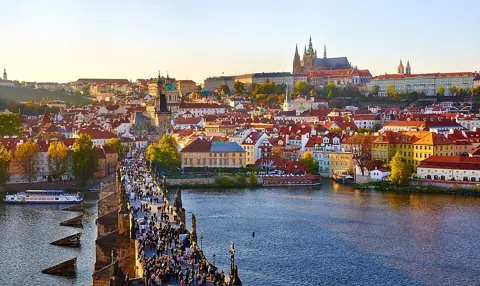
Walk from Old Town Square to the Charles Bridge and up to Prague Castle, and you are moving through roughly seven centuries of continuous construction without a single obvious gap. That continuity is unusual for a major Central European capital, most of which lost large parts of their historic fabric to 20th-century warfare and the reconstruction that followed. Prague's centre did not.
What actually makes up "the historic centre"
UNESCO's Historic Centre of Prague listing covers the historic core of the city — built up mainly across the medieval districts of the Old Town (Staré Město), the Lesser Town (Malá Strana) and the New Town (Nové Město), along with the Castle district above the river — as a single serial property, together with the separately located Průhonice Park southeast of the city. The listing recognises the site for three linked reasons: it shows continuous urban growth from the Middle Ages to today and influenced later urban development across Central and Eastern Europe; it forms an architectural ensemble of exceptional quality in both individual buildings and the overall townscape; and it played an outstanding role in medieval European culture and learning, including through Charles University, founded in Prague in 1348.
Most of what defines the skyline and street pattern took shape between the 11th and 18th centuries, with a major building boom in the 14th century under Holy Roman Emperor and Bohemian King Charles IV, whose projects included the New Town's layout, the Charles Bridge and the core of St Vitus Cathedral.
Why the centre avoided the destruction seen elsewhere
Prague's historic core did not undergo the scale of physical destruction that reshaped the historic centres of many other Central European cities in the mid-20th century. The city was not the target of the sustained area bombing that flattened parts of cities further west and north during the war, and its historic building stock — the churches, palaces, townhouses and bridges that make up the UNESCO site — survived that period largely structurally intact.
That survival is a matter of what did not happen to the buildings, not a story of active wartime protection or a deliberate decision by any single actor — and it's a narrower claim than "Prague was untouched by the 20th century." The city still went through occupation, a difficult postwar and Communist-era period, and decades of underinvestment in maintenance that left many historic buildings in poor physical condition by the time of the political changes of 1989, even where their basic structure remained.
Reading the layers as you walk
Because so much of the centre survived physically, buildings here tend to show multiple historical layers stacked on top of each other rather than being a clean example of one single style. A few patterns are worth watching for as you walk:
- Ground-floor arcades and vaulted cellars in Old Town buildings often preserve Romanesque or early Gothic stonework, even where the visible street-level façade above is a much later Baroque or Rococo remodelling.
- Sgraffito façades — a scratched, two-tone plaster decoration technique — mark Renaissance-era work, visible on buildings like the House at the Minute, standing right beside the Prague Astronomical Clock on Old Town Square.
- Ornate curved Baroque façades, common through Malá Strana and much of the Old Town, largely date from the 17th and 18th centuries, a period of extensive rebuilding after the Thirty Years' War, when many older Gothic buildings were reworked rather than replaced.
- Later 19th- and early 20th-century insertions, including Art Nouveau buildings like the Municipal House, sit directly alongside much older neighbours, filling in gaps or replacing individual buildings without disrupting the surrounding medieval street pattern.
A single building on a street like Karlova or Nerudova can carry a Romanesque cellar, a Gothic ground floor, and a Baroque upper storey and façade — not because anyone planned it that way, but because each generation built onto what was already standing rather than starting over.
The centre's current pressures
UNESCO's own state-of-conservation assessment for the site identifies development pressure — particularly proposals for buildings and roofscapes that would alter the historic skyline — as an ongoing concern, alongside the routine challenge of maintaining historic materials and craftsmanship across such a large, continuously inhabited area. The city also faces river flood risk, managed since major flooding in 2002 through improved protective barriers along the Vltava.
The property's dual structure is also worth understanding if you plan to visit both parts: the historic urban centre and Průhonice Park, an English-style landscaped park with an extensive rose collection, are listed as one serial site despite sitting in different parts of the city, connected by their shared history rather than by geography. Most visitors only ever see the urban half, which is reasonable for a short trip, but it means the "Historic Centre of Prague" you read about on a UNESCO plaque is technically a larger designation than the streets you're walking through.
Walking the centre with this in mind
None of this changes where you should walk, but it changes what you're looking at while you do. A building with an obviously mismatched roofline, an oddly narrow infill structure between two older neighbours, or a ground floor that looks structurally older than the storeys above it is not a flaw in the streetscape — it is usually a visible record of the centre's long, continuous rebuilding rather than a single planned design. Prague's centre reads less like a museum piece frozen at one moment and more like a document that has been edited by every generation that lived in it, which is precisely the quality UNESCO's inscription is built around.
What this guide does not cover
This overview covers the historic centre's physical survival and layering, not a walking-route itinerary through it or ticketed access to individual monuments like Prague Castle or St Vitus Cathedral, both of which have their own opening hours and admission rules that change independently of the history described here.