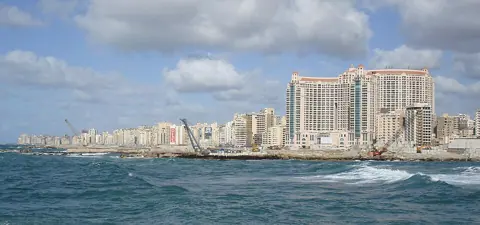
Sultan al-Ashraf Qaitbay built his harbour fort between 1477 and 1479 on the ruins of Alexandria's ancient lighthouse, according to Egypt's Ministry of Tourism and Antiquities. That pairing sets the pattern for the whole city: what survives of Hellenistic and Roman Alexandria is mostly underneath or inside later buildings, so a day trip works best when it is built around a few places where those layers can actually be seen, not around the famous names alone.
How do you get from Cairo to Alexandria by train?
The express train from Cairo's Ramses station is the usual route for a day trip. The Man in Seat 61, a rail travel guide updated on 14 September 2026, describes three express types on the line (Talgo, VIP Express and Spanish-built express trains) and puts the journey at about 2.5 hours.
The same guide reports that non-Egyptians pay separate foreigner fares priced in US dollars, that the Egyptian National Railways booking website is limited to Egyptian citizens, and that foreigners can buy at the Arab and Foreign Reservation Office in Ramses station. We could not open the Egyptian National Railways site to confirm timetables or fares, so check departure times at Ramses the day before, and book the return at the same time.
Two things follow from a 2.5-hour ride each way. Five hours of your day are spent on the train, which leaves time for three or four sites, not the whole city. And a late return train is the natural choice, which is why the fort's evening hours matter.
Which Bibliotheca Alexandrina ticket should you buy?
The Bibliotheca Alexandrina is a modern institution which describes its mission as recapturing "the spirit of openness and scholarship" of the ancient library, in its own words. Visitors expecting ancient ruins will find a working library, museums and exhibition halls instead.
The admission page sets separate prices for non-Egyptians. A Main Library ticket already includes guided tours, Culturama shows, the Sadat Museum and the permanent and temporary exhibitions.
| Ticket (non-Egyptian) | Adult | Student |
|---|---|---|
| Main Library | EGP 150 | EGP 20 |
| Antiquities Museum | EGP 100 | EGP 50 |
| Manuscripts Museum | EGP 60 | EGP 30 |
| Inclusive: Main Library, Antiquities, Manuscripts | EGP 300 | EGP 120 |
The inclusive ticket is not always the better buy. An adult who wants all three pays EGP 150 + 100 + 60 = EGP 310 separately, so the inclusive ticket saves EGP 10. A student pays EGP 20 + 50 + 30 = EGP 100 separately, EGP 20 less than the EGP 120 inclusive ticket. An adult who skips the manuscripts pays EGP 250 for the library and Antiquities Museum.
The admission page lists the History of Science Museum as closed for maintenance and did not give opening hours or a weekly closing day. Check the library's site on the morning of your trip before building the day around it.
What else fits into one day?
The Ministry of Tourism and Antiquities publishes hours and prices for the state sites. They differ enough to decide the order of your day.
| Site | What you see | Hours | Foreign adult / student |
|---|---|---|---|
| Qaitbay Fort | 15th-century Mamluk fort on the lighthouse site | Daily 09:00 to 20:00 | EGP 200 / 100 |
| Kom el-Dikka | Roman and Byzantine quarter, 2nd to 6th century AD | Daily 09:00 to 17:00 | EGP 200 / 100 |
| Graeco-Roman Museum | The city's classical collection, founded 1892 | Sun to Thu 09:00 to 17:00; Fri and Sat 09:00 to 20:00 | EGP 400 / 200 |
| Alexandria National Museum | Prehistory to modern era, in a former pasha's palace | Daily 09:00 to 17:00 | EGP 220 / 110 |
The Ministry describes Kom el-Dikka as an open-air museum holding Egypt's only Roman theatre, a small odeon, plus the Villa of the Birds and Roman baths with underfloor heating. The National Museum occupies the Italianate palace of Asaad Basili Pasha, opened to the public in 2003, and includes artefacts raised from Abu Qir Bay. At the Graeco-Roman Museum, the ticket window closes at 16:30 from Sunday to Thursday and at 19:00 on Friday and Saturday.
Other sites appear on the Ministry's ticket list dated November 2024: the Catacombs of Kom el-Shoqafa and Pompey's Pillar at EGP 200 each for foreign adults, the Royal Jewellery Museum at EGP 220, and the Mustafa Kamel and Anfushi tombs at EGP 100 each. The prices it gives for Qaitbay, the Graeco-Roman Museum and the National Museum match the Ministry's current site pages, though the list closes Qaitbay at 19:00 rather than 20:00, so don't leave the fort to the last hour.
A workable order
- Start at whichever museum closes first on your day: the Graeco-Roman Museum or the National Museum on a Sunday to Thursday, both of which close at 17:00.
- Walk the Kom el-Dikka ruins before 17:00.
- Spend the middle of the day at the Bibliotheca Alexandrina, where the guided tour is included in the Main Library ticket.
- End at Qaitbay Fort, open until 20:00, before the train back.
If the return is on a train you have not yet booked, or if you want both Kom el-Shoqafa and the Graeco-Roman Museum, switch to an overnight: the site hours above cannot fit five ticketed stops and five hours of rail into one day. On a Friday or Saturday, the Graeco-Roman Museum's later closing frees the morning: see Kom el-Dikka first, take the museum in the late afternoon and keep the fort for the end.