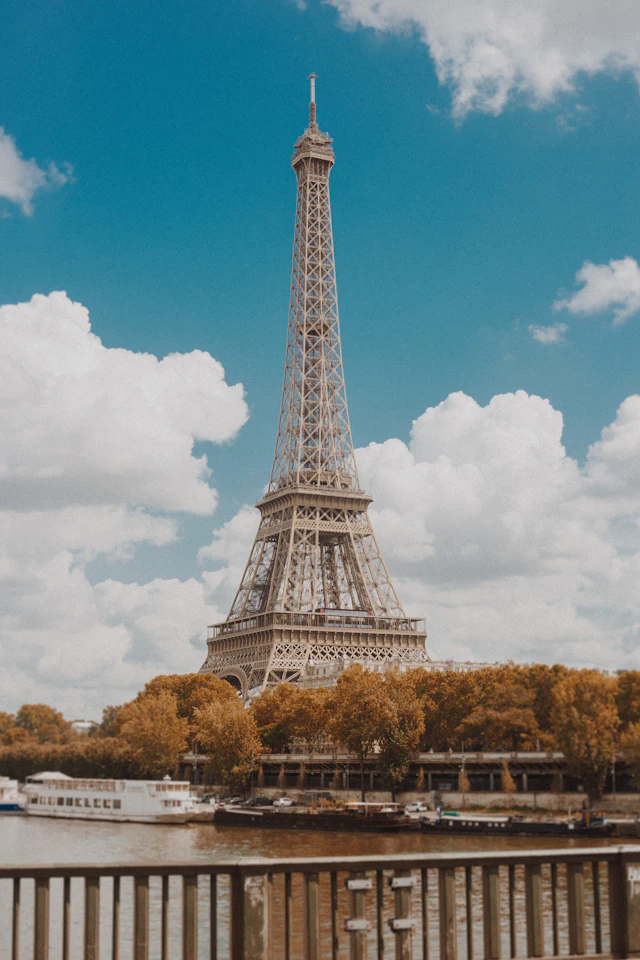
Paris tap water is not a second-best option to bottles: the water utility, Eau de Paris, describes the water at its public fountains as of a quality comparable to bottled water. And the Wallace fountains are not museum pieces; most of them are still in working order, and they run on the same network as every building in the city.
This guide covers what the 2024 tests found, what is in the water, how many Wallace and sparkling fountains actually work, what the law says about a free carafe, and how to refill a bottle. It relies on Eau de Paris, the regional health agency (ARS Île-de-France), the City of Paris open-data portal and the DGCCRF, France's consumer authority.
What the 2024 tests found
The independent check on Paris water is the health agency's annual report. The ARS Île-de-France report for 2024 on the Eau de Paris network, which Eau de Paris publishes on its website, splits the city into four distribution zones: Centre, Nord-Ouest, Sud-Ouest and Est.
Three zones had a clean record. Centre had 521 samples, Nord-Ouest 264 and Sud-Ouest 411, with no non-compliant sample for either bacteriological or physico-chemical limits, and each was graded A, "eau de bonne qualité", good-quality water.
The Est zone had one exception. Of 405 samples, all met bacteriological limits and 99.75% met physico-chemical limits; the report says the water showed "un dépassement ponctuel de la limite de qualité pour un pesticide", a one-off exceedance of the limit for a pesticide, "sans toutefois nécessiter de restrictions d'usage", without any restriction on use. The zone was graded B, "eau de qualité convenable ayant fait l'objet de non-conformités limitées".
The agency's standard conclusion for the compliant zones is that the water "a été conforme aux limites de qualité réglementaires fixées pour les paramètres bactériologiques et physicochimiques", met the regulatory limits for the parameters tested, "compte tenu des connaissances scientifiques actuelles", in the light of current scientific knowledge.
One caveat on the document: the PDF carries the header "Rapport non validé", unvalidated report. It is the version Eau de Paris links from its quality page, and this guide reports it as published.
The report also explains what happens when something goes wrong. The ARS says samples are analysed by laboratories approved by the health ministry, that the operator is informed immediately of any breach of standards and must correct it, and that in the most serious cases the measures can go as far as advising against using the water for food. The 2024 report records no restriction on use in any Paris zone.
Testing is done twice over. Eau de Paris says its own laboratory analyses more than 300,000 microbiological or physico-chemical parameters a year, with continuous monitoring, and that an independent laboratory mandated by the health authorities runs a separate check whose summary the ARS publishes monthly.
What is in Paris water
Paris water comes half from rivers and half from underground. Eau de Paris says half is drawn from the Seine and the Marne and treated at plants in Orly and Joinville, and the other half is groundwater collected within about 150 kilometres, around Provins, Sens and Fontainebleau to the south and near Verneuil-sur-Avre to the west.
River water goes through several stages. Eau de Paris describes screening and clarification, then ozonation, ultraviolet treatment and finally "une faible quantité de chlore", a small amount of chlorine, added to guarantee its quality all the way to your tap. The ARS report measured average free chlorine of 0.12 to 0.16 milligrams per litre across the four zones.
Chlorine is one of the complaints residents make. Eau de Paris's 2026 residents' survey, run by the pollster Qualimétrie with 1,000 people in June 2026, found 85% satisfied, and said the main reservations concerned taste, smell, chlorine and limescale. Trust in tap-water quality stood at 77%, down 8 points on 2025.
The same survey describes how residents drink. Three in four drink tap water at home, nearly one in two choose tap water when out and about, and a quarter regularly use the fountains, according to Eau de Paris.
Once treated, the water is stored in five large reservoirs on the edge of the city and distributed through 2,000 kilometres of pipes, according to Eau de Paris.
Limescale follows from hardness. The ARS says water can become scale-forming from about 20 French degrees of hardness, and its 2024 figures for Paris ranged from 14.01 to 36.50 degrees depending on the zone and sample. The ARS classes calcium and magnesium, the minerals behind hardness, among the non-toxic elements that make up water's natural mineral content.
Nitrates are also reported zone by zone. The regulatory limit is 50 milligrams per litre; 2024 averages were 38.03 in Centre, 36.63 in Nord-Ouest, 31.94 in Sud-Ouest and 21.38 in Est, with no sample above the limit.
Eau de Paris also publishes a typical mineral profile from its laboratory. The table below gives its figures alongside the limits it cites from the public health code; the page does not state units.
| Name | Local name | What it is | Price range |
|---|---|---|---|
| Calcium | calcium | Main hardness mineral; Eau de Paris figure 90 | No fee stated |
| Magnesium | magnésium | Mineral; Eau de Paris figure 6 | No fee stated |
| Sodium | sodium | Figure 10 against a limit of 200 | No fee stated |
| Nitrates | nitrates | Figure 29 against a limit of 50 | No fee stated |
| Fluoride | fluor | Figure 0.17 against a limit of 1.5 | No fee stated |
| Total mineralisation | minéralisation totale | Dry residue at 180°C; figure 420 | No fee stated |
| Tap water | eau du robinet | The same network water served to every building | €0.0042 per litre (Eau de Paris) |
| Carafe of water | carafe d'eau | Tap water served with a restaurant meal | Free |
Fluoride is low. The ARS notes that a concentration close to 1 milligram per litre helps prevent tooth decay and that levels above 2 to 3 milligrams per litre can be harmful; the Eau de Paris profile gives 0.17 against a limit of 1.5.
Eau de Paris puts the price of its water at €0.0042 a litre, and says someone drinking 1.5 litres a day spends €2.32 a year. At 1 January 2026, the full price was €4.23 per cubic metre including tax, excluding the subscription.
Wallace fountains, then and now
The Wallace fountain is a philanthropic gift from the aftermath of war. Eau de Paris says Sir Richard Wallace (1818–1890), a wealthy Englishman moved by what Parisians suffered during the siege of 1870–1871, which had cut off their running water, gave the city 50 drinking fountains. The first was inaugurated in 1872 on boulevard de la Villette.
A Musée Carnavalet curator quoted by Eau de Paris places the gift in a wider English philanthropic movement of installing drinking fountains to encourage people to choose water over alcoholic drinks.
The design is by the sculptor Charles-Auguste Lebourg, cast in iron so it could be reproduced in numbers. Eau de Paris says there are three models: the large model with four caryatids back to back under a dome decorated with dolphins, which is the most common; a small-column model; and a wall-mounted model, whose last example is on rue Geoffroy-Saint-Hilaire.
Something the originals had is gone. Eau de Paris says the fountains were first fitted with pewter cups on chains, "supprimés pour des raisons d'hygiène en 1952", removed for hygiene reasons in 1952.
The colour is another detail with a story. Eau de Paris attributes the choice of colour to Napoleon III, and says seven Wallace fountains in other colours can be seen in the 13th and 20th arrondissements.
How many are left depends on which source you read. Eau de Paris says "plus d'une centaine", more than a hundred, and that fifty have a hidden misting system. Its open dataset on the City of Paris portal, updated on 21 September 2026, listed 113 Wallace fountains, of which 104 were marked available and nine were not.
The fountains need heavy maintenance. An Eau de Paris fountain specialist says a Wallace weighs nearly 600 kilograms and comes apart in three main blocks, and a maintenance technician says a full restoration takes one to two months on average.
For the 150th anniversary, an original Wallace was installed in the courtyard of the Musée Carnavalet, the museum of the history of Paris. Eau de Paris gives the month as April 2022 on one page and March 2022 on another; both agree on the year. If you are building a walking route, our three days by arrondissement guide can help you string neighbourhoods together.
Sparkling and other fountain types
Paris offers free fizzy water in the street. Eau de Paris says Paris was the first city in France to offer sparkling water free at public fountains, with the first "Pétillante" installed in the jardin de Reuilly in 2010, and that there are now 17. The open dataset matches, listing 17, of which 16 were marked available on 21 September 2026.
The Wallace and the Pétillante are only two of about ten fountain types. The comparison table uses the counts in the Eau de Paris open dataset of 21 September 2026 and the descriptions on Eau de Paris's own pages.
| Type | What Eau de Paris says | Records in dataset |
|---|---|---|
| Fontaine bois | Largest dataset category; the dataset does not define it | 979 |
| Wallace | Cast-iron caryatid fountain, first installed 1872 | 113 |
| 2-in-1 fountain | Dataset category; not described separately on Eau de Paris pages | 101 |
| Arceau | "O"-shaped, accessible to children and wheelchair users | 50 |
| Borne fontaine | Post fountains, mainly in parks, dating from the mid-19th century | 42 |
| Pétillante | Free sparkling water; first in 2010 | 17 |
| Totem | Called "the star of the quays" in summer | 10 |
| Poings d'eau | Five artworks along tram T3, by Pascale Marthine Tayou | 5 |
| Albien | Water drawn from 600 metres underground | 3 |
| Millénaire | Created in 2000; Eau de Paris says four | 3 |
The Albien fountains are the curiosity. Eau de Paris says they draw on a deep aquifer through wells drilled between 1996 and 2002, and the three with fountains are at place Paul-Verlaine (13th), square Lamartine (16th) and square de la Madone (18th). Their water is low in minerals and rich in iron, and is treated to make it drinkable.
The simpler fountains have their own history. Eau de Paris credits the post fountains, found mainly in parks and gardens, to the comte de Rambuteau, prefect of the Seine from 1833 to 1848, and places the four Millénaire fountains, created in 2000, on the parvis of Notre-Dame, place Saint-Michel, quai François-Mauriac and at the Bibliothèque François-Mitterrand.
Public fountains long mattered for another reason. Eau de Paris says water carriers, who drew water from the Seine or public fountains and sold it in the street, disappeared in 1880 when running water reached buildings.
The Mât Source is the newest model, according to Eau de Paris, which counts 70 of them across the city, accessible to children and wheelchair users and fitted with misting. The dataset does not use that name as a separate type, so the table's counts cannot be matched one for one with Eau de Paris's pages.
How many fountains actually work
The headline number for Paris drinking fountains is not settled even within Eau de Paris. Its history and fountains pages say 1,200, its management page says 1,300, its refill-network page mentions 1,500 fountains and water points, and its open dataset had 1,323 records on 21 September 2026.
The dataset is more precise than the round numbers, because it records each fountain's status. On 21 September 2026, 1,238 were marked available ("OUI") and 85 unavailable ("NON"), with reasons such as a device awaiting repair. That is a snapshot, not a guarantee for the day you visit.
Winter changes the picture. Eau de Paris says it has to close part of the network "de novembre à mars", from November to March, because frost makes the ground slippery, creates a risk of falls and damages pipes, but that it keeps more water points open each winter, chosen with the City's social services.
Eau de Paris's advice for hot spells is to drink regularly before you feel thirsty, especially for older people and young children, and to keep a bottle with you to refill at fountains during your journeys. Some fountains, including fifty Wallaces and the Mât Source model, also offer misting, which Eau de Paris calls the latest feature added to the network.
The water is the same wherever you drink it. Eau de Paris says the fountains "sont alimentées par le même réseau que celui qui dessert l'ensemble des immeubles parisiens et est donc la même que celle du robinet", supplied by the same network as every Paris building and therefore the same as tap water.
Free water in restaurants and shops
A carafe of tap water with a restaurant meal is free. The DGCCRF's guidance for restaurants says "vous pouvez vous contenter d'une carafe d'eau ; celle-ci est gratuite", you can make do with a carafe of water, and it is free. SignalConso, the DGCCRF's consumer platform, adds that you can refuse to order mineral water or wine.
Cafés and bars have a display duty too. The DGCCRF says they must show clearly on their menu or on a sign that customers can ask for free drinking water, under article L541-15-10 of the Environment Code introduced by the anti-waste law of 10 February 2020.
The phrase to use is simply "une carafe d'eau, s'il vous plaît". A carafe is not the same as "une bouteille d'eau", which is bottled water and is not covered by the free-carafe rule. If you want to know how the rest of the bill works, our guide to tipping and service compris explains what is already included.
Shops can help with refills as well. In 2020 Eau de Paris launched "Ici, je choisis l'eau de Paris", a network of businesses that fill bottles with tap water free on request. You spot the sticker on the window or find partners on the map, go in and ask; each business decides whether to leave a carafe on the counter, offer a self-service fountain or fill your bottle for you.
The motive is plastic. Eau de Paris says France consumes 8.7 billion litres of water sold in plastic bottles each year, and that such bottles are among the ten types of waste that most pollute rivers and oceans.
The size of that network is another moving number. Eau de Paris's pages say more than 1,000 partners on one page and more than 1,500 on another, and it names partners such as the restaurant Nosso in the 13th and the crêperie Lulu la Nantaise in the 10th.
What this guide does not cover
We did not open the Eau de Paris interactive fountain map or the City's winter "Solidarité à Paris" guide, so this guide does not list which fountains stay open in winter. The fountain status figures are a snapshot of the open dataset on 21 September 2026.
We could not open article L541-15-10 of the Environment Code on Légifrance, which refused automated access, so the free-water display rule is described as the DGCCRF states it. The 2024 health report is marked "unvalidated" in its header, and we did not read the ARS monthly summaries or the four zone summaries.
Eau de Paris's mineral table does not state its units, so this guide gives the figures without them. The guide does not cover water quality in buildings with old lead pipes, private wells or water outside the Eau de Paris network, such as in the suburbs.