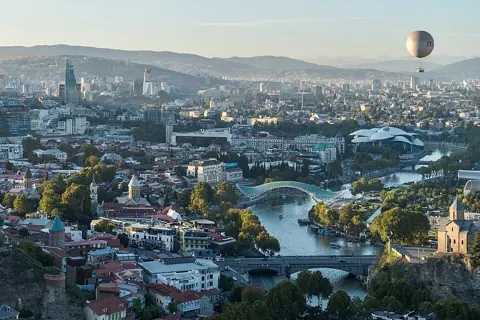
Tbilisi exists specifically because of hot sulphur water rising out of the ground, and the old town's layout, its bathhouse district, and even a common explanation of the city's own name all trace back to that same geological fact.
Why the city is here at all
According to founding accounts commonly told in Georgia and repeated by the Georgian National Tourism Administration, the site of Tbilisi was chosen because of naturally occurring hot sulphur springs discovered in the area, with the city's name traditionally connected to "tbili," the Georgian word for warm. Whether or not you take the specific founding legend literally, the geological reality behind it is not in dispute: natural hot sulphur springs genuinely rise in this part of the Kura river valley, and they've supported a continuous bathing tradition for a very long time, still functioning today rather than existing only as a historical curiosity.
This is worth knowing before you visit because it reframes the bathhouse district from a tourist attraction bolted onto the old town into the actual reason the old town is where it is — the baths came first, in a geological sense, and the city grew around them.
Abanotubani, the bath district
The domed brick bathhouses cluster in Abanotubani, the bath district at the foot of the old town, easily recognisable by their low brick domes rising out of the ground rather than standing as conventional buildings — a design that helps retain heat and reflects the fact that much of each bathhouse is built partly underground around the spring water itself. Several historic bathhouses operate in this small area, most offering both a shared public bathing section at a lower cost and private rooms, usually with domed ceilings and their own small pool, rented by the hour for a group or individual.
What to expect if you go
Private rooms give you a bathing pool to yourself or your group for a set time, which is the more comfortable option for a first visit if you'd rather not share a communal pool with strangers. The shared public sections are cheaper and are where more of the older local bathing culture is still visible, with regulars who've been coming for years. Bring swimwear and sandals; towels and robes are commonly available to rent at the front desk if you don't bring your own, and a scrub-and-massage service is usually offered as a paid extra at the more traditional houses.
Reading the old town around the baths
Tbilisi's old town climbs the hillside above Abanotubani in a layout shaped by the same river valley and hot springs that justified the original settlement — narrow streets, balconied wooden houses built close together, and churches from multiple eras stacked up the slope toward the Narikala fortress overlooking the whole district. Walking up from the baths toward the fortress, rather than starting at the top and working down, follows the historical logic of the city's growth outward from the water source, and makes the old town's layout easier to read as you go rather than encountering it as an unordered collection of old buildings.
The Kura (Mtkvari) river, running along the base of the old town, was the city's other founding necessity alongside the springs — transport, trade and defence all depended on the river long before the modern city extended well beyond it in both directions.
The old town's other layers
Beyond the baths and the climb to Narikala, Tbilisi's old town includes a genuinely mixed religious and architectural history worth noticing as you walk through it — Georgian Orthodox churches, a historic synagogue, and a mosque sit within a fairly compact area, reflecting the city's long history as a crossroads between Persian, Ottoman and Russian spheres of influence at different periods. This layering is easiest to notice on foot, moving slowly through the narrow streets rather than driving or taking transport directly to a single landmark.
Many of the old town's balconied wooden houses, a distinctive architectural feature of the district, have undergone restoration in recent years, and it's common to see a beautifully restored house standing next to one still in visibly poor condition — a reminder that the old town is a living, unevenly developed neighbourhood rather than a uniformly preserved historic district.
Planning around the baths
If sulphur bathing is a priority rather than an afterthought, build it into your day rather than squeezing it in — private rooms are typically booked by the hour and a satisfying visit runs closer to an hour than fifteen minutes, and you'll want time afterward before doing anything requiring you to be freshly showered and odour-free. This guide does not cover specific bathhouse names, current prices or booking platforms, all of which vary and change; check individual bathhouses' own current information before choosing one.