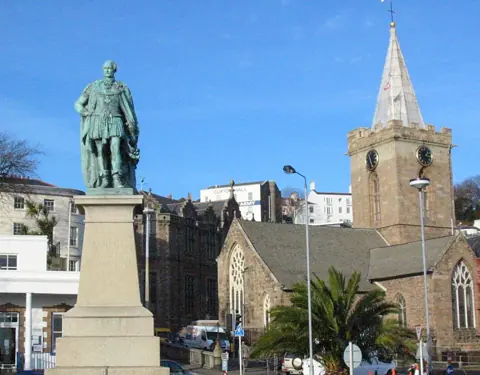
Say "Guernsey" and most people mean one island. Constitutionally, Guernsey is also the name of a Bailiwick that includes three other inhabited islands — Alderney, Sark, and Herm — each governed differently enough that treating them as interchangeable extensions of Guernsey itself would get the politics, and in Sark's case the entire visitor experience, wrong.
What "Bailiwick" means here
The Bailiwick of Guernsey, according to the States of Guernsey's own constitutional information, is a group of islands — Guernsey, Alderney, Sark, Herm, Jethou, Brecqhou and Lihou — that together form a Crown Dependency, a self-governing territory belonging to the British Crown but outside the United Kingdom, distinct from the separate Bailiwick of Jersey despite both being part of the Channel Islands. The States of Guernsey itself notes there are three parliaments within the Bailiwick, for Guernsey, Alderney and Sark. Within the Bailiwick of Guernsey, Guernsey itself is the largest island and seat of the main government, but Alderney and Sark each have their own distinct governing arrangements, and Herm is administered differently again, as a leased rather than self-governing island.
Guernsey: the main island and the main government
Guernsey is self-governing through the States of Guernsey, its own parliament and government, handling the island's domestic affairs — much like Jersey and the Isle of Man handle theirs as separate Crown Dependencies. Saint Peter Port, the Bailiwick's capital, is where most visitors arrive and where the Bailiwick-wide institutions (courts, the Lieutenant Governor's role representing the Crown) are based.
Alderney: self-governing, but smaller in scale
Alderney has its own local government, the States of Alderney, responsible for island-specific matters, while certain functions are handled at Bailiwick level through Guernsey. It's the northernmost of the main Channel Islands, closer to France than to Guernsey itself, and reachable from Guernsey by short flight (Aurigny operates year-round daily service) or seasonal ferry.
Sark: a separate jurisdiction, and no cars at all
Sark has its own parliament, Chief Pleas, and its own distinct legal and governing arrangements within the Bailiwick, making it more constitutionally separate from Guernsey than Alderney is. Sark is also the island most visitors remember for one specific reason: it does not allow private cars. Transport on Sark runs on bicycles, horse-drawn carriages, and small tractors used for agricultural and limited commercial purposes, a restriction maintained as a deliberate, long-standing policy rather than a side effect of the island's small size alone (Herm, comparably small, has its own separate no-car tradition too, for similar reasons).
Herm: private, small, and car-free by tradition too
Herm is the smallest of the Bailiwick's regularly visited islands, privately leased rather than self-governing in the way Alderney or Sark are, and administered as part of Guernsey's own jurisdiction rather than through a separate local parliament. Like Sark, Herm does not accommodate private cars, keeping both of the Bailiwick's smaller islands notably different in pace and feel from Guernsey and Alderney.
Why the distinctions matter for a visitor
Beyond the constitutional trivia, these differences have practical effects:
- Transport planning differs by island — Guernsey and Alderney have ordinary roads and vehicles; Sark and Herm do not, and you should plan a visit to either around walking, cycling, or a horse-drawn ride rather than assuming any vehicle-based option.
- Currency and administration are Bailiwick-wide — Guernsey pounds and sterling are used across all four islands, and Bailiwick-level institutions (like the courts) apply throughout, even where local government differs.
- A single trip covering more than one island needs its own separate ferry or flight leg — these are not connected by bridge or tunnel, and each inter-island crossing should be checked and booked as its own journey.
How the islands differ in size and pace
Scale explains much of why these islands feel so different from each other despite sitting within a few kilometres of one another. Guernsey is by far the largest and most populous, with Saint Peter Port functioning as a genuine small city with shops, restaurants, and a working harbour. Alderney is considerably smaller and quieter, with a single small town, and its remoteness relative to Guernsey (it sits closer to the French coast than to Guernsey itself) gives it a different character again. Sark and Herm are smaller still, and their lack of cars is only part of what makes a day there feel unlike a day on Guernsey — narrower paths, a slower pace, and considerably less commercial infrastructure define the experience as much as the transport restriction does.
Currency and everyday practicalities across the Bailiwick
Guernsey issues its own banknotes and coins, pegged at par with sterling, and both circulate interchangeably across all four inhabited islands of the Bailiwick — you won't need to change currency moving between Guernsey, Alderney, Sark, and Herm. Mobile coverage and card payment acceptance, however, can be noticeably patchier on Sark and Herm than on Guernsey itself, given their smaller populations and more limited commercial infrastructure, so carrying some cash is a sensible precaution on either island even if you rarely need it on Guernsey.
Before you plan beyond Guernsey itself
If your trip includes Alderney, Sark, or Herm, treat each as a separate island visit requiring its own transport booking and a clear-eyed expectation of what "getting around" means there — a companion VoyageWindow guide covers the specific ferries and flights connecting all four islands in more detail.