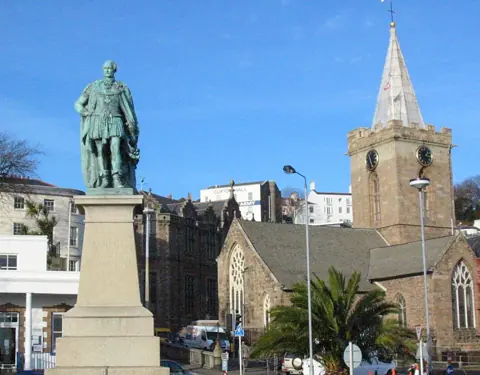
Guernsey's postcards still sometimes show glasshouses catching the light across the island's countryside — a leftover image from an era when growing tomatoes and flowers under glass was one of Guernsey's defining industries. That industry has receded sharply. What has taken its place, and now dominates the island's economy by a wide margin, is finance.
Finance: the sector Guernsey runs on now
Guernsey describes itself, through its own promotional body Guernsey Finance, as "a leading international finance centre," with specialisations spanning investment funds (particularly private equity), insurance (including captive insurance and insurance-linked securities), private wealth and trust services, and banking. The organisation cites roughly £1 trillion in assets managed through the jurisdiction and describes channelling tens of billions of pounds into the UK economy specifically, figures worth treating as the industry's own characterisation of its scale rather than independently verified statistics.
As with comparable finance centres elsewhere in the Channel Islands, this sector operates through licensed firms in office buildings with no visitor-facing component — there's no tour, no showroom, nothing built for a traveller to see. It is the reason Guernsey's economy has stayed prosperous even as its older horticultural industry declined, but it isn't something you'll encounter directly during a visit.
What happened to the greenhouses
Guernsey built a substantial horticultural export industry around tomatoes and cut flowers grown in glasshouses, taking advantage of a mild climate and, for a period through the twentieth century, favourable trading conditions for exporting to the UK mainland. That industry has shrunk considerably from its peak, squeezed by competition from larger-scale, lower-cost growers elsewhere in Europe and changes in trade and transport economics that reduced the advantage small Channel Islands producers once held.
Many of the old glasshouse structures remain visible across the island's rural parishes, some still used for smaller-scale or specialist growing, others repurposed or left standing. This guide could not confirm a current, official count of how many greenhouses remain in active commercial tomato production, and if that specific number matters to your visit, it's worth checking with the States of Guernsey's current agricultural statistics rather than relying on an outdated general impression of the industry's scale.
The Guernsey cow: a genuine local breed, not just a name
The Guernsey is a distinct dairy cattle breed that originated on the island, prized for producing rich, naturally golden-tinted milk with higher butterfat than some other common dairy breeds. Like the Jersey cow on the neighbouring island, Guernsey cattle have been exported successfully enough over the past century-plus that herds now exist across Britain, North America, New Zealand, Australia, and South Africa — meaning most "Guernsey cows" milked worldwide today aren't actually on Guernsey.
Guernsey Dairy, operating on the island since 1951, processes milk from local farms into milk, butter, cream, ice cream, and buttermilk, sourced from RSPCA Assured-certified local producers, and functions as the practical, visible face of the island's dairy sector for a visitor — a working dairy rather than a museum piece, running production every day of the year according to its own site.
What a visitor can realistically see and taste
- Guernsey Dairy's products — milk, cream, butter, and ice cream — available island-wide in shops and cafés, the most direct way to encounter the Guernsey cattle breed's reputation.
- Remaining greenhouse structures in the countryside, worth noting as a historical landscape feature rather than expecting an operating tomato industry at its old scale.
- Local farm shops, where some smaller horticultural and dairy producers sell directly, offering a more specific, small-scale version of the island's agricultural identity than supermarket shelves do.
What remains largely invisible, as with the other Channel Islands and the Isle of Man's own finance sector, is the finance sector itself — the industry actually driving the island's prosperity has no public-facing side to visit.
Why the shift from greenhouses to finance happened at all
Guernsey's move from horticulture to finance wasn't a single decision but a gradual reallocation of the island's limited land and labour toward whichever sector offered the better return. As shipping costs fell and larger, cheaper growing regions in mainland Europe and beyond became easier to compete against, the economics of small-island glasshouse tomato growing became harder to sustain, even with a favourable climate. Finance, by contrast, doesn't depend on land area or transport costs to the same degree — a licensed fund administrator needs office space and skilled staff more than acreage — which made it a natural sector for a small island with limited physical space but a stable legal and regulatory environment to grow into instead.
That shift has had a real effect on how the island looks and what kind of jobs are available. Office employment in Saint Peter Port has grown considerably relative to agricultural employment across the island as a whole, and property and rental costs in the town itself reflect a finance-driven economy more than a horticultural one, even though the countryside parishes retain a visibly more rural, agricultural character.
What this guide does not cover
This article explains the general shift in Guernsey's economy from horticulture to finance, and the Guernsey cattle breed's status; it does not provide current agricultural production statistics or investment guidance related to Guernsey's finance sector. For verified current figures, consult the States of Guernsey and Guernsey Finance directly rather than relying on this overview alone.