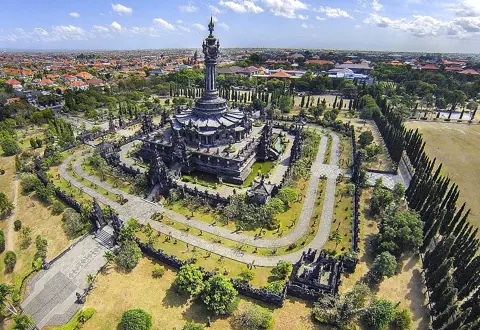
Neither governor's circular on foreign-visitor conduct in Bali uses the word sarong. What Surat Edaran Gubernur Bali No 04 Tahun 2023, signed by Governor Wayan Koster on 31 May 2023, actually obliges foreign tourists to wear is busana yang sopan, wajar, dan pantas — modest, reasonable and proper clothing — when visiting sacred areas, tourist attractions and public places, and during activities in Bali generally (checked 16 September 2026). The cloth and sash offered at a temple entrance are how individual temples put that into practice. The harder rule is separate and specific: the same circular prohibits foreign tourists from entering the Utamaning Mandala and Madyaning Mandala of a sacred place such as a pura or pelinggih, except for the purpose of praying, in Balinese customary dress, and not while menstruating.
What the governor's circular says
Governor's Circular 4/2023 is a single document listing twelve obligations and eight prohibitions for foreign visitors, and it is unusual in being addressed to the visitors themselves. The list of addressees runs from the provincial parliament and police chief through the bandesa of the Majelis Desa Adat and the head of Ngurah Rai airport authority, and item sixteen is Wisatawan Mancanegara — foreign tourists. The circular records that it followed a 13 April 2023 meeting with the Coordinating Ministry for Maritime Affairs and Investment to draft a single national "Do's and Don'ts" text for foreign visitors to Bali.
Three of its clauses govern what happens at a temple. The first obligation is to honour the sanctity of the pura, pratima and consecrated religious symbols. The third is the dress clause quoted above. Among the prohibitions, foreign tourists may not climb a sacred tree, and may not behave in a way that defiles a sacred place, with the circular naming climbing sacred structures and being photographed in improper dress or without clothing as its examples.
The circular was restated two years later. On 24 March 2025 the provincial government announced Surat Edaran No 7 Tahun 2025 on the new order for foreign tourists in Bali, described by the governor as an update to the 2023 circular ahead of a regional regulation and governor's regulation planned for that year (checked 16 September 2026). The provincial account of the 2025 circular reproduces the temple clauses in the same words. We could not locate the text of Circular 7/2025 in the province's own legal database when we checked, so the 2023 circular remains the version you can read in full.
The two zones you cannot enter
Bali's foreign-tourist prohibition names zones, not buildings, which is what makes it workable across thousands of temples with different layouts. Balinese spatial ordering divides a site by value rather than by function: Peraturan Daerah Provinsi Bali No 5 Tahun 2005 on building architecture describes outdoor space as arranged according to the hulu–teben axis, or Utama, Madya and Nista Mandala, and calls the three-way division of a site the tri mandala pattern (checked 16 September 2026). Governor's Regulation 25/2020 separately instructs temple caretakers to use the Tri Mandala Pura according to its religious, educational and socio-cultural functions.
The table below sets out the three zones and how the foreign-tourist prohibition treats each.
| Zone | Rank in the tri mandala order | In the foreign-tourist prohibition |
|---|---|---|
| Utamaning Mandala | Utama, the highest | Named: entry prohibited except to pray |
| Madyaning Mandala | Madya, the middle | Named: entry prohibited except to pray |
| Nista Mandala | Nista, the lowest | Not named |
Which physical courtyard corresponds to which zone is a matter of the individual temple's layout, so the practical question at the gate is not "how many walls have I passed" but "where does the person at the entrance say the line is". That person is the authority the circular's final obligation points you to: foreign tourists are required to obey whatever specific rules apply at each attraction and activity.
Naming the sarong and sash
Balinese customary dress has a legal definition in Bali, and it is worth reading because it is the phrase the circular uses for the prayer exception. Peraturan Gubernur Bali No 79 Tahun 2018 on Balinese Traditional Dress Day lists, in Article 4, the minimum elements of busana adat Bali: for women a kebaya, a kamen, a selendang (also called senteng) and neat hair; for men a destar (udeng), a shirt, a kampuh, a selendang and a kamen (checked 16 September 2026).
So the garment an English-language sign calls a sarong is the kamen, the wrapped lower cloth, and the sash tied at the waist over it is the selendang or senteng. Both appear in the regulation's minimum list for men and for women alike. Bali also treats dress as a protected cultural object in its own right: Peraturan Daerah Provinsi Bali No 4 Tahun 2020 lists busana among the objects of cultural strengthening and defines it in its elucidation as everything worn from head to foot by Balinese people as a reflection of identity (checked 16 September 2026).
No provincial document read for this guide sets a colour, a length, a fabric or a hire fee for the cloth handed to visitors, and none requires a temple to provide one. That part is set locally, which is why the loan is free at some temples, bundled into an entrance ticket at others, and sold separately at others again.
The sign at the gate
The notice board you read before entering a Balinese temple is required by regulation, and knowing which one explains why the boards say what they say. Peraturan Gubernur Bali No 25 Tahun 2020 on the protection of temples, pratima and religious symbols, promulgated on 29 May 2020, requires in Article 13(3) three specific measures: prohibiting anyone in a state of cuntaka or sebel from entering the temple, prohibiting anyone not directly connected with a ceremony, prayer, piodalan or temple-protection activity from entering, and posting a notice board announcing both prohibitions (checked 16 September 2026).
That regulation also supplies the definition the sign is working from. Article 1(10) defines cuntaka or sebel as a state of impurity arising from death, birth, menstruation, and other matters regarded as impure. Article 45 then states both prohibitions as free-standing rules applying to every person, not only to visitors. The menstruation restriction a traveller sees quoted at an entrance is therefore not a local improvisation and not aimed at tourists: it is one item in a list that includes a recent death or birth in the household, and it applies to Balinese worshippers on the same terms.
Who enforces a temple rule
Enforcement of the entry prohibitions runs through customary law, not through a police fine, and this is the single most useful thing to understand about them. Governor's Regulation 25/2020, Article 46, provides that a person who breaches the Article 45 prohibitions is subject to sanksi adat — customary sanctions — imposed by the desa adat and/or the pengempon pura, the group of residents responsible for maintaining that temple. The regulation lists three forms: arta danda, a monetary penalty; pengaksama danda, an apology; and sangaskara danda, a specified ceremony.
Damage, theft and defilement are treated differently. The same article routes those to sanctions under national legislation, and Governor's Circular 4/2023 states in its own terms that foreign tourists breaching its obligations and prohibitions face sanctions or legal process under Indonesian law.
The customary route also explains the variation you will meet. Governor's Regulation 25/2020 defines awig-awig as rules made by a desa adat or banjar adat, and pararem as decisions of the adat village assembly implementing them or settling new matters. Each temple sits inside an adat village with its own written rules, so the province sets a floor and the village sets the detail above it.
Besakih during the annual ceremony
Pura Agung Besakih publishes its own visitor arrangements, issued as a separate circular for the period of its annual ceremony. Surat Edaran Gubernur Bali No 2 Tahun 2026, dated 14 March 2026, covers the Karya Ida Bhatara Turun Kabeh, which the circular states is held once a year at Purnama Sasih Kadasa; in 2026 the peak fell on Thursday 2 April with the ceremony continuing for 21 days to Thursday 23 April (checked 16 September 2026).
Its rule on access is stated in one line. Visitors may enter the sacred area of Pura Agung Besakih only outside the prayer area, while worshippers follow a published prayer schedule by regency, with visitors from outside Indonesia allocated 21 and 22 April 2026. Everyone enters through the Candi Bentar in the Manik Mas area. The circular also records that the site management provides changing rooms for worshippers and visitors in the Manik Mas area, and that stalls there sell wastra — customary dress, endek, songket and traditional cloth — among local products.
Two further rules in that circular are easy to miss. Worshippers and visitors are strictly prohibited from bringing or using plastic bags, plastic straws, styrofoam and other single-use plastic products into the sacred area, and are required to carry out all the waste they generate. Those provisions are written for the ceremony period covered by the circular, so check the current arrangements before a visit at another time of year.
What this guide does not cover
This guide covers provincial rules published by the Bali provincial government and read in full at the sources listed, and it stops where those documents stop. It does not tell you the entry rule at any named temple other than Besakih during its annual ceremony, because those rules are set by each temple's desa adat under its own awig-awig and pararem and are not published centrally.
Three specific gaps are worth naming. None of the documents read here addresses the canang offerings placed on pavements and doorsteps outside temple grounds; Governor's Regulation 25/2020 protects religious symbols including uperengga, ceremonial equipment, but does not mention offerings laid on a public footpath. None sets a price or a deposit for borrowing a cloth at a gate. And none states an entry fee, an opening time or a photography rule for an individual temple.
What to do with all of this on the day is short. Arrive covered from waist to ankle and with shoulders covered, take whatever cloth and sash are offered at the entrance and wear both, read the notice board before you pass through it, and treat the boundary the attendant points to as the boundary — the provincial prohibition is written around zones that only the people at that temple can locate for you.