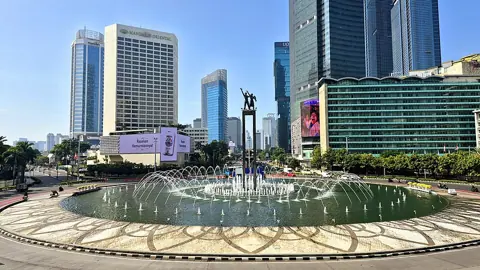
Jakarta is still the capital of Indonesia. The law that creates a new capital in East Kalimantan, Undang-Undang No. 3 Tahun 2022 tentang Ibu Kota Negara, does not itself move the seat of government. It names the new capital Nusantara, fixes its boundaries, creates an authority to build and govern it, and then makes the transfer itself depend on a separate Presidential Decree issued at some later point. Until that decree exists, Jakarta keeps the position, function and role of capital, and the replacement statute written for Jakarta sits unstarted. What follows reports the status of those documents as published on Indonesia's official legal database, checked on 16 September 2026. It is a status report, not a timetable, and it does not forecast a date.
What the 2022 law provides
Undang-Undang No. 3 Tahun 2022 is the founding document, and it does four separate things rather than one. It gives the capital a name, defines it as a special provincial-level regional government unit, draws its territory, and sets up the body that will run it. Pasal 1 angka 3 defines the entity as "Ibu Kota Negara bernama Nusantara dan selanjutnya disebut sebagai Ibu Kota Nusantara", a "satuan pemerintahan daerah yang bersifat khusus setingkat provinsi" (UU Nomor 3 Tahun 2022, full text, enacted and promulgated 15 February 2022, checked 16 September 2026).
The territory is specific. Pasal 6 places Nusantara in East Kalimantan across parts of Kutai Kartanegara regency and Penajam Paser Utara regency, with Balikpapan city on the southern boundary, and gives an area of roughly 256,142 hectares of land together with roughly 68,189 hectares of sea. The governing body is not an elected provincial administration: under Pasal 5 ayat (4), the Kepala Otorita Ibu Kota Nusantara holds ministerial rank and is "ditunjuk, diangkat, dan diberhentikan oleh Presiden setelah berkonsultasi dengan DPR".
The law also fixes a minimum political commitment rather than a completion date. Pasal 24 ayat (3) designates the preparation, construction and relocation as a national priority programme for "paling singkat 10 (sepuluh) tahun" from the law's entry into force, or at least until the third of the construction phases set out in the Nusantara master plan is finished. The phases themselves live in a separate instrument, Peraturan Presiden No. 63 Tahun 2022, whose record describes five implementation phases across 2022 to 2045 (JDIH BPK record for Perpres No. 63 Tahun 2022, in force 18 April 2022, checked 16 September 2026).
The clause that moves the capital
Pasal 39 ayat (1) is the single provision that decides when Indonesia's capital changes, and it is worth reading in full rather than in summary. It states that the position, function and role of the Ibu Kota Negara "tetap berada di Provinsi Daerah Khusus Ibukota Jakarta sampai dengan tanggal ditetapkannya pemindahan Ibu Kota Negara dari Provinsi Daerah Khusus Ibukota Jakarta ke Ibu Kota Nusantara dengan Keputusan Presiden". The transfer date is not in the statute. It is delegated to a Presidential Decree, a Keputusan Presiden, which is a distinct legal instrument from the law itself.
Three consequences follow in the same article. Pasal 39 ayat (2) says the Nusantara Capital Authority begins to exercise the special regional government of Nusantara only from the date that transfer is determined. Ayat (3) and ayat (4) keep East Kalimantan province and the two regencies running ordinary local government, and collecting local taxes and levies, in the meantime, except for powers and permits tied to the preparation, construction and relocation work.
The design of Pasal 39 is why status reporting is the only honest register here. The law does not contain a date, so no reading of the law produces one.
Jakarta's own law is waiting
Jakarta has a replacement statute already passed and already promulgated, and it has not started running. Undang-Undang No. 2 Tahun 2024 tentang Provinsi Daerah Khusus Jakarta was enacted on 25 April 2024 (JDIH BPK record for UU No. 2 Tahun 2024, checked 16 September 2026). Its Pasal 2 ayat (1) converts "Provinsi Daerah Khusus Ibukota Jakarta" into "Provinsi Daerah Khusus Jakarta", and its Pasal 3 ayat (2) assigns the province the functions of "Pusat Perekonomian Nasional dan Kota Global" rather than the seat of government.
The commencement clause is the point. Pasal 73 provides that the law takes effect "pada saat ditetapkannya Keputusan Presiden mengenai pemindahan Ibu Kota Negara", and Pasal 70 revokes the 2007 Jakarta law at that moment (UU Nomor 2 Tahun 2024, full text, checked 16 September 2026). UU No. 3 Tahun 2022 does the mirror image from its own side: Pasal 41 ayat (1) strips out the provisions of the 2007 law that made Jakarta the capital, again from the date of that same decree.
The three documents that decide Jakarta's status are compared below by what each one does and when it bites.
| Document | What it does | When it takes effect |
|---|---|---|
| UU No. 3 Tahun 2022 | Creates Nusantara, the Authority and the transfer mechanism | 15 February 2022 |
| UU No. 21 Tahun 2023 | Amends the 2022 law on powers, area, planning and funding | 31 October 2023 |
| UU No. 2 Tahun 2024 | Renames Jakarta and redefines it as economic centre | On the capital-transfer decree |
So the practical answer to "has the capital moved" is written into commencement clauses rather than into news. While UU No. 2 Tahun 2024 has not commenced, Jakarta is legally what it has been since 2007.
What the law does not say
The elucidation to UU No. 3 Tahun 2022 does not give land subsidence as a reason for the move, and that is worth stating plainly because it is the reason most often repeated. The Penjelasan Umum grounds the relocation in economic concentration, saying the move is based on "terpusatnya kegiatan perekonomian di Jakarta dan Jawa yang mengakibatkan kesenjangan ekonomi Jawa dan luar Jawa", and it adds that Jakarta can no longer carry the role of capital because of "pesatnya pertambahan penduduk yang tidak terkendali, penurunan kondisi dan fungsi lingkungan, dan tingkat kenyamanan hidup yang semakin menurun".
Uncontrolled population growth, environmental decline and falling liveability are what the statute names. Flooding, tidal inundation and subsidence rates are not named in that passage. They are handled by a different body of regulation entirely, described in the next section.
We are also not going to give you a subsidence figure in centimetres per year. We could not open the Ministry of Public Works website from here, and neither the capital law nor the Nusantara Capital Authority pages we read publishes a rate, so any number we printed would not trace to a page we actually read. If you need one, ask Badan Geologi under the Ministry of Energy and Mineral Resources, which runs the groundwater-basin monitoring for Jakarta, or the Ministry of Public Works directly.
The coastal works and the sea wall
Jakarta's coastal defence sits under separate presidential regulation, not under the capital law. Peraturan Presiden No. 77 Tahun 2025, dated 24 June 2025, establishes the Badan Otorita Pengelola Pantai Utara Jawa, a non-structural agency responsible for preparation, planning, construction and development along Java's north coast, with a steering council and an executive board (JDIH BPK record for Perpres No. 77 Tahun 2025, checked 16 September 2026). The same record places the Giant Sea Wall among the national strategic projects under Peraturan Presiden No. 12 Tahun 2025, the medium-term national development plan for 2025 to 2029.
That is a governance fact rather than a construction fact. A regulation creating an authority tells you who is responsible and under what mandate; it does not tell you what is standing on the shoreline today, and this guide makes no claim about the physical state of any defence work.
Separately, on the Nusantara side, Peraturan Presiden No. 75 Tahun 2024 of 11 July 2024 covers acceleration of construction there, aimed at basic and social services and commercial facilities in the core government area (JDIH BPK record for Perpres No. 75 Tahun 2024, checked 16 September 2026). Its record does not use the phrase "ibu kota politik" and does not name a target year.
What a visitor in Jakarta sees
A traveller in Jakarta today sees a working capital city, and the relocation is almost entirely invisible from the street. The ministries, the presidential complex and the national monument are where they were, because Pasal 39 ayat (1) keeps the capital's position, function and role in Jakarta until the decree. Your arrival airport, your visa arrangements, your MRT and TransJakarta journeys and your hotel district are unaffected by the capital law, which is concerned with the seat of government rather than with civil aviation or immigration.
On the Nusantara side, the Authority publishes its own account of progress. Its about page states that the first phase covering 2022 to 2024 is complete and that construction entered a second phase running from 2025 to 2029, listing the palace, the MPR/DPR complex and civil-servant housing among first-phase works (Otorita Ibu Kota Nusantara, Tentang IKN, checked 16 September 2026). Its articles index records a swearing-in of civil servants at Nusantara on 8 June 2026 described as the first such ceremony there (Otorita Ibu Kota Nusantara, Artikel & Berita, checked 16 September 2026).
Nothing in the documents read for this article changes what you should book, where you should stay, or which airport you should fly into. If that changes, it will change on the date of a Keputusan Presiden, and that decree will be published in the same legal databases cited here.
What this article does not settle
This article reports the contents of named legal instruments and two pages published by the Nusantara Capital Authority, and it settles nothing beyond them. It does not assess whether the project is on track, behind, well funded or otherwise, and it takes no position on the merits of moving the capital. Those are questions about performance, and the documents read here are about competence and status.
Four specific gaps are worth naming. We did not verify a land subsidence rate for Jakarta from any government page, because the Ministry of Public Works site would not open. We did not verify the physical state of any coastal defence structure. We did not verify visitor access arrangements for Nusantara, so treat the Authority's own site as the only source on that. And we did not confirm, either way, whether the Keputusan Presiden under Pasal 39 ayat (1) has been issued.
Check two places before you rely on anything above. The national legal database entry for UU No. 3 Tahun 2022 will show any further amendment or any implementing decree, and the Nusantara Capital Authority's own site carries its statements on what stage construction has reached. Both were checked on 16 September 2026 and both can change without a news story attached.