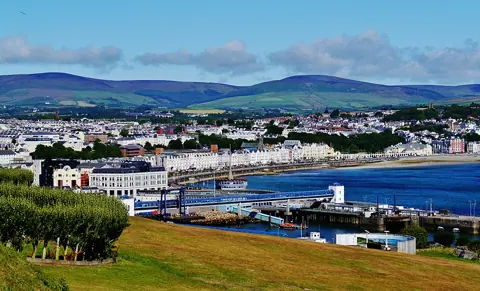
For most of the year, the Isle of Man's economy is close to invisible to a visitor: it runs on financial services, e-gaming, and manufacturing conducted in office buildings around Douglas, none of it built for anyone to look at. For two weeks in early summer, that changes completely, as the TT Races take over the roads, the ferries, and the accommodation market island-wide.
What actually pays the bills
The Isle of Man's modern economy centres on financial services — banking, insurance, and corporate and trust administration, benefiting from the island's own tax regime as a Crown Dependency distinct from the UK's — alongside a substantial e-gaming sector, in which online gambling and betting companies are licensed and regulated under Manx law. Manufacturing, aerospace components among them, and a growing space and satellite services sector round out a diversified but largely business-to-business economy rather than one built around consumer-facing industry a tourist would naturally encounter.
None of this has a visitor-facing side. Office buildings housing licensed finance and gaming companies are not open to the public, there is no equivalent of a factory tour, and this guide will not pretend otherwise. If you're curious about the sector, the honest answer is that there isn't much to see beyond noting that the tax and regulatory environment behind it is real and shapes the island's prosperity considerably more than tourism does.
The TT: the two weeks everything else defers to
The Isle of Man TT (Tourist Trophy) motorcycle races run on closed public roads around the island's Mountain Course, a 37.73-mile circuit, and are split into a practice and qualifying week followed by a race week — for the 2025 running, qualifying spanned May 26 to May 30 and racing ran from May 31 to June 7, according to the event's own site. Exact dates shift slightly year to year within a similar late-May-to-early-June window, so check the current year's confirmed schedule directly.
What the TT does to everyday logistics
Roads that make up the Mountain Course are closed to normal traffic during racing and practice sessions, which affects not just spectators but anyone trying to get around the island for ordinary reasons during those windows — a grocery run or a trip to the airport can mean waiting for a closure to lift. Bus and heritage rail travel continues, and the operator's own multi-day travel tickets are pitched partly at TT visitors, covering unlimited travel on non-race days specifically, which tells you how much the schedule bends around the event even for public transport.
Qualifying week, according to the event's own materials, tends to suit first-time visitors better than race week: sessions run in the afternoon and evening, leaving daytime free to explore rather than committing a full day to trackside viewing.
If you're not there for the TT
Outside the TT fortnight, the Isle of Man is a considerably quieter, less price-sensitive destination — accommodation availability opens up, and the roads that form the Mountain Course function as ordinary scenic driving routes rather than a closed circuit. If motorsport isn't your reason for visiting, deliberately avoiding the TT window can mean a calmer trip, though you'll also miss an event genuinely central to how the island sees itself.
Planning around it either way
- Decide early whether your trip is built around the TT or deliberately avoiding it — the difference in booking pressure, road access, and atmosphere is substantial.
- If attending, book Steam Packet ferry crossings and accommodation as early as your plans allow; late bookings during the fortnight face limited availability and higher prices.
- If avoiding it, double-check the current year's TT dates against your travel dates before booking, since the exact window moves slightly year to year.
- Either way, don't expect access to the island's finance or e-gaming businesses as part of a visit — that side of the economy has no visitor-facing component.
Why the island invests so heavily in the event
The TT is not simply tolerated as a disruptive but profitable annual event — it functions as a significant piece of the island's identity and, indirectly, its economy, drawing visitors, media attention, and sponsorship interest well beyond what a territory of the Isle of Man's size would otherwise attract. Local businesses across hospitality, retail, and transport plan much of their commercial year around the fortnight, and the roads themselves, closed to normal traffic during sessions, are otherwise ordinary public roads used for daily commuting the rest of the year — one of the reasons the event has such a distinctive, whole-island character rather than being confined to a purpose-built circuit the way most motorsport events are.
What this guide does not cover
This article explains the shape of the Isle of Man's economy and the TT's effect on visitor logistics; it does not provide current TT ticket prices, road closure timetables, or ferry fares, all of which should be checked directly with the Isle of Man TT and Isle of Man Steam Packet Company before you book.