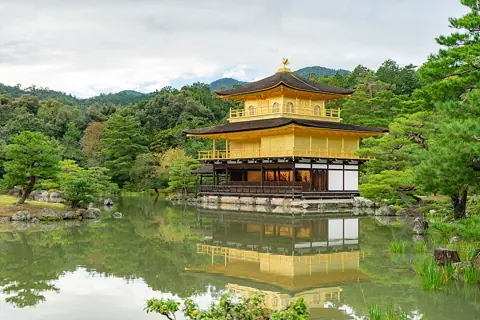
The clap is the giveaway. At a Shinto shrine you bow twice, clap twice and bow once; at a Buddhist temple you press your palms together in silence and never clap at all — and in Kyoto the two sit within a few hundred metres of each other, share the same gravel, the same purification basin and sometimes the same guardian lions, so the wrong sound gets made in the wrong building all day long.
Kyoto is the worst city in Japan for this particular mistake, because it has an unusually high density of both, and because the visual cues that separate them were deliberately blurred for a thousand years of combined worship. The good news is that the procedure itself is short, published by the shrines in their own words, and forgiving.
This guide covers general worship at Shinto shrines and how that differs from Buddhist temples, using Kyoto shrines as the worked examples. It does not cover formal commissioned prayer rites (ご祈祷), weddings, or the shrine-specific rituals of individual festivals.
Shrine or temple?
Telling a Shinto shrine from a Buddhist temple is the reader's real problem, and one object settles it more reliably than any other. The Association of Shinto Shrines describes the 鳥居 (torii) as the structure erected at the boundary dividing the shrine's inner world from the outside, with the area inside it being the sacred precinct where the deity resides (神社本庁, 鳥居について, checked 7 September 2026). A torii means you are entering a shrine.
Nothing else is quite as safe, and the same authority says so. Its page on 狛犬 (komainu), the paired stone guardians, notes that komainu are generally found at shrines but are occasionally placed at temples too, and cites the pair at the Nandaimon of Todai-ji, a temple, as the oldest stone example in Japan (神社本庁, 狛犬について, checked 7 September 2026). The same page adds that some shrines substitute other animals entirely: foxes at Inari shrines, oxen at Tenmangu shrines, each being the messenger of the enshrined deity. So the foxes at Fushimi Inari are not decoration and not a temple signal; they are the Inari cue specifically.
The table below sets out the cues that actually separate the two on sight, and what each one changes about what you do.
| Cue | Shinto shrine (神社) | Buddhist temple (寺) |
|---|---|---|
| Gate | Torii, marking the sacred boundary | Roofed gate (山門) with doors, often with guardian statues |
| Object of worship | No image on view; the hall faces an unseen deity | A visible Buddhist image, often approachable inside the hall |
| Standing burner | None | Large incense burner in front of the main hall |
| Sound you make | Two claps, audible | None; palms together in silence |
| Staff | Priests and miko in white and coloured hakama | Monks in robes; often a ticket office for the halls |
Two more practical differences follow from that list rather than from doctrine. Temples in Kyoto frequently charge admission to their main halls and gardens while shrine precincts are usually free to enter, and temples often have graves attached, which shrines do not. If you have paid at a gate to walk into a wooden hall containing a statue, you are at a temple, and you should not clap.
How do you purify first?
Purification at the 手水舎 comes before worship, and the Association of Shinto Shrines calls it the first of the procedures. Its page traces the practice to the myth in the Kojiki in which Izanagi-no-Mikoto, returning from Yomi, the land of the dead, immersed himself in water to perform 禊祓 — the washing away of impurity — and describes 手水 as the simplified form of that immersion (神社本庁, 手水舎について, checked 7 September 2026).
The sequence the same body publishes has three movements: take the ladle in your right hand, draw water and wash your left hand, being careful not to let the used water fall back into the basin; move the ladle to your left hand and wash your right; move it back to your right hand, pour water into your cupped left palm and rinse your mouth from that palm, never putting your mouth to the ladle, then let water run over your left hand once more (神社本庁, 参拝方法, checked 7 September 2026).
Two Kyoto shrines and one Kyoto temple publish a fourth movement that the national body's page does not mention: standing the ladle upright at the end so the remaining water runs down the handle, cleaning it for the next person, and replacing it face down. Yasaka Jinja lists it as step five of five, and Kiyomizu-dera lists it as step five as well. Where sources differ like this, the shrine in front of you is the one to follow — the national page states the basic form, not the only form.
There is also a version for basins with no ladle at all, which matters because many have been removed and left as running spouts. The Tokyo Metropolitan Shrine Agency publishes it explicitly for flowing water: wash both hands, cup water in both hands and rinse your mouth from them, then wash both hands again (東京都神社庁, 参拝の作法, checked 7 September 2026; that page is served over HTTP only).
What is the shrine sequence?
The worship sequence at the offering box is 二拝二拍手一拝, and the Association of Shinto Shrines states that this form emerged through long change and is now the basic one, while adding that some shrines perform their own special method and that you should follow the shrine's own manner where one exists. The table below sets out each step, the shrine authority's own description of the movement, and the specific error visitors make at that step.
| Step | What you do | What people get wrong |
|---|---|---|
| Approach | Walk the path avoiding the centre line, the 正中, the deity's route | Walking straight up the middle for the photograph |
| Bell and coin | Ring the bell, then place the coin in the box | Throwing the coin hard from a distance |
| Two bows | Back flat, bend 90 degrees at the waist, twice | A shallow nod that never reaches level |
| Two claps | Hands together at chest height, right fingertips slid down about one joint, hands opened to shoulder width, two claps | Clapping at a temple, or clapping before bowing |
| Prayer | Bring the hands fully together and pray | Praying first and bowing afterwards |
| One bow | Straighten, then one more deep bow | Turning away before the final bow |
The 正中 point is the one most often over-interpreted, so take the authority's own framing. The centre of the approach path is understood as the way the deity passes, and avoiding it derives from the 正中作法 that priests observe during rites; when you must cross the centre, you may lower your head slightly as you pass, or turn to face the hall and bow once before crossing. The same page then says plainly that there is no rigid rule about how to walk the path, and warns against being so absorbed in form that you break a particular shrine's rules or collide with other worshippers (神社本庁, 参道について, checked 7 September 2026).
Kyoto's own shrines publish the same sequence, which is the useful confirmation. Heian Jingu instructs visitors to purify at the temizuya, refrain from walking the centre because it is the 正中, remove hats at the hall, bow to 90 degrees twice, clap twice at chest height, pray, and bow deeply once more (平安神宮, ご参拝の方へ, checked 7 September 2026). Yasaka Jinja lists it as coin and bell, two bows, two claps, prayer or report, one bow (八坂神社, ご参拝について, checked 7 September 2026). Fushimi Inari Taisha's own worship guide adds the detail that the offering should not be thrown but placed quietly from close to the box, and that the correct visit continues from the main hall out to the auxiliary shrines, the Okusha Hohaisho and Inariyama (伏見稲荷大社, 参拝の作法, checked 7 September 2026; HTTP only).
Where does Izumo differ?
Izumo Oyashiro, the great shrine in Shimane, is the documented exception to the two-clap rule, and it says so on its own FAQ page. Answering how one should worship there, the shrine states that while the general form is 二礼二拍手一礼, the formal procedure at Izumo Oyashiro is 二礼四拍手一礼 — two bows, four claps, one bow — and that this form should also be used at the other halls in the precinct, not only the main one (出雲大社, よくあるご質問, checked 7 September 2026).
The same answer explains the number, and the explanation is more specific than the retellings usually are. At the shrine's largest festival, the imperially-sponsored 例祭 on 14 May, eight claps are performed; eight has long signified an unlimited number, so eight claps praise the deity without limit. Four is stated to be half of that, used for ordinary day-to-day worship, with eight reserved for that single annual rite.
Izumo's FAQ carries a second instruction that is easy to miss and is a genuine route rule rather than an etiquette flourish. It directs worshippers to pray at the Honden from the Yatsuashi-mon gate first, then to proceed around the enclosing 瑞垣 fence anticlockwise, worshipping at each hall in turn. If you are travelling to Izumo, that is the order to walk in.
How do temples differ?
Buddhist temple worship replaces the clap with incense and silence, and Kiyomizu-dera publishes the sequence for its own main hall. Purify your hands at the water first — the temple frames washing the hands as cleansing the mind and says there is no strict rule for the order. Then buy a stick of incense at the main hall, which the temple prices at JPY 10 per stick, light it from the candle, and extinguish the flame by fanning with your left hand rather than blowing it out with your mouth, before standing it in the burner.
The worship itself is four movements and none of them makes a sound. Stand at the centre of the main hall facing the Kannon image, bow where you stand, place your offering, and put your palms together quietly in 合掌 (清水寺, お参りの作法と手順, checked 7 September 2026). The temple also invites visitors up into the 外陣, the outer worship area, to be nearer the image — an access that has no shrine equivalent, since a shrine's inner hall is closed and its object of worship is not on view.
Set the two side by side and the practical differences are these. At a shrine you ring a bell, offer a coin, bow twice, clap twice and bow once. At a temple you offer incense where a burner stands, bow, offer, and hold your palms together without clapping. The purification basin is common to both. The bow is common to both. Only the clap and the incense are exclusive, which is exactly why they are the two things worth remembering.
What is not a rule?
A large amount of what circulates in English as Japanese shrine etiquette is not stated by any shrine, and some of it is contradicted outright by the shrine bodies themselves. The most-repeated example is the coin. The Association of Shinto Shrines addresses the belief directly under the heading お賽銭の額に決まりは無い — there is no set amount for the offering — noting that people do offer 5 yen for ご縁 (a connection) or 45 yen for 始終ご縁 (a lasting connection), but that no amount has ever been formally fixed, and that what matters is the feeling behind the offering rather than the sum or the pun (神社本庁, お賽銭の今と昔, checked 7 September 2026). The 5-yen story is real folklore, widely told and harmless; it is not a requirement, and arriving without a 5-yen coin is not a problem to solve.
The idea that a shrine visit has a strict correct form is likewise denied by the institutions. Yasaka Jinja opens its worship page by stating that there is not, originally, any rigid rule of etiquette for visiting a shrine, that anyone may worship in any manner, and that it publishes the general form only because wanting to be careful is a natural response to sincere feeling. The Tokyo Metropolitan Shrine Agency uses almost the same words, adding that forms of respect differ between people, shrines and regions. Nobody will stop you, correct you, or think less of you for getting the order wrong.
Several other beliefs also fail to appear in any official text consulted here. No shrine page states that you must not pass through a torii on a particular side, that photographs of the buildings are broadly forbidden, that women may not enter during menstruation, that you must visit before noon, or that a wish spoken aloud does not count. What shrines do publish are ordinary precinct rules, and those are worth reading because they are enforced.
What do Kyoto shrines require?
The rules Kyoto shrines actually enforce are about behaviour in the precinct rather than the shape of your bow, and they are published as prohibitions. Fushimi Inari Taisha issued a list dated 1 January 2022 that bans smoking and open flame, entering restricted areas including the Honden and the space beyond the fences, flying drones, climbing on lanterns, sitting on the ground or shouting, eating and drinking outside the marked free rest areas including eating while walking, bringing pets other than assistance animals, walking the grounds in wedding dresses or other dress unsuitable for worship, and — the one visitors trigger most often — blocking worshippers by photographing or filming on the narrow paths. The notice states that anyone doing these will be asked to stop and, if they do not comply, to leave (伏見稲荷大社, Request for All Visitors, checked 7 September 2026).
Photography rules are shrine-specific and each one is narrower than a blanket ban. Heian Jingu's FAQ states that photography is prohibited from the Daigokuden towards the Honden and permitted elsewhere, with commercial shooting requiring an application (平安神宮, ご来宮の皆様へ, checked 7 September 2026). Yasaka Jinja states that commercial photography in the precinct by professional photographers other than its affiliated studio is entirely declined, and asks school groups wanting a group photograph to contact the shrine office in advance. Kamigamo Jinja requires prior permission for photography in the precinct and for any drone flight above it, at festival and non-festival times alike, and declines non-affiliated professional photographers at first-shrine-visit and Shichi-go-san ceremonies (上賀茂神社, 撮影・ドローンについて, checked 7 September 2026).
The practical reading is that a handheld snapshot of a building is usually fine and a tripod, a paid photographer, a costume shoot or a drone usually is not. The other consistent Kyoto instruction is on the path itself: Yasaka Jinja asks visitors to walk along the edges rather than the middle, because the centre is the deity's road — the same idea the national body describes as a form of respect rather than a rule, published by an individual shrine as an instruction. Where a shrine states it, follow it.
What about goshuin?
A 御朱印 is documented as a record of having worshipped, not as a collectable obtained on arrival. The Association of Shinto Shrines traces it to the 納経受取の書付, the receipt given when a hand-copied sutra was offered at a shrine or temple, citing the Heike Nokyo offered at Itsukushima Jinja as the famous case; the practice broadened until people who had only worshipped, without offering a sutra, also asked for written proof, and the word 御朱印 itself appears only from around 1935 (神社本庁, 御朱印について, checked 7 September 2026).
That history survives in how temples still bill it. Chion-in, the head temple of the Jodo sect in Kyoto, lists its charge under the heading 納経料 — sutra-offering fee — at JPY 500 for a seal written directly or on a pre-written slip, JPY 700 for a hanging scroll, and states that it does not accept postal requests (知恩院, 御朱印, checked 7 September 2026). Heian Jingu charges JPY 500 and also offers a paper version.
On timing, one Kyoto shrine states the convention outright. Yasaka Jinja's worship page says under 御朱印・授与品を賜るタイミング that these are customarily received after worshipping. That is the single piece of goshuin etiquette this guide can source to a shrine: worship first, then join the queue at the office. Notices asking visitors not to treat the seal as a stamp rally are widely reported, but no official shrine or temple page consulted here published such a notice, so treat that framing as commentary rather than as a stated rule.
The same "meaning before mechanics" logic applies to the fortune slip. The Association of Shinto Shrines states that tying the omikuji at the shrine's rack is a custom and that carrying it home is equally acceptable, and that the point is to re-read it and measure your own conduct against it rather than to score the result (神社本庁, おみくじ, checked 7 September 2026).
So the whole thing reduces to about ninety seconds. Purify at the basin, walk to the side of the path, ring the bell, place the coin rather than throw it, bow twice, clap twice, pray, bow once, and buy the seal afterwards. Then walk to the next building, look for the incense smoke, and keep your hands quiet.