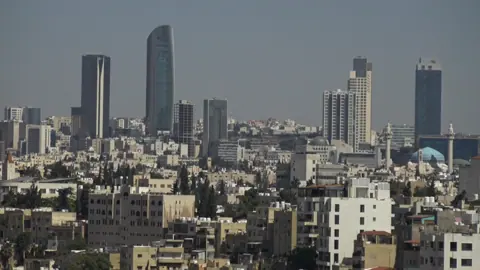
The Department of Antiquities puts the hilltop of Amman's Citadel at about 840 m above sea level, and the Jordan Tourism Board puts the Dead Sea at 427 m below it. A day trip from the capital therefore descends roughly 1,267 m (840 + 427), into the lowest land on Earth. That drop explains most of what matters on the day: the heat, the sudden floods in the valleys that cut down to the shore, and a lake that is shrinking in plain sight.
How do you get from Amman to the Dead Sea without a tour?
There are three workable ways, and they differ mainly in how much control you have over the return time.
| Option | Suits | Trade-off |
|---|---|---|
| Rental car | Travellers who also want Mujib, the Baptism Site or Ma'in | You drive the descent and the return yourself; plan to be back before dark |
| Hired driver or taxi for the day | Families, non-drivers, anyone who wants to swim and not drive | Agree the price and the return time before leaving Amman |
| Hotel or resort transfer | Guests or day-pass buyers at a Dead Sea resort | Tied to the resort's timetable and its private beach |
Jordan's intercity coach operator, JETT, lists Aqaba, Jerash, Petra, Ajloun, Karak and Wadi Rum among its featured destinations, along with transport to the King Hussein Bridge crossing. Neither its homepage nor its route and programme pages listed a Dead Sea service on 27 September 2026, and its live schedule could not be read without a booking search. If you want to try a bus, ask at a JETT terminal the day before; do not build a same-day return around it.
For licence rules, fines and what rental contracts say about border areas, see our guide to renting a car in Jordan.
Where you can get into the water
The Jordan Tourism Board describes Amman Tourist Beach as the public day-trip option, with what it calls "encouraging prices", but its page did not publish the admission fee or opening hours. The other public spaces it names are the Dead Sea Corniche and a 3.5 km promenade along the shore. Up on the escarpment, the Panorama Dead Sea Complex sits on the edge of the Zara cliffs, with dining and views over the water. Most other swimming is at resort beaches, reached by buying a day pass from the hotel.
Why is the Dead Sea shoreline falling?
Any fixed elevation for the shore goes out of date within a year. The US Geological Survey's Earthshots page on the Dead Sea gives the decline in stages: 17 cm a year from 1930 to 1973, 62 cm a year in 1974 to 1979, 79 cm a year in 1981 to 1990, a full metre a year from 1994 to 2001, and 1.2 m a year in a 2018 report. Over the past 50 years the surface has dropped by 45 m, by the USGS count.
The main cause is upstream. The Jordan River, USGS says, once carried 1.3 billion cubic metres of fresh water into the sea each year and now brings only about 100 million, much of it agricultural runoff and sewage. Evaporation keeps working on a lake that is barely fed, and the USGS also records a salt layer on the lake bottom growing about 10 cm thicker each year.
For a visitor, the consequence is on the ground rather than in the statistics. As the water retreats, sinkholes open in the salty seabed left behind, and the USGS notes they are increasing in number, which makes building on that land hazardous. That is why the practical rule is simple: swim where a beach operator has built access to the water, and do not walk out across exposed mud flats or former shoreline to reach it.
When is a Dead Sea day trip unsafe?
Three kinds of risk apply to this trip, each with a dated official source.
Floods. The US State Department states that areas including Petra and the Dead Sea often face heavy rain and flash flooding from October to March. The UK FCDO's safety page, updated 10 September 2026, adds that the Jordanian government sometimes issues flood alerts in the November to March rainy season, particularly along the Jordan Valley. Canyon trails that open onto the shore, such as Mujib's, are the places where this matters most.
Roads. The same US page reports that the US Embassy in Amman advises its employees to avoid driving at night outside the Amman metropolitan area, and warns of unmarked speed bumps and frequent collisions with livestock. The FCDO notes that stray animals, broken-down vehicles and unmarked roadworks are common. A daylight return is the single easiest risk reduction on this route.
Regional security. For British travellers, as of September 2026, the FCDO's warnings page records strikes by Iran in locations across the region, including Jordan, since 8 July, and says areas around security or military facilities may be targets or experience falling debris. Its regional risks page, part of the same advice updated 10 September 2026, warns that roads within Jordan and land border crossings with Israel and the West Bank can close at no notice. The Dead Sea's Jordanian shore faces the West Bank, so check your own government's advice on the morning you travel.
What else is on the Dead Sea shore, and what does it cost?
Two official sites work well as the second half of a Dead Sea day, and their prices come from the bodies that run or regulate them.
The Mujib Biosphere Reserve, run by the Royal Society for the Conservation of Nature (RSCN), stretches about 24 km along the eastern shore and covers about 212 km², with its lowest ground about 402 m below sea level. It was established in 1985. The RSCN 2026 price list sets these tax-inclusive prices:
| Trail | Duration | Non-Jordanian | Resident | Jordanian |
|---|---|---|---|---|
| Siq Trail (water trail, self-guided) | 2 to 3 hours | 23 JOD | 21 JOD | 17 JOD |
| Ibex Trail (hiking, guided) | 3 to 4 hours | 23 JOD | 20 JOD | 17 JOD |
The Jordan Tourism Board's entrance fee table gives a different figure for the Siq Trail: 21 JD for foreigners plus 16% tax, which comes to 24.36 JD. The RSCN list is dated 2026 and comes from the reserve's operator, so treat 23 JOD as the current price and expect to confirm it when booking. Neither source gave a season or opening months for the water trail.
The Baptism Site, Bethany Beyond the Jordan (Al-Maghtas), lies on the east bank of the Jordan River, nine kilometres north of the Dead Sea, according to UNESCO, which inscribed it in 2015. The Jordan Tourism Board lists entry at 12 JD for most foreign visitors, including a shuttle and guide, with 5 JD for other Arab nationals and 3 JD for Jordanians. The Jordan Pass site offers Baptism Site tickets to pass holders at 8 JD.
A day that keeps the risks small
- Check the flood situation and your government's travel advice before leaving Amman, especially between October and March.
- Drive down in the morning and do Mujib or the Baptism Site first, while it is cooler.
- Swim in the afternoon at a public beach or resort with built access to the water.
- Leave the shore with enough daylight to finish the climb back to Amman before dark.
If a flood alert is in force or border-area roads are closed on the day, the switch is easy: keep the day in Amman, where the Citadel and Roman Theatre fill a morning, and move the Dead Sea to a later date.