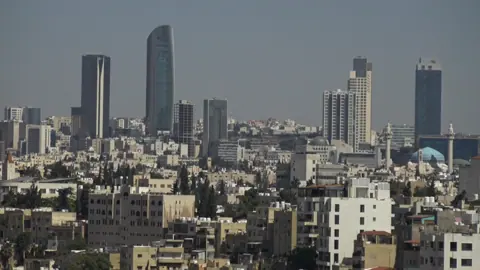
The Roman Theatre below Jabal al-Qal'a seats about 6,000 people and was built in the 2nd century AD under the emperor Antoninus Pius, according to Jordan's Department of Antiquities, which began restoring it in 1957. The theatre and the Citadel above it belong to the same ancient city, Philadelphia, and the Citadel had already been the Ammonite capital of Rabbath Ammon for centuries before that. Seen this way, downtown Amman is one site split between a hilltop and a valley, and the order you walk them in follows the history.
What was Amman before it was Amman?
The Department of Antiquities' page on Amman's archaeological sites sets out the sequence. Excavations found settlement on the Citadel hill from the Bronze Age to the late Islamic periods. In the Iron Age the Ammonites made it their capital, Rabbath Ammon, with a palace and temple. In the Hellenistic period the Ptolemaic ruler Ptolemy Philadelphus rebuilt the city and renamed it Philadelphia. Under Rome it grew into one of the cities of the Decapolis league.
Christianity added three churches on the hill in the Byzantine period. Under the Umayyads the Citadel became the seat of the governor, a dar al-imara, and an Umayyad town was built on the site. The American Center of Research (ACOR), which excavated there with the Department, describes the Citadel as dominating one of the seven jebels, or hills, that make up the capital.
The hill shaped all of this. The Department describes Jabal al-Qal'a as a natural hill about 840 m above sea level, surrounded by valleys on every side except the north, where it joins the slope of Jabal al-Hussein. That made it the defensible administrative and religious centre, while public buildings for entertainment and water spread along the valley floor below.
What is on the Citadel hill?
Three monuments carry most visits, but the hill holds more than that. The Department's list includes Bronze Age caves, Ammonite houses, the Roman temple, a Byzantine church, an olive press, Umayyad houses, a market square with shops, the mosque, the palace entrance hall, an Umayyad bath, fortifications, a water reservoir and an Ayyubid tower.
The "Temple of Hercules". ACOR calls this name inaccurate and uses "the Great Temple of Amman". An inscription dates its construction to the term of the Roman governor Geminius Marcianus, AD 161 to 166. The restored columns stand 13.5 m tall, only across the front of the temple, and the temple rose from a podium of 43 by 27 m. The Hercules link comes from fragments found nearby: a colossal marble hand and elbow thought to belong to a statue of Hercules about 13 m tall. ACOR and the Department excavated the temple between 1990 and 1993.
The Umayyad complex. The Department reads the Umayyad Citadel as a complete early Islamic town plan: a large palace, mosque, market square, shops, streets, houses, bath complex and reservoir. It points to the palace entrance hall as an early form of the gateway halls later used in Abbasid palaces. It also says the ziyada, an outer enclosure around a mosque long thought to have entered mosque architecture in the Tulunid and Abbasid periods, appears here first. On that basis the Citadel was added in 2024 to the list of heritage in the Islamic world, according to the Department.
The Jordan Archaeological Museum. Planned in 1949 and opened in 1951, the museum is small, no more than 750 m² according to the Department's museum page. Its display halls run in chronological order from the Palaeolithic to the late Islamic and early Ottoman periods, with finds from excavations across Jordan, not only from Amman.
What is in the Roman Theatre area downtown?
The theatre stands south of the Roman street and east of the Seil Amman, the stream bed that ran through the ancient lower city. The Department describes three tiers of seating that sorted the audience: the lowest for senators, with seats of honour; the middle for citizens; and the top for the poor, foreigners, slaves and women. A niche at the top of the third tier was dedicated to the city's deities.
When the Department restored the theatre, it placed two museums in its vaults: the Museum of Popular Life in the western vault and the Popular Museum of Jewellery and Costume in the eastern vault. The Jordan Pass site lists this pair as the Museum of Popular Traditions. The Jordan Tourism Board's fee table says the 2 JD theatre ticket covers the museums and other sites.
Two more Roman buildings sit close by:
- The Odeon. A small theatre for about 400 spectators, begun in AD 130 and completed around 141, while the large theatre was under construction. The Department restored it in 1986 but rebuilt only the lower seating, because nothing remained of the upper tier.
- The Nymphaeum. A monumental fountain about 600 m west of the theatre, at the junction of the ancient cardo and decumanus, built over four barrel vaults above the Seil Amman and fed by water channelled from Ras al-'Ayn. Its facade was 65 m long. Today only part of its back wall stands; the Department notes that houses and shops now occupy what was its forecourt. The Jordan Tourism Board dates it to AD 191.
The walk between the theatre and the Nymphaeum passes through the downtown market streets. The Jordan Tourism Board notes that the Grand Husseini Mosque there was built by King Abdullah I in 1924 on the site of a much older mosque.
Tickets, hours and the walking order
Prices come from the Jordan Tourism Board's entrance fee table, and hours from the Ministry of Tourism and Antiquities' Jordan Pass attractions list.
| Site | Foreigners | Jordanians | Hours |
|---|---|---|---|
| Amman Citadel | 3 JD | 0.25 JD | 08:00 to 17:00 |
| Roman Theatre, with its museums | 2 JD | 0.25 JD | 08:00 to 17:00 |
| Jordan Archaeological Museum (on the Citadel) | see note below | see note below | 08:00 to 17:15 |
| Museum of Popular Traditions (in the theatre) | included in theatre ticket | included | 08:00 to 17:15 |
The fee table also lists an "Amman Archaeological Museum" at 3 JD for foreigners, separately from the Citadel. The Department of Antiquities calls the Citadel museum an integral part of the site, but neither source says clearly whether the Citadel ticket covers it. Ask at the Citadel gate. The Jordan Pass list gave no seasonal or Friday variation in hours; check locally during Ramadan and on public holidays.
Which order works
- Start at the Citadel when it opens at 08:00. It is the top of the hill and holds the longest visit: temple, Umayyad complex and museum.
- Walk down to the Roman Theatre. The two sites are about 500 m apart in a straight line by the Department of Antiquities' coordinates, and the walk is downhill.
- See the Odeon next to the theatre, then continue about 600 m west through the market streets to the Nymphaeum.
If you arrive in the afternoon, reverse the priority rather than the route: both sites close at 17:00 on the Jordan Pass list, so go to the Citadel first and leave the theatre for another morning if time runs short.