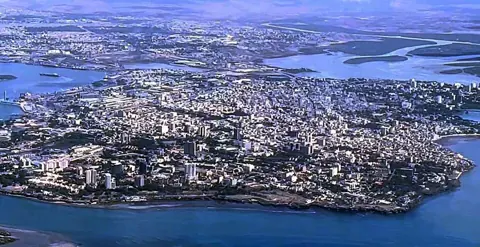
Portuguese builders finished Fort Jesus in 1596 to a design by the Italian architect Giovanni Battista Cairati, placing it on a coral rock spur at the southern edge of Mombasa to protect the port. The port was there first. That order matters for a visitor: the fort was an outsider's fortress added to an existing harbour town, and over the following centuries it changed hands many times.
How are Fort Jesus and the Old Town connected?
UNESCO inscribed only the fort, its moat and immediate surroundings, 2.36 hectares, in 2011. The 31-hectare Old Town around it is the buffer zone, which UNESCO describes as giving the fort its historic context. The Old Town is not a separate World Heritage Site, but it has its own national protection.
The ICOMOS evaluation written for the 2011 decision says the Old Town was declared a Conservation Area in 1990, confirmed by designation in 1991. It was protected for its "high concentration of 18th century buildings" and the quality of its urban fabric. Day-to-day conservation sits with the Mombasa Old Town Conservation Office, a department of National Museums of Kenya (NMK), the same body that runs the fort.
The two sites also shared their pressures. In 2011, ICOMOS cited a 2003 survey finding that about a quarter of the Old Town's urban fabric was in bad condition, and that rising land values could push owners to sell or redevelop. It recommended a management structure involving residents and the municipal council. The fort, meanwhile, drew heavy visitor numbers: Kenya's nomination estimated that 70% of tourists visiting the coast went to Fort Jesus.
Four centuries in one building
NMK's museum page and the ICOMOS evaluation set out the fort's working lives:
- From 1593. A Portuguese garrison fort. Its layout of five bastions and a moat reflects Renaissance ideas of proportion, NMK's World Heritage page explains.
- 1696 to 1698. Omani forces besieged the fort. ICOMOS notes Omani raids on Portuguese positions on the coast from 1652 onward.
- 1837 to 1895. Used as barracks.
- 1895 to 1958. When the British protectorate was proclaimed on 1 July 1895, the fort became a prison. ICOMOS dates its use as a prison to 1958, when it was declared a National Park.
- 1962 onward. After excavation, it opened as a museum, built with a grant from the Gulbenkian Foundation.
UNESCO sums up those centuries as the fort coming "under Arab, Swahili and English control". NMK frames the site as a meeting point of "African, Arab, Turkish, Persian and European" influences. A common misreading treats Fort Jesus as a purely Portuguese monument. The building you walk through carries layers from each occupier, and the museum inside displays archaeological finds from Fort Jesus and other coastal sites.
What does a Fort Jesus ticket cost in 2026?
NMK revised admission fees at its sites from 7 May 2026, under Legal Notice 79 of 2025. Fort Jesus shares a price line with the Karen Blixen Museum in Nairobi:
| Category in the NMK notice | Adult | Child |
|---|---|---|
| Kenya / East Africa | KES 550 | KES 300 |
| Residents / Africa | USD 9 | USD 6 |
| Foreigners (outside Africa) | USD 17 | USD 8 |
The Legal Notice describes the middle category as African residents excluding citizens of East African Community states. The notice sets the two non-East African categories in US dollars, so budget in dollars rather than relying on a shilling conversion.
The NMK pages read for this guide did not list opening hours for Fort Jesus, and the online entry page did not load. Check hours by phone with the museum on Nkrumah Road, or at the gate, before planning a late-afternoon visit.
Walking the Old Town as a guest
The Old Town is a residential district, not a museum. The Kenya Tourism Board's Old Town page describes narrow streets, carved wooden doors and mosques, and a community of artisans and merchants. Its buildings reflect contact with Arab, Persian, Indian and European traders. Many buildings are private homes, so ask before photographing people or doorways where residents are sitting.
A practical order for the day is fort first, streets second: the museum gives names and dates to what you then see outside. If you arrive by train from Nairobi, Kenya Railways' Mombasa commuter rail timetable shows link trains from Mombasa Terminus to Mombasa Railway Station in the city, timed to the Madaraka Express. Our Madaraka Express guide has fares and departures. If you arrive on the night train, which reaches Mombasa before dawn, rest first and save the Old Town for daylight.