How much does Nairobi National Park cost for foreign visitors?
The rates come from the Wildlife Conservation and Management (Access, Entry and Conservation) (Fees) Regulations, 2025, published as Legal Notice No. 160 of 2025 in the Kenya Gazette. The schedule has four price columns: East African citizen and Kenya resident in shillings, and non-resident and African citizen in US dollars. It has no high and low season columns.
| Park or site | Non-resident adult | Non-resident child or student | African citizen adult |
|---|---|---|---|
| Nairobi National Park | USD 80 | USD 40 | USD 40 |
| Nairobi package: park, Orphanage, Safari Walk | USD 105 | USD 55 | USD 55 |
| Animal Orphanage or Safari Walk, each | USD 25 | USD 15 | USD 15 |
| Orphanage and Safari Walk package | USD 40 | USD 20 | USD 25 |
| Amboseli or Lake Nakuru | USD 90 | USD 45 | USD 50 |
| Tsavo East or Tsavo West | USD 80 | USD 40 | USD 40 |
| Tsavo West and Amboseli package | USD 150 | USD 80 | USD 80 |
| Tsavo East, Tsavo West and Amboseli package | USD 215 | USD 115 | USD 115 |
| Hell's Gate, Mt Longonot, Mt Elgon, Ol Donyo Sabuk | USD 50 | USD 25 | USD 20 |
For comparison, East African citizens pay KES 1,000 and Kenya residents KES 1,350 for an adult day at Nairobi National Park. The East African partner states, as listed on Kenya's eTA portal, are Burundi, the Democratic Republic of Congo, Rwanda, South Sudan, Tanzania and Uganda.
The regulations define a daily fee as valid for up to 24 hours. They exempt children aged five and under, people with disabilities, Kenyan citizens aged 70 and over, and registered tour drivers, guides, boat crew and porters. A private vehicle with fewer than six seats pays KES 600 a day.
Is the Nairobi package worth it?
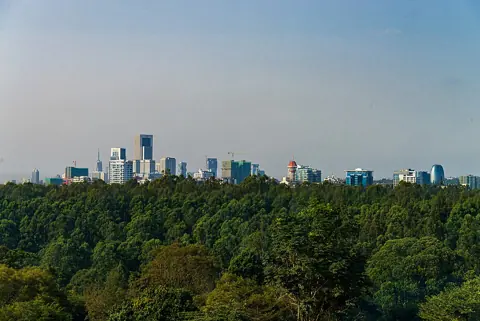
It is worth it if you plan to visit the Animal Orphanage or the Safari Walk as well as the park. The Kenya Tourism Board describes the 117 sq km park as sitting at the edge of the city, with both sites attached to it.
Two non-resident adults doing all three: separately, USD 80 + 25 + 25 = USD 130 each, or USD 260 for two. The package is USD 105 each, or USD 210. They save USD 50.
The same couple doing the game drive only: USD 160 for two. Buying the package they will not use costs USD 50 more.
A family of two adults, a child of eight and a child of four, doing all three: two adult packages at USD 105 plus one child package at USD 55 comes to USD 265. The four-year-old is free because the exemption covers children aged five and under. If the family drives in their own car, add KES 600 for the vehicle.
An Amboseli and Tsavo West safari: single-park fees of USD 90 + 80 = USD 170 per non-resident adult against USD 150 for the package. The regulations we read do not say how long the package stays valid. Before relying on it for a multi-day trip, ask your operator or KWS how many days it covers.
How do you pay KWS park fees?
KWS sells single-park entry through its KWSpay service on eCitizen, the Government of Kenya's payments platform. The page needs JavaScript, and we could not read its full terms. Most safari operators pay fees on their clients' behalf, so check whether your quote includes conservation fees before you pay for a ticket yourself.
Why the Maasai Mara costs differently
The Maasai Mara National Reserve does not appear in the 2025 KWS fee schedule, which lists the national parks, reserves and sanctuaries whose fees KWS charges. The Mara is managed outside KWS, so a KWS package or eCitizen KWS ticket does not cover it.
The reserve also has two management sides with separate ticketing. The Mara Triangle's fees page says it does not accept cash and takes M-Pesa or card. Its 12-hour ticket runs from 06:00 to 18:00 whatever time you enter. Visitors staying in the Triangle who drive in through Sekenani Gate on the Narok side are told not to pay until they enter the reserve at Purungat Bridge. The Triangle's current rates are published only as an image that we could not read, so this guide does not quote Mara fees. Check them with your lodge or operator.
Health and road notes for a park day
The UK's National Travel Health Network and Centre advises yellow fever vaccination for travellers aged 9 months and older visiting risk areas, including game reserves and national parks. It generally does not advise it for trips limited to Nairobi. For a Nairobi-only stay it rates malaria risk as very low, while most lowland parks carry a risk where tablets are advised.
The U.S. State Department advises against driving between cities at night because of poor roads, poor street lighting and the threat of banditry. For Amboseli or Tsavo, plan to reach the park and your lodge before dark.
For the airport leg of your trip, see our JKIA to city centre guide. Before you book, check the Kenya eTA rules.