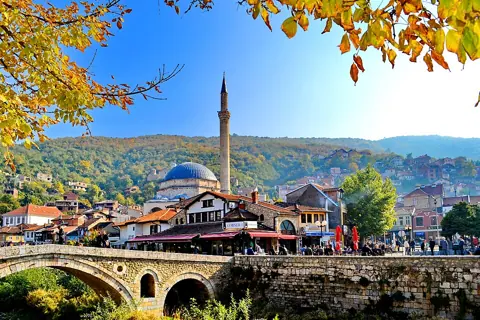
Prizren packs a genuinely mixed religious and imperial history into a compact old town, and Kosovo more broadly holds some of the most significant medieval Serbian Orthodox monasteries anywhere, sitting inside a country whose relationship with that heritage is entangled with recent conflict and an unresolved political dispute. Visiting well here means reading the layers accurately and being deliberate about how you approach sites that carry weight beyond their architecture.
Prizren's Ottoman-era old town
Prizren's old town developed substantially under Ottoman rule, and its street pattern, stone bridge, hilltop fortress (Kalaja) and cluster of historic mosques reflect that period directly. The city was, for centuries, a genuinely mixed settlement — home to Muslim, Serbian Orthodox Christian and Catholic communities among others, each leaving distinct religious buildings within a fairly compact area. Walking between a historic mosque, an Orthodox church and a Catholic cathedral within the same old town is one of the more legible ways to encounter this layered coexistence directly, rather than reading about it abstractly.
The medieval monasteries: what they are and why they matter
Four medieval Serbian Orthodox sites in Kosovo — Visoki Decani, the Patriarchate of Pec, the Church of the Holy Virgin of Ljeviska in Prizren, and Gracanica Monastery — are collectively inscribed as the "Medieval Monuments in Kosovo" UNESCO World Heritage Site, listed in 2004 and placed on the List of World Heritage in Danger since 2006, recognised for their Byzantine-Romanesque architecture, frescoes and religious significance. These are active religious communities, not solely historical monuments — monks or nuns live and worship at several of these sites, which shapes how a respectful visit should look.
Why this is a genuinely sensitive subject
These monasteries carry deep religious and historical meaning for Serbian Orthodox Christianity, and they sit within Kosovo, a country whose 1998-1999 conflict and subsequent 2008 declaration of independence remain part of an unresolved dispute with Serbia, which does not recognise that independence. Security arrangements at some monastery sites have, at various points, involved international peacekeeping presence given this history. This guide describes the sites' heritage status and practical visiting considerations factually; it does not adopt a position on the underlying political dispute, and it avoids atmosphere writing about conflict or damage, since that risks treating a serious and, for many people, painful history as scenery.
Practical guidance for visiting
A few things worth confirming and preparing before visiting any of these monasteries:
- Check current access arrangements directly with the specific monastery or Kosovo's tourism authorities before travelling, since this guide could not confirm current opening hours or any security-related visiting procedures for a specific site at the time of writing.
- Dress modestly: covered shoulders and knees for everyone, and a head covering for women is customary at many Orthodox sites, sometimes available to borrow at the entrance.
- Keep voices low and phones silent inside any active place of worship, and avoid photography during services or where signage or staff indicate it isn't permitted.
- If a site has any form of security checkpoint or identification request, treat this as standard practice for the location rather than something unusual to react to.
- A respectful, unhurried pace suits these sites better than treating them as a quick photo stop on a longer itinerary.
Getting between Prizren and the monasteries
Distances between Prizren and specific monastery sites vary — some are a manageable day trip by car or organised tour, while others sit further afield within Kosovo. This guide could not confirm current public transport options reaching specific monasteries directly, and a private driver, tour operator, or rental car is the more realistic way to combine several stops in one day. Confirm any tour operator's described access and itinerary directly rather than assuming a generic "Kosovo monasteries tour" covers a specific site you have in mind.
Reading Prizren and the monasteries as one visit
Treated together, Prizren's old town and Kosovo's medieval monasteries show two different things: a city that functioned, for long stretches of its history, as a genuinely mixed religious community within one urban space, and a set of separate religious sites whose significance and current context are shaped by a much more recent and still unresolved history. Neither should be read as a stand-in for the other, and neither needs an opinion from a visitor — only attentiveness to what each place actually is.
Why Prizren rewards a slow visit
Prizren's old town is compact enough to see the main landmarks in a single afternoon, but the layered history described above is easy to miss at that pace. Slowing down enough to notice which quarter you're in, which community historically built which structure, and how those different buildings relate physically to one another within a few short streets tends to reveal more about the city than moving briskly between a fixed list of sights. This is a city built for that kind of attentive walking rather than a checklist approach, and the mix of Ottoman-era architecture with the city's own more recent history rewards the extra time.
Combining Prizren with a broader Kosovo itinerary
If Prizren is one stop within a wider Kosovo trip that also includes Pristina and perhaps one or more monastery visits, sequencing matters a little. Many travellers find it useful to visit Pristina first for basic orientation and any practical arrangements like transport bookings, then move to Prizren and any nearby monastery as a more history-focused leg of the same trip, rather than reversing that order. This isn't a rigid rule, and this guide could not verify a single best itinerary structure that suits every traveller, but it reflects how the two experiences — a functioning capital city and a set of historically weighted sites — tend to sit better with a bit of orientation first.
What this guide does not cover
This article does not cover the political history of Kosovo's independence or the broader Kosovo-Serbia dispute in detail, take a position on contested historical claims, or provide current opening hours and admission details for any specific monastery, since none of those were verified to a standard this guide requires. Confirm practical details directly with the relevant institution before travelling.