No Macao government source says which bakery made the first Macao egg tart, and none says it happened in Coloane. The claim you will meet on shop signs and in travel writing is a commercial story, not a heritage finding, and the official record deliberately treats the tart as a craft shared by many bakeries.
That does not make a trip to Coloane Village (路環市區, Vila de Coloane) pointless. The village has three eateries that the Macao Government Tourism Office names with addresses and hours, a chapel and temples with classified-monument status, and a bus network that runs every few minutes on weekdays. This guide sets out what the heritage record says about the tart, where the official sources say to eat, and how to get there.
What the egg tart record shows
The Macao egg tart is officially a craft, not a brand. The Cultural Affairs Bureau (文化局) lists "葡撻製作技藝", the Portuguese egg tart making craft, as item 63 of the 2020 batch on Macao's Intangible Cultural Heritage Inventory, and in 2025 it moved onto the smaller Intangible Cultural Heritage Register as item 21, by Despacho 114/2025.
The bureau's entry describes the tart as a "焦糖酥皮蛋撻", a caramelised puff-pastry egg tart, made from flour, butter, eggs, milk, cream and sugar. It sets out the method: low-gluten flour and butter folded repeatedly and rested, pressed into moulds, then filled with a custard of milk, sugar, pure egg-yolk liquid and cream before baking. The features it lists are layer upon layer of flaky crust and a caramelised golden custard that is "甜而不膩", sweet but not cloying.
The crucial sentence is about who makes it. The bureau says many bakeries in Macao make and supply the tart, that they have "已將傳統配方改良" (improved the traditional recipe) into a caramelised version "with Macao characteristics", and that "各家餅店所使用的材料分量和烘焙手法各有不同": each bakery uses different quantities and baking methods. It names no bakery, no founder and no date of arrival in Macao.
The bureau frames the craft's value as "基於葡萄牙甜點製作技藝上的創新和傳承", innovation and transmission built on Portuguese dessert-making. That is the official position: a Macao adaptation of a Portuguese pastry, carried on by many bakeries, with no single originator.
The same register batch in 2025 added three other food crafts: almond cake, bridal cakes and bamboo-pole noodles. The 2026 inventory batch added the pork chop bun, milk tea and Western pastry-making, so the egg tart sits within a wider official effort to record Macao's everyday food rather than to crown particular shops.
| Name | Local name | What it is | Price range |
|---|---|---|---|
| Macao egg tart | 葡撻 | Caramelised puff-pastry tart, listed as a heritage craft | Not published |
| Caramelised puff-pastry egg tart | 焦糖酥皮蛋撻 | The Cultural Affairs Bureau's own description of the tart | Not published |
| Pastel de nata | Pastel de nata | Portuguese custard tart named by the tourism office | Not published |
| Pastéis de Belém | Pastéis de Belém | Lisbon bakery's trademarked tart, baked since 1837 | Not published for Macao |
| Serradura | Serradura | Dessert the tourism office ranks alongside the egg tart | Not published |
| Pork chop bun | 豬扒包 | Pork chop in a bun; 2026 heritage inventory item | Not published |
| Almond cake | Not given in the source | Pastry on the 2025 heritage register | Not published |
| Bamboo-pole noodles | Not given in the source | Noodle craft on the 2025 heritage register | Not published |
Lisbon's claim and Macao's version
The origin claim for the custard tart that rests on a company's own record is Lisbon's, and it says nothing about Macao. Pastéis de Belém states on its own website that "in 1837 we began making the original Pastéis de Belém", following an ancient recipe from the Mosteiro dos Jerónimos.
Its history page explains the link. After the 1820 liberal revolution, all convents and monasteries in Portugal were closed in 1834, and someone from the monastery began selling sweet pastries in a shop attached to a neighbouring sugar-cane refinery. From 1837 the pastries were baked in buildings attached to that refinery, following the monastery's "secret recipe", which the bakery says is known only to master confectioners working in a "secret room" and has "remained unchanged to the present day".
The bakery sits at Rua de Belém 84 to 92 in Lisbon and opens every day from 8am to 9pm, closing at 10pm from 1 July to 30 September. None of the pages read on its site mentions Macao, Coloane or any licensing link to Asia.
The Macao Government Tourism Office tells a shorter story. Its "Macanese & Portuguese Dishes" page says the most famous desserts are "either pastéis de nata (Portuguese egg tarts) or serradura", that the tart "originated in a monastery in Portugal 200 years ago", and that "it became popular only after it arrived Macao". It describes an "egg-custard stuffed pastry with a bitter caramel flavor".
The two government bodies do not quite agree. The same tourism office page says "desserts from Portugal were imported to Macao while the pure and original taste remained unchanged", while the Cultural Affairs Bureau says Macao bakeries "improved the traditional recipe". If you want the official answer to whether the Macao tart differs from Lisbon's, it is the bureau's: yes, by design.
The tourism office's video gallery also carries two titles that bear on the question: "Bites of heritage: How do Macao's egg tarts differ from Portuguese pastel de nata", and a 2017 item titled "BBC Lord Stow - The legacy of Macao's iconic dish". Only the titles were checked for this guide, so what the videos say is not reported here.
Where the tourism office says to eat
The tourism office's "Tranquility Tour in Coloane Village" is the only official list of places to eat in the village, and it names three eateries with addresses, hours and telephone numbers. It is a curated tour, not a register, and each record carries the note "Operating hours of merchant might have been adjusted."
| Eatery | Address | Hours (tourism office) | What it serves |
|---|---|---|---|
| Loja de Sopa de Fitas de Cais Coloane | 116 Rua dos Navegantes | 8am–10pm | Seafood-topped noodles in a cha chaan teng setting |
| Lou Van Fai Kei | 33–37 Rua da Cordoaria | 7am–6pm | 1950s café: yum cha mornings, siu mei and rice at noon |
| Nga Tim | 8 Rua do Caetano | 12pm–12am | Macanese and Cantonese dishes beside the chapel |
The noodle shop, Estabelecimento de Comidas Loja de Sopa de Fitas de Cais Coloane, serves what the tourism office calls "marine product-topped noodles" from "self-supplied marine products". Its signature dishes are Shark's Fin Noodles with a soup base of shark's fin bones, chicken and ham, Noodles with Beef Brisket in Broth, and Abalone and Mushroom Noodles with Oyster Sauce. Its telephone number is +853 2888 2153.
Lou Van Fai Kei "was established in the 1950s", according to the tourism office, and is run by "Uncle Hoi, the son of the founder"; the "Fai" character on its signboard is the founder's calligraphy. The office describes a "nostalgic 60s setting" of metal hanging fans, a glass-brick wall and green-rimmed tableware. It serves yum cha in the morning and siu mei and rice dishes at noon, and its recommendations include rice with char siu and egg, pork chop rice, and a pork chop bun the office says customers recognise as "the best in Macao". Its number is +853 2888 0003.
Nga Tim is "situated on the sea shore next to the Chapel of St. Francis Xavier", and the tourism office notes the spot was a filming location for the Hong Kong film "Look for a Star". It serves Macanese and Cantonese dishes, with recommendations of feijoada, roasted pork knuckle with crispy skin, "Sauna Shrimps" cooked on hot rocks after soaking in huadiao wine, crab curry, fried rice with bacalhau, and serradura. Its number is +853 2888 2086.
The same tour names one food shop rather than a restaurant. Lane de Peixe Ieng Lei is a "fifty-year-old" dried marine products dealer in a seaside stilt house at 33 Rua dos Navegantes, open 8am to 8pm, and the tourism office says only "a few marine product dealers" remain in the village. It sells salted yellow croaker, threadfin, mackerel and white herring, "over 20 varieties of fish maw" and more than thirty other dried marine products.
For egg tarts specifically, the tourism office says only that around Largo do Presidente António Ramalho Eanes, the village's central pedestrian square with a statue of Cupid, "you'll find quite a number of local stalls that offer you delicacies, dried seafood products, Portuguese egg tarts, local cuisine". It names no stall or bakery, and neither does any other official page read for this guide.
A weekday route through the village
A weekday suits Coloane Village because the eateries' published hours are the same every day and the buses run most often on weekday mornings. The tourism office's own tour describes stepping into the village as "just like stepping into a time-machine, where natural landscape and the seashore of Hengqin come into view", and it lists 16 sights.
The order above is this guide's suggestion built from the hours the tourism office publishes. Nga Tim opens only at noon, so a morning visitor who wants its Macanese dishes should plan the chapel and murals first, while Lou Van Fai Kei closes at 6pm and suits an early lunch.
Lou Van Fai Kei's split between yum cha in the morning and siu mei at noon matters if you are timing a visit around one meal. The tourism office gives no times for the switch, so ask when you arrive.
The shipyards north of the village are a separate stop. The tourism office's tour includes the Lai Chi Vun Shipyards and a revitalisation plan covering "over 3,000 square metres"; what is actually open there is covered in the guide to what is open at the shipyards.
The village has a public library too. The Coloane Library on Avenida de Cinco de Outubro occupies a 1911 Portuguese-style building that was once the Coloane municipal school, and it opens Monday 2pm to 8pm and Tuesday to Sunday 8am to 8pm, closing on public holidays.
Getting there by bus or taxi
Five bus routes stop in Coloane Village according to the transport bureau's current route sheets: 21A, 25, 26, 26A and 50. Routes 25, 26 and 50 end at the Vila de Coloane health-centre stop (C686), while 21A and 26A pass through the Rua da Cordoaria stop (C659) on their way to Ká-Hó and Hác-Sá.
| Route | From | Weekday frequency (sheet) | Coloane stop |
|---|---|---|---|
| 25 | Portas do Cerco | Every 5–9 min at peaks, 8–12 midday | C686 Vila de Coloane / Posto de Saúde |
| 26 | Bacia Norte do Patane | Every 16–25 min | C686 Vila de Coloane / Posto de Saúde |
| 26A | Bacia Norte do Patane | About every 8–15 min | C659 Rua da Cordoaria |
| 21A | Barra transport hub | Every 20–30 min | Rua da Cordoaria |
| 50 | Praceta 24 de Junho | Every 12–20 min | C686 Vila de Coloane / Posto de Saúde |
Route 25 is the frequent one. Its sheet, dated 27 December 2025, shows weekday departures every 5 to 9 minutes from 6am to 10am and 3pm to 8pm, every 8 to 12 minutes from 10am to 3pm, and every 12 to 15 minutes until 1:15am; weekends and holidays are less frequent. Route 15, which older tourism office material listed for Coloane, now runs from Jardins do Oceano to Ká-Hó on its April 2026 sheet and shows no Coloane Village stop.
The standard fare is MOP6 per trip, and the tourism office warns that no change is given on buses. Holders of approved stored-value cards such as Macau Pass pay MOP3, with a transfer discount that extends to 60 minutes for trips between the peninsula and the Coloane fare zone. How those cards and local SIMs work is covered in the guide to transit cards and SIM operators.
Taxis are the alternative. The tourism office gives a flag-fall of MOP21 for the first 1,600 metres and MOP2 per 220 metres after that, plus a MOP5 surcharge from the Macao peninsula to Coloane and MOP2 from Taipa; there is no surcharge in the other direction.
In a typhoon, the route sheets say last departures leave 20 minutes before Signal No. 8 is hoisted, 30 minutes for route 26, and at the moment it is hoisted for route 50.
Chapel, temples and pier after lunch
The Chapel of St Francis Xavier is the village's best-known building, and its Mass schedule is short. The Diocese of Macau's June 2026 table lists only a Sunday 10am Cantonese Mass there, with no weekday or Saturday Mass, and the tourism office gives visiting hours of 9:30am to 5:30pm.
The tourism office describes the chapel as built in 1928 in "the baroque style of Macao's major churches", standing behind a monument to a local victory over pirates in 1910. The Cultural Affairs Bureau's monument record, MC001, says the site was an orphanage run by Canossian sisters in 1904 and that the church once held St Francis Xavier's relics and the remains of 59 Japanese and 14 Vietnamese dead gathered after the 1835 fire at St Paul's. The tourism office says the relic has since been moved to St Joseph's Seminary and the Sacred Art Museum.
Tam Kong Temple, dedicated to a Taoist god of seafarers, is MC002 on the bureau's list and was built in 1862. The two official sources disagree about its whalebone dragon-boat model: the tourism office says "four feet long", the bureau "over three metres". The bureau says this is the only temple in Macao built solely for Tam Kong, and its birthday on the 8th day of the 4th lunar month brings dragon and lion parades, a float parade and a poon choi banquet to the village.
The Ancient Temple of Tin Hau (MC003) holds a bell dated 1763, which the bureau says proves the temple is at least 200-plus years old; the tourism office calls it the oldest temple on the island. The tourism office also notes a second, smaller Tin Hau temple off Travessa da República with a moon gate facing the sea.
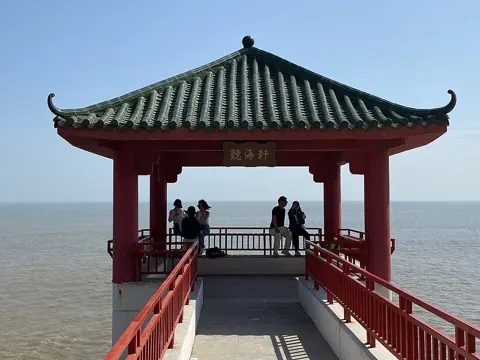
Coloane Pier, MC009, is an Art Deco building bearing the words "路環碼頭" and "PONTE DA COLOANE". The bureau says passenger ferries stopped in the early 1980s after the 1968 causeway and 1974 bridge took the traffic, and the pier was later used only by Hengqin residents landing produce to sell in Macao. How the islands and the peninsula connect today is set out in the guide to peninsula, Taipa and Coloane links.
What this guide does not cover
Lord Stow's Bakery's founding year, founder, recipe, outlets, hours and prices are not covered, because its own site could not be read beyond the homepage and no government page states them. Other egg tart bakeries that appear in travel writing are not named, because no official source or readable company site names them.
Egg tart prices are not given anywhere in this guide, since no official source publishes them. The guide does not cover weekend crowd levels or road closures in the village, for which no official data was found, and it does not cover Hác-Sá beach, Ká-Hó village or the Coloane hiking trails. It does not verify whether the three eateries' hours have changed since the tourism office recorded them, as the office itself warns they may have.