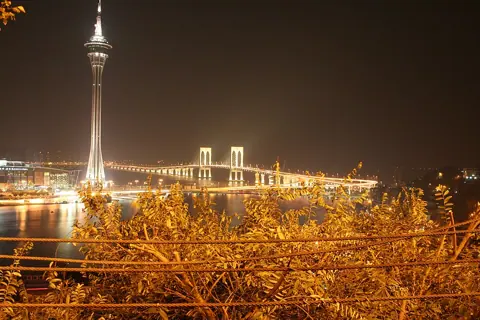
Macau has two entry regimes stacked on top of each other, and visitors usually learn about the second one at the door. The immigration rules decide whether you get in; a 2012 gaming law decides where you can walk once you are.
How long can you stay?
That depends entirely on which passport you hold, and the government publishes the list. The Public Security Police Force grants the limit of stay according to the travel document presented.
| Passport held | Maximum stay |
|---|---|
| Most passports (default) | 30 days |
| EU or Schengen member state | 90 days |
| Brazil, Japan, Korea, Mexico, Mongolia and others on the published list | 90 days |
| Cyprus, Israel, Lebanon, New Zealand | 3 months |
| British citizens | 6 months |
| Brunei, Kazakhstan | 14 days |
| Hong Kong Permanent Identity Card or Re-entry Permit | 1 year |
Who cannot get authorisation on arrival?
Six nationalities, by a rule in force since 1 July 2010. Nationals of Bangladesh, Nepal, Nigeria, Pakistan, Sri Lanka and Vietnam must apply for a Macao visa in advance through Chinese diplomatic or consular missions and cannot obtain one on arrival.
For everyone else who needs an authorisation issued at the border, the published fees are MOP 200 single-entry or MOP 300 multiple-entry for an individual, MOP 100 or MOP 150 for children under 12, and MOP 400 or MOP 600 per passport for a family passport.
What do you actually receive at the border?
A piece of paper, not a stamp. Since 10 July 2013, under the Non-stamping Immigration Clearance Policy, the Arrival Card requirement was abolished and passengers instead receive a printed Slip of Authorization to Stay bearing the limit of stay in Macao.
Keep it. It is the only record you will hold of the date your permitted stay ends, and the penalty schedule below is calculated from that date.
The other published requirement is an onward or return ticket, waived only if you can prove residence in mainland China or Hong Kong.
Which checkpoint should you use?
Any of nine, with one important caveat about the automated lanes. The government lists nine checkpoints handling non-resident clearance, all of them with staffed manual channels.
| Checkpoint | Location |
|---|---|
| Border Gate (Portas do Cerco) | Praça das Portas do Cerco |
| Qingmao | Qingmao Port |
| Zhuhai–Macao Cross-border Industrial Zone | Avenida de Parque Industrial |
| Hong Kong–Zhuhai–Macao Bridge | HZMB Macao Port |
| Hengqin Port, Macao Port Zone | Hengqin |
| Outer Harbour Ferry Terminal | Largo do Terminal Marítimo |
| Taipa Ferry Terminal | Estrada de Pac On, Taipa |
| Inner Harbour Ferry and Yacht Terminal | Rua das Lorchas |
| Airport | Avenida de Wai Long, Taipa |
The automated joint-inspection channels are a different matter. They operate at three checkpoints only — Qingmao and Hengqin, both 24 hours, and the HZMB checkpoint from 08:00 to 22:00 — and the published eligibility is mainland residents, Macao residents and Hong Kong permanent residents. Foreign passport holders may use them at Hengqin, the HZMB and Qingmao only after completing a registration, and only if they hold a valid residence permit, work visa or student visa of another country or region.
What does overstaying cost?
MOP 500 to 800 for each overdue day, capped at MOP 15,000. Two separate official pages state the same figures.
The classification matters as much as the amount. Overstaying is an administrative infraction rather than a criminal offence and carries no penalty of deprivation of liberty. But the escalation is real: overstaying more than 30 days, failing to pay promptly, or having a previous violation within the past year exposes you to deportation and a period of entry interdiction, and those deported cannot apply for residence or special authorisation for two years after that interdiction period expires.
Extensions exist. The government publishes an "Extension of Authorization to Stay" service, with one application type specified as up to a maximum of 90 accumulated days.
What stops you on the casino floor?
Age 21, and it is an entry rule rather than a gambling rule. Law No. 10/2012, in force since 1 November 2012, prohibits entry to casinos by persons who have not completed 21 years of age — and Article 2(2) extends that prohibition to all spaces accessible only through a casino entrance.
The same article bars several other categories from entry.
- Persons judicially declared interdicted or incapacitated by a final decision
- Persons suffering notorious psychic anomaly
- Public administration workers and security-force agents, unless authorised by the Chief Executive
- Individuals notoriously intoxicated or under the effect of drugs
- Bearers of weapons, devices or explosive materials
- Bearers of devices whose principal purpose is recording images or sound, unless authorised by the concessionaire concerned
The penalty for breaching Article 2 is a fine of MOP 1,000 to 10,000.
Note the shape of the recording-device provision. It is written around devices whose main or only purpose is recording, and it makes the concessionaire, not the government, the body that can authorise an exception. Whether it is officially read to cover an ordinary smartphone is not something any published source settles.
What this guide does not cover
Several things could not be confirmed and are therefore absent rather than guessed. No official source states the opening hours of the Border Gate, the ferry terminals or the airport checkpoint — only the three automated channels have published hours. No official source states that any checkpoint excludes foreign passports, and equally none affirmatively confirms that every one admits them.
There is no published dress code for Macau's gaming floors in Law No. 10/2012 or on the regulator's site; any dress requirement you encounter is a house rule. The detailed text of the law's exclusion provisions could not be retrieved in full.
Most importantly for anyone planning a Macau leg inside a Hong Kong trip: no official Hong Kong source states whether a visitor returning from Macau is granted a fresh visa-free period on each arrival, or whether any limit applies to repeated entries. Do not assume the clock resets.